Messina is a harbour city located near the north-east tip of Sicily. It is the third largest city on Sicily, and the 13th largest in Italy, with a population of 216,918 inhabitants in the city proper and 595,948 in the wider metropolitan area.
Friday, 7th September 2018
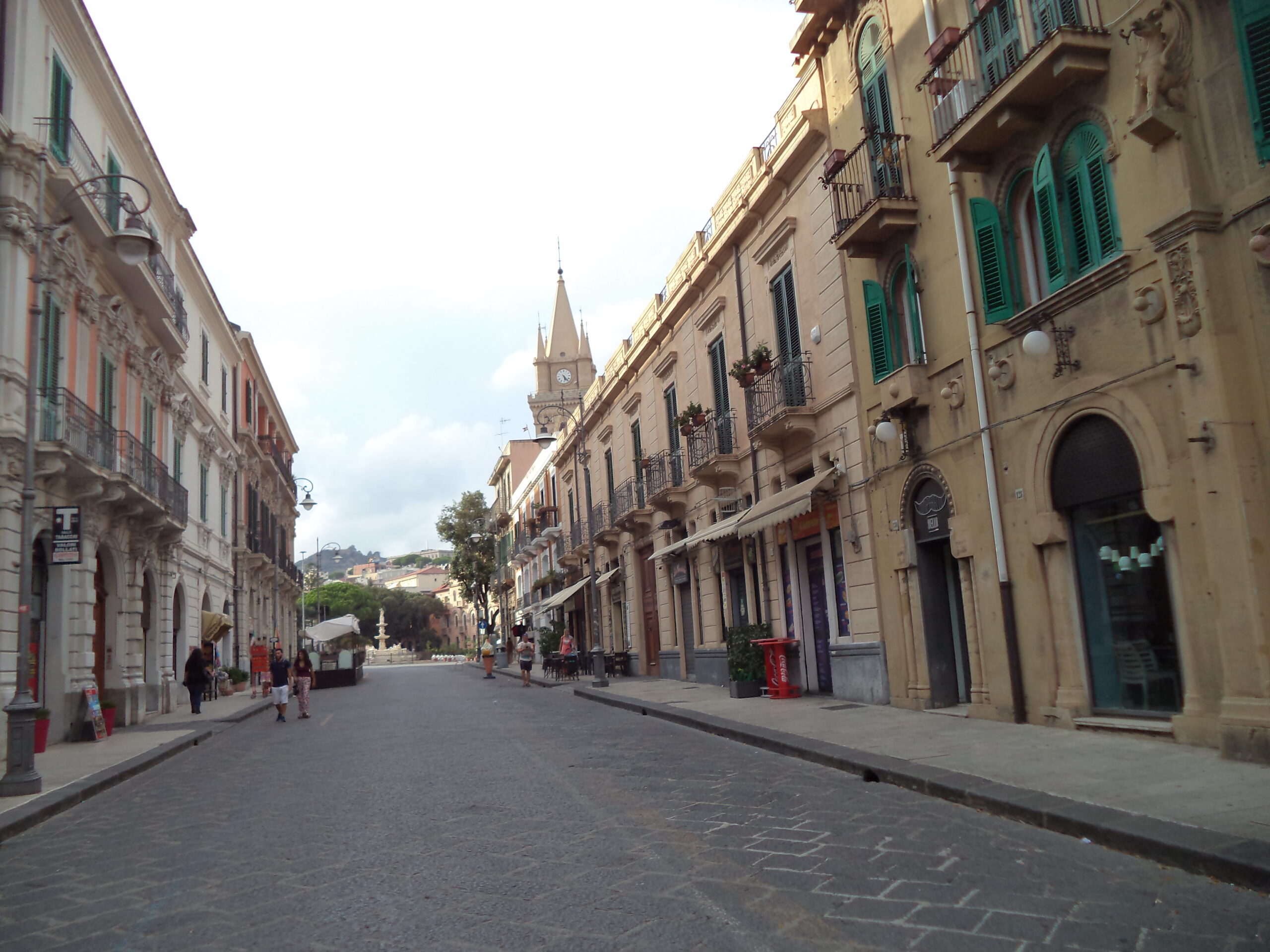
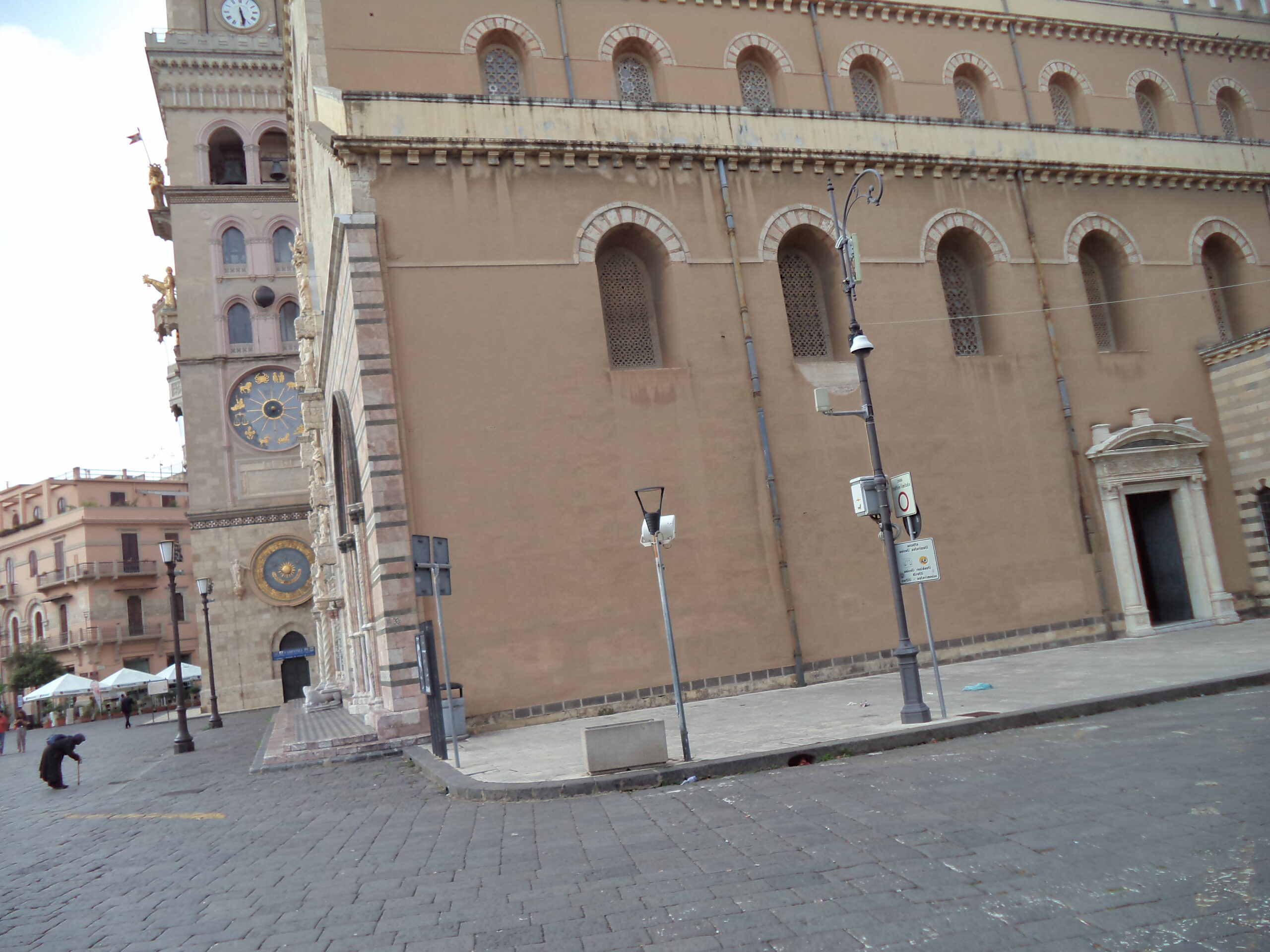
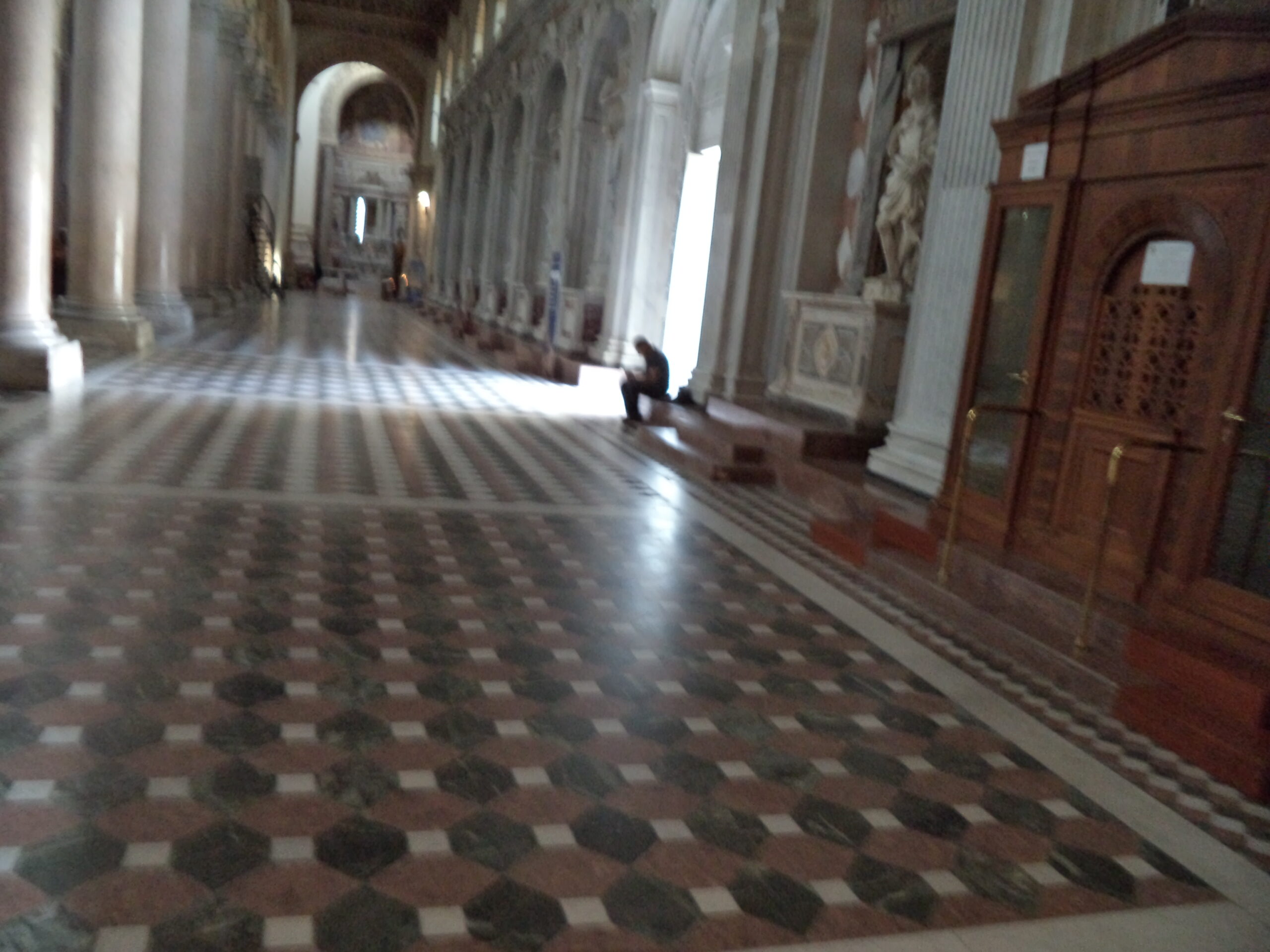
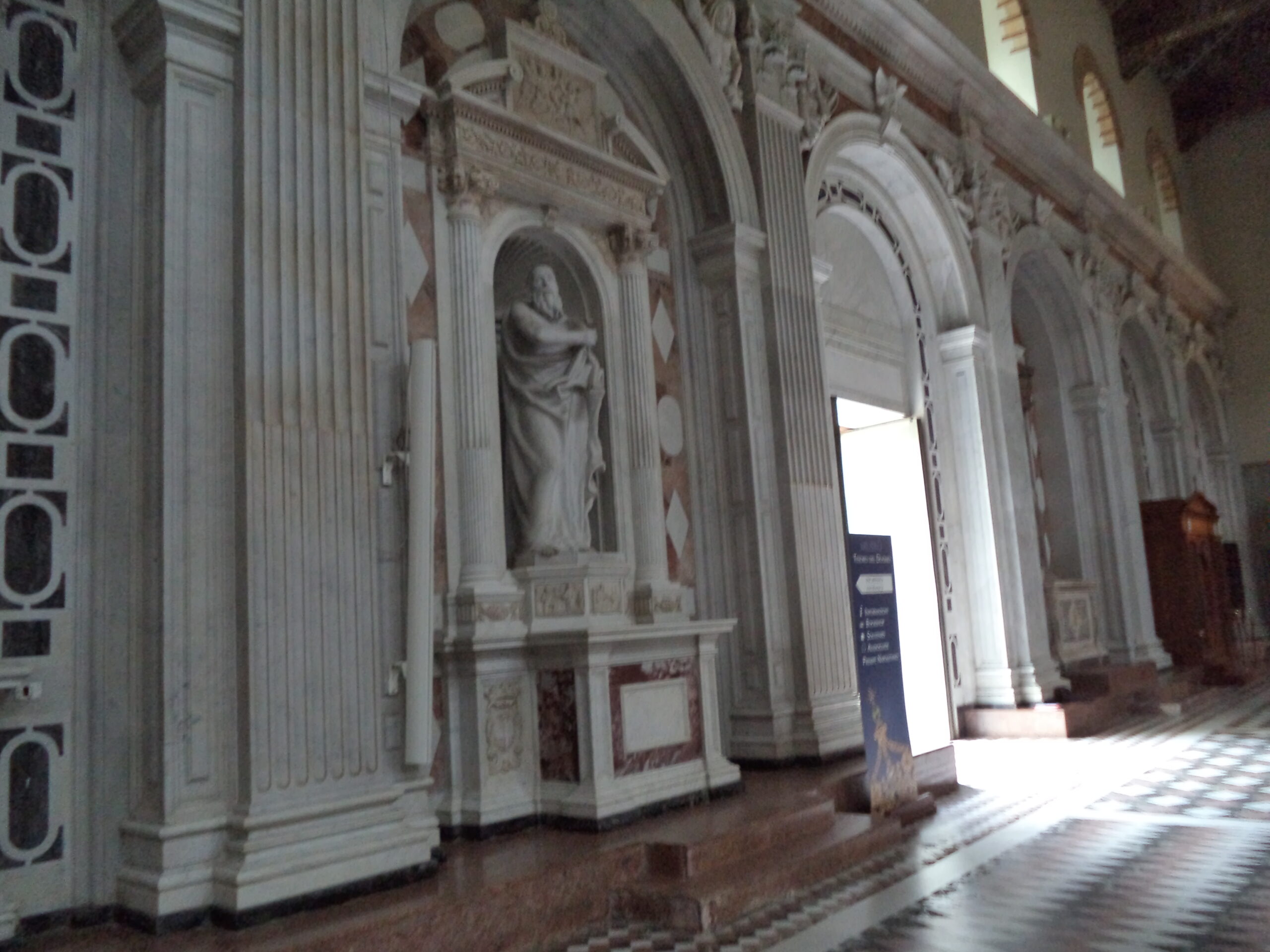
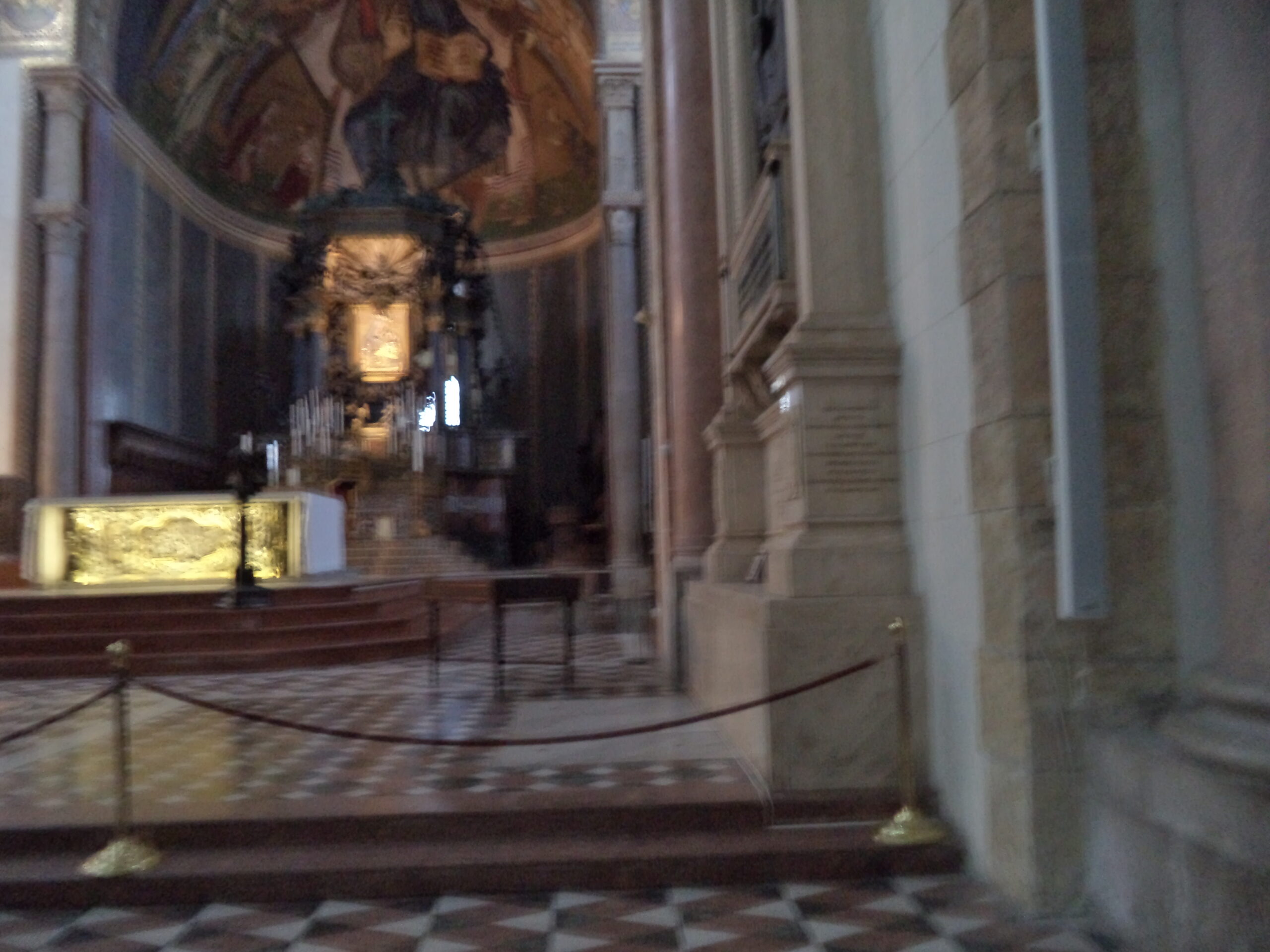
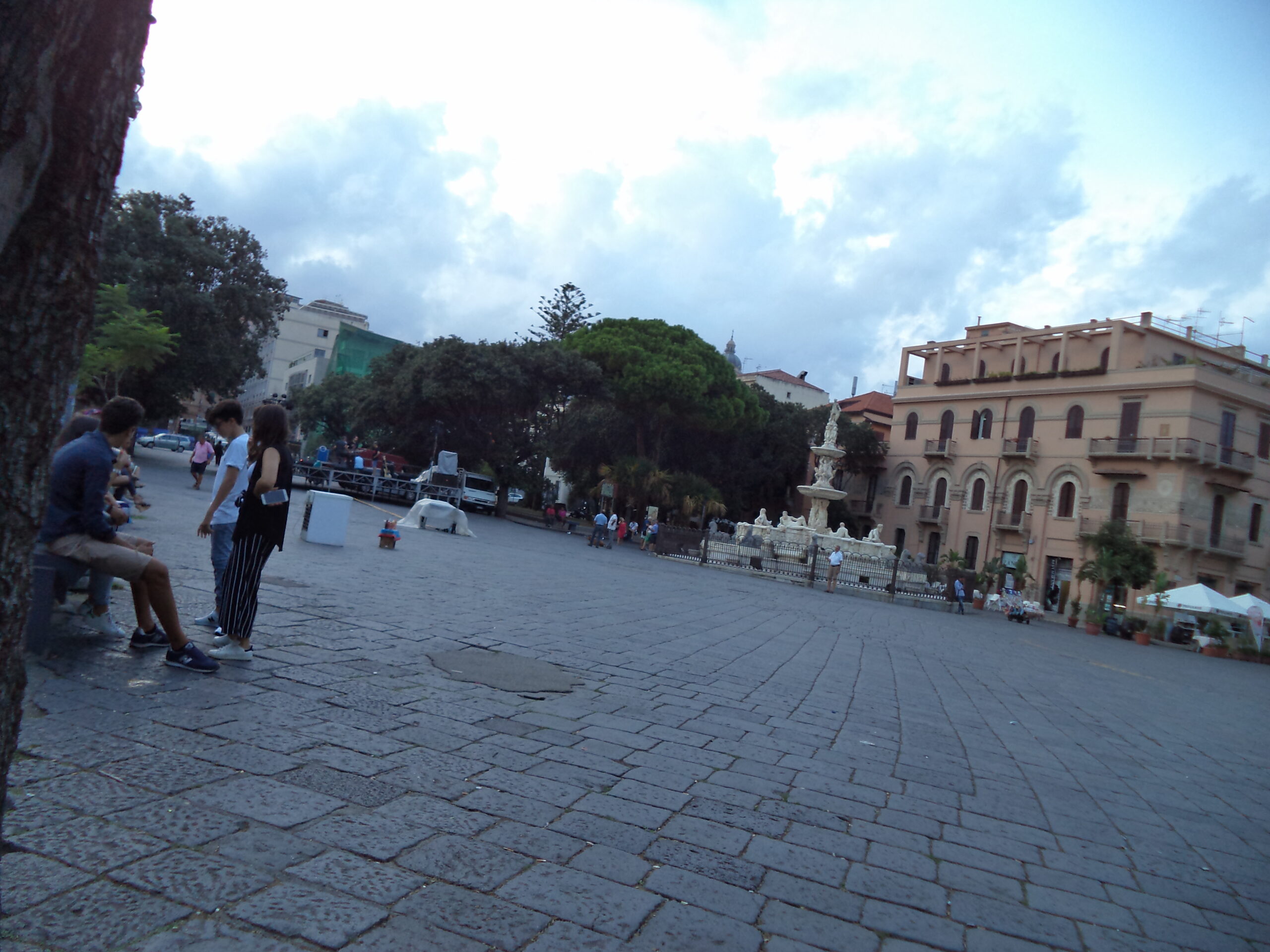
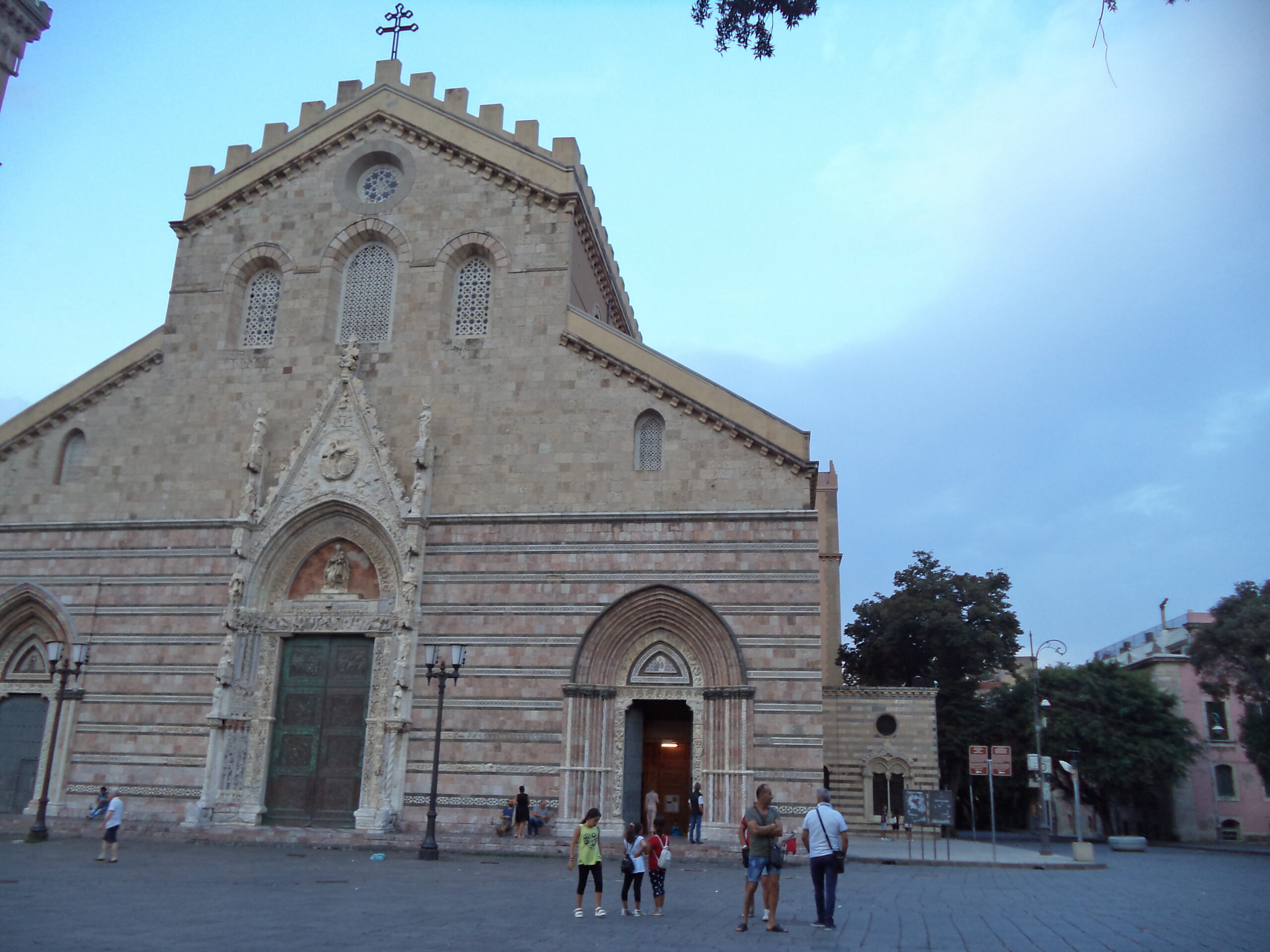
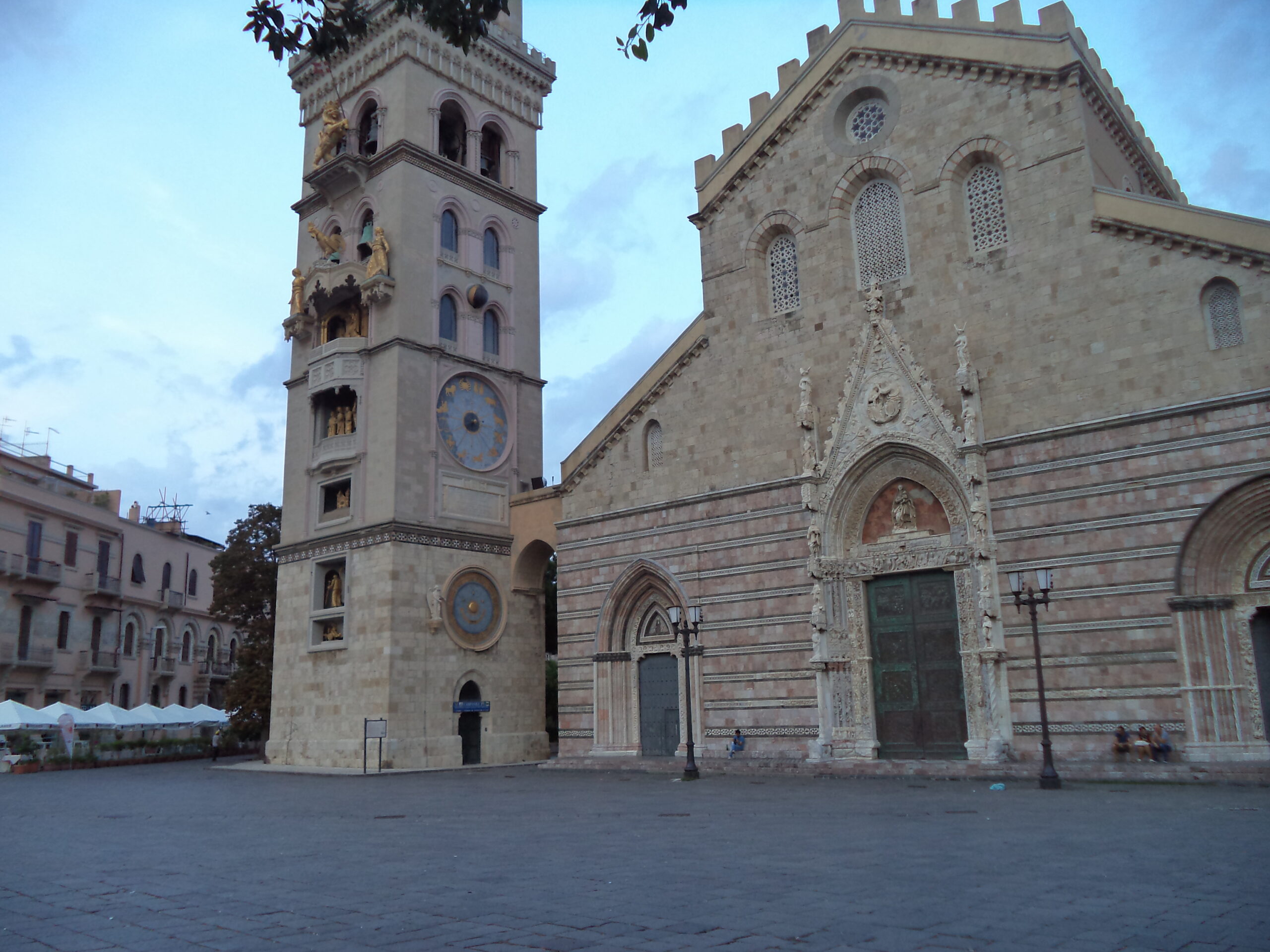
View along Via Primo Settembre. A wide street that runs from the main railway station to the cathedral. The street is lined with historic buildings, many containing shops and other businesses. The top of the bell tower belonging to Messina Cathedral can clearly be seen ahead. The top of the tower has a square profile with a clock face on the side that is in view. It is topped with a central spire and four smaller spires at each corner. The tower is 65 metres in height.Looking towards one of the side walls belonging to Messina’s historic cathedral. The front façade can also be seen at a very acute angle as well as one side of the bell tower. The side wall is relatively plain. It is covered with tan coloured plaster and there are simple arched windows. There is a more elaborate side doorway surrounded by neoclassical decoration. The distinctive bell tower claims to contain the most complex astronomical clock in the world and is one of the city’s main attractions. It was constructed by the Ungerer Company of Strasbourg in 1933. The side of the tower that is in view contains three mechanical features, which can distantly be seen. The dial near the bottom is a perpetual calendar that shows the full date and the time of moveable Christian feasts. Further up, another large round dial with the details highlighted in gold, is a planetarium. This shows the position of the nine planets with the signs of the zodiac around the edge. Further up still is a 1.2 metre sphere showing the phase of the moon. The sphere is half-gold and half-black. In the photo, the visible part is almost all black, with just a thin sliver of gold down the left side. This indicates there was a new moon when this photo was taken. The cobbled square surrounding the cathedral can also be seen.Inside Messina Cathedral looking down one of the side aisles. The floor is decorated with geometric marble tiles. There are large marble columns running down the left side. The wall down the right side contains elaborate neoclassical decoration including statues. A wooden structure with two doors can be seen immediately to the right. This is a confessional booth.
Massina Cathedral was built by the Normans and was consecrated in 1197 by the Archbishop Berardo. It was heavily reconstructed in the twentieth century due to a disastrous earthquake that struck Messina in 1908 and later heavy aerial bombardment during World War II. In 1943 incendiary bombs fell on the roof destroying much of the interior.
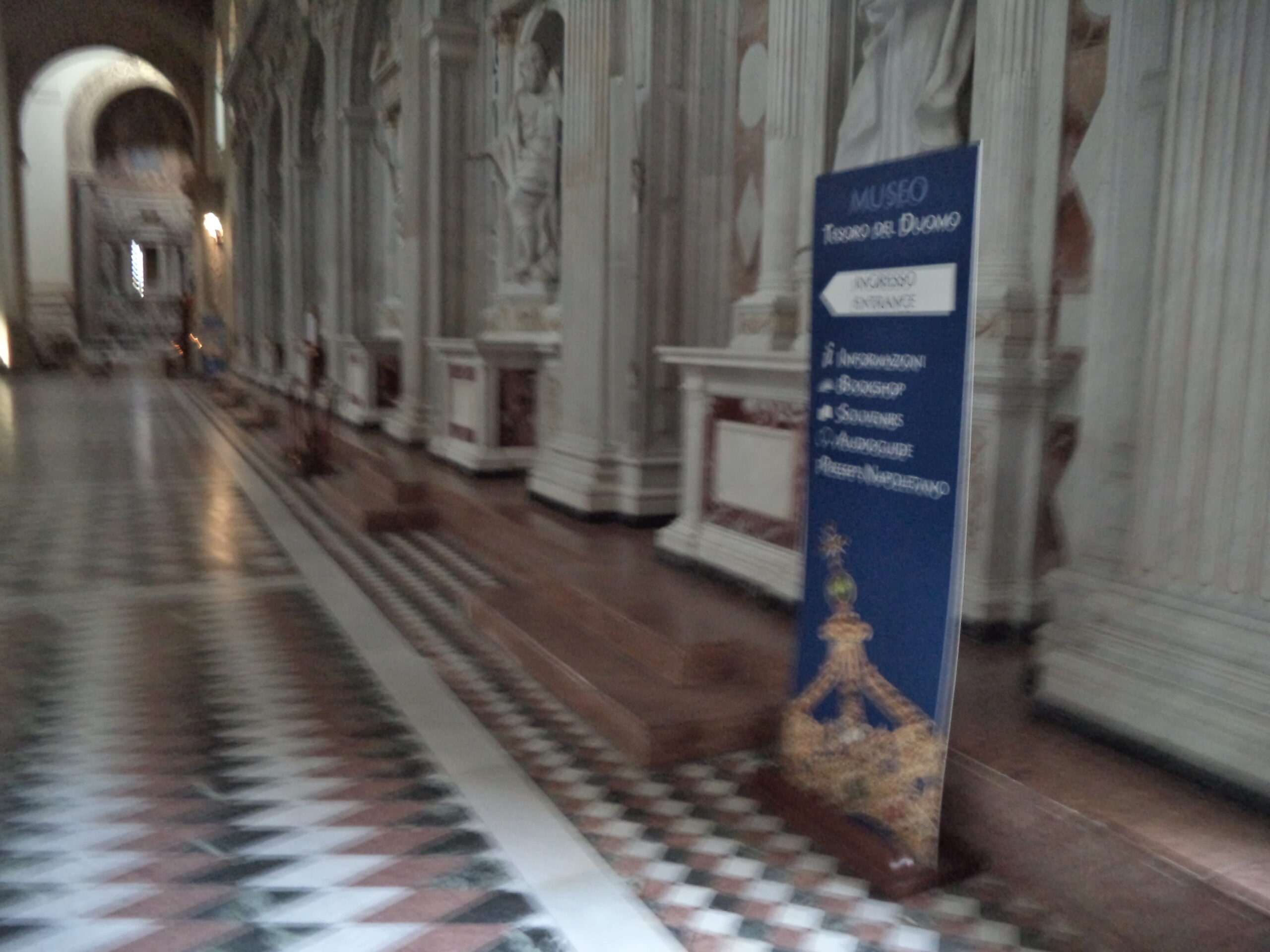
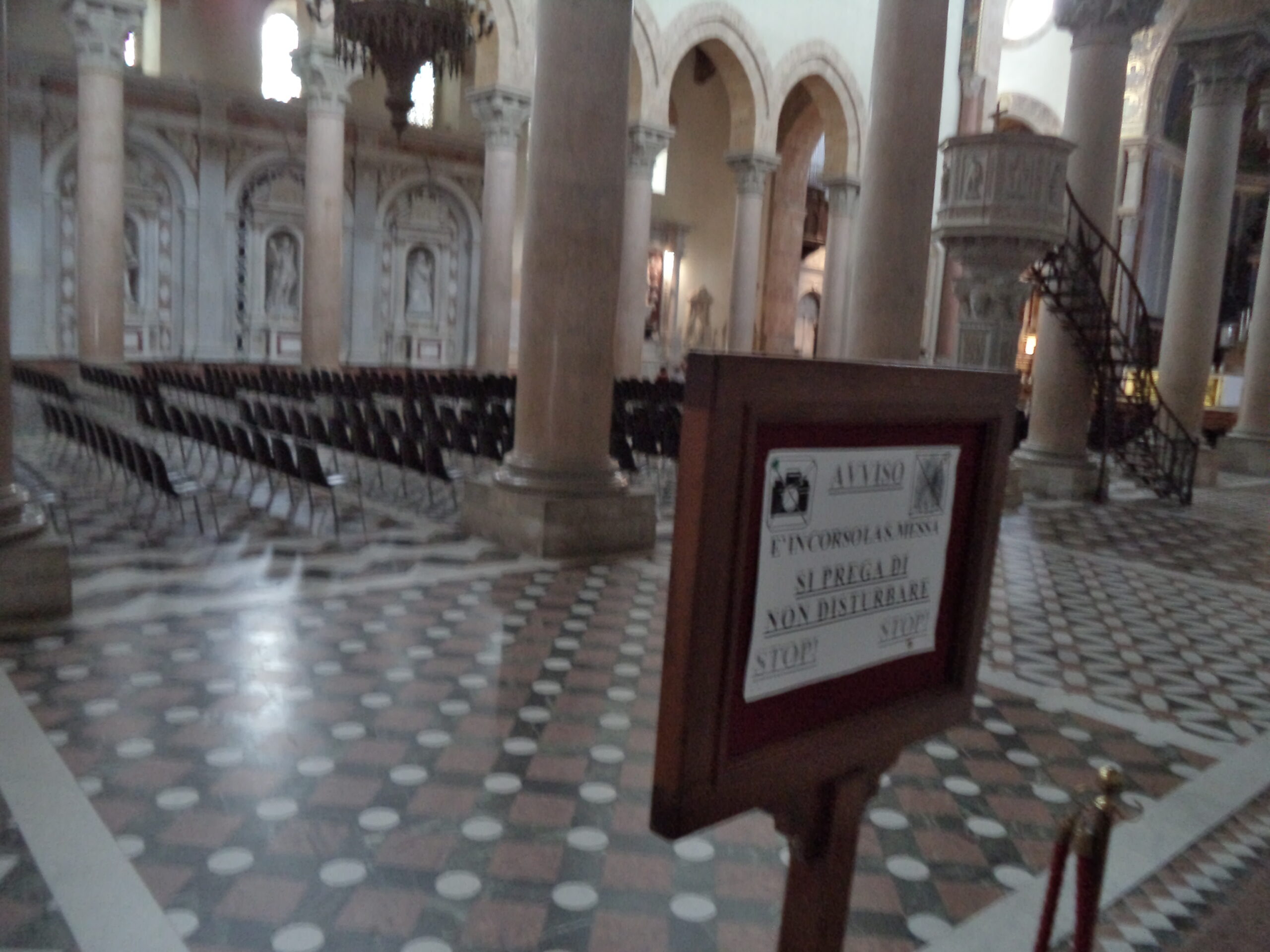
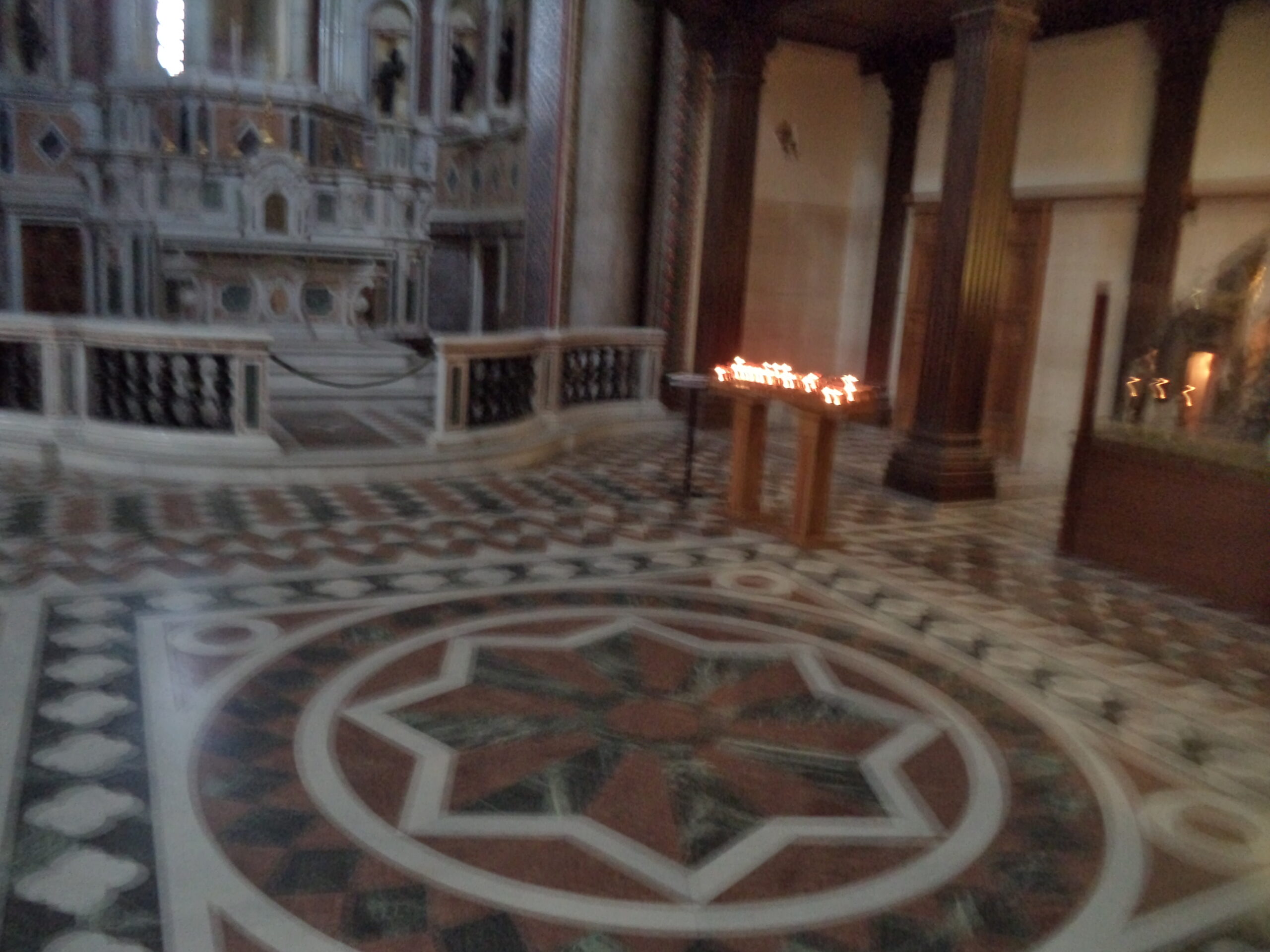
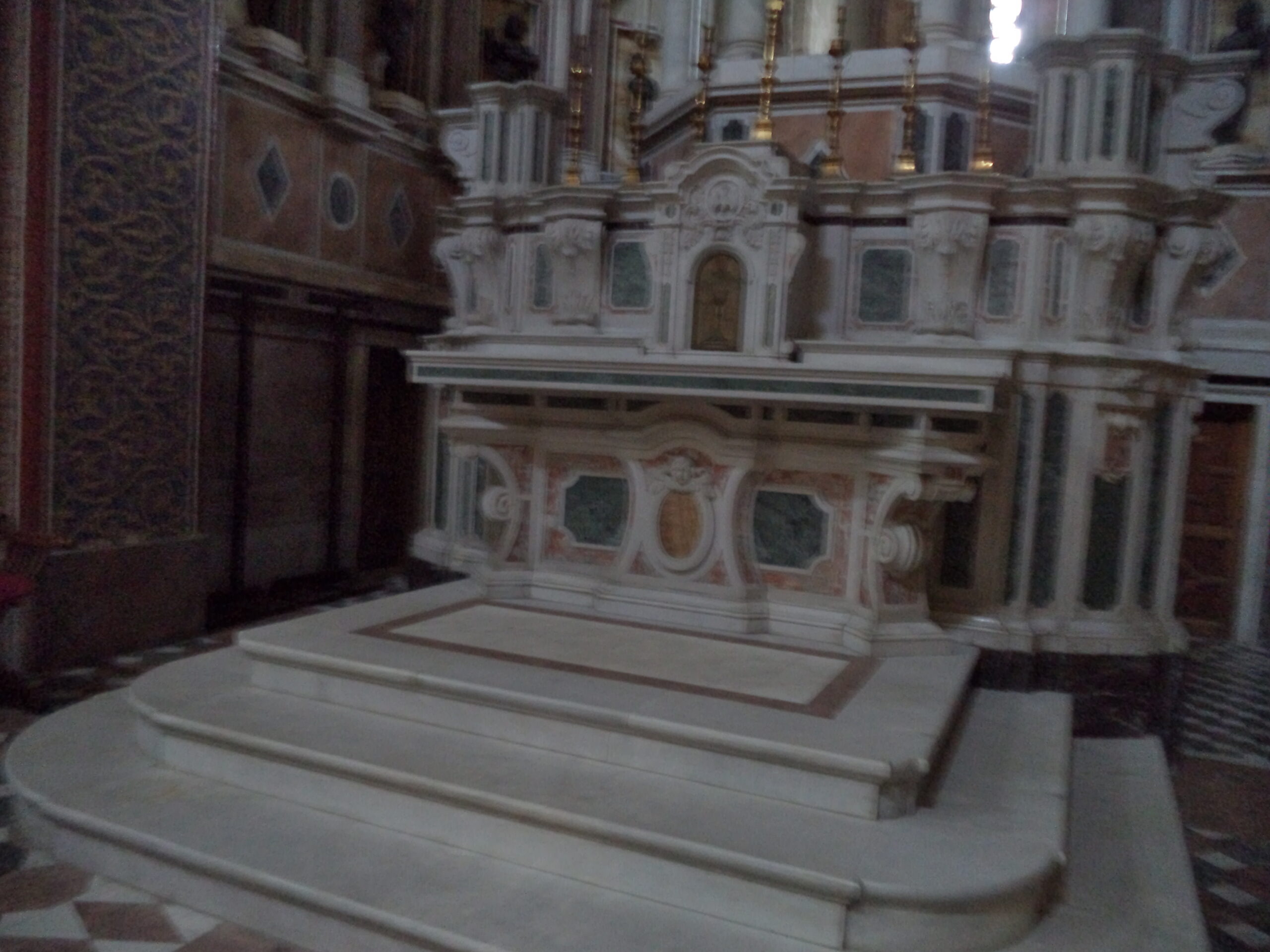
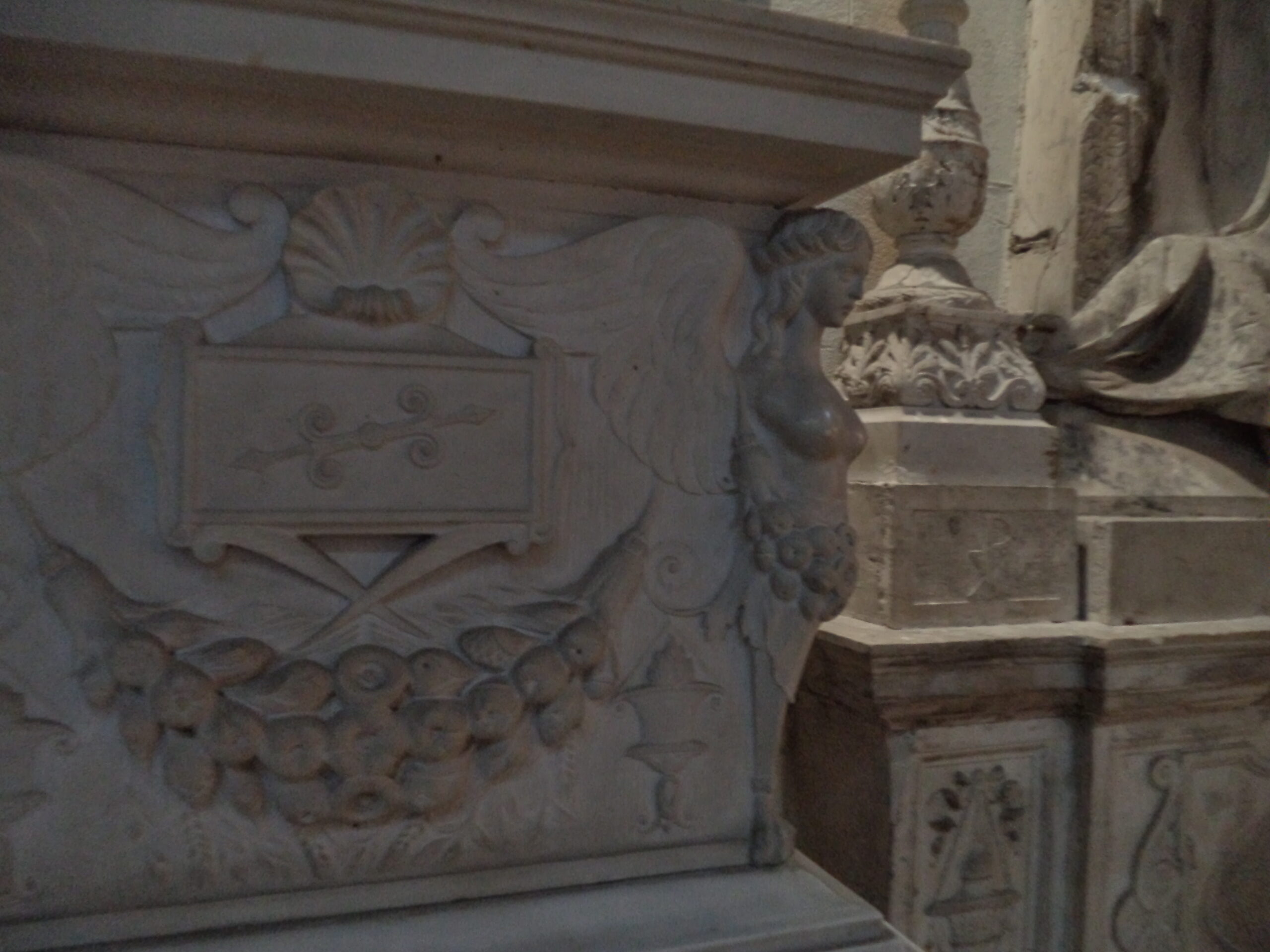
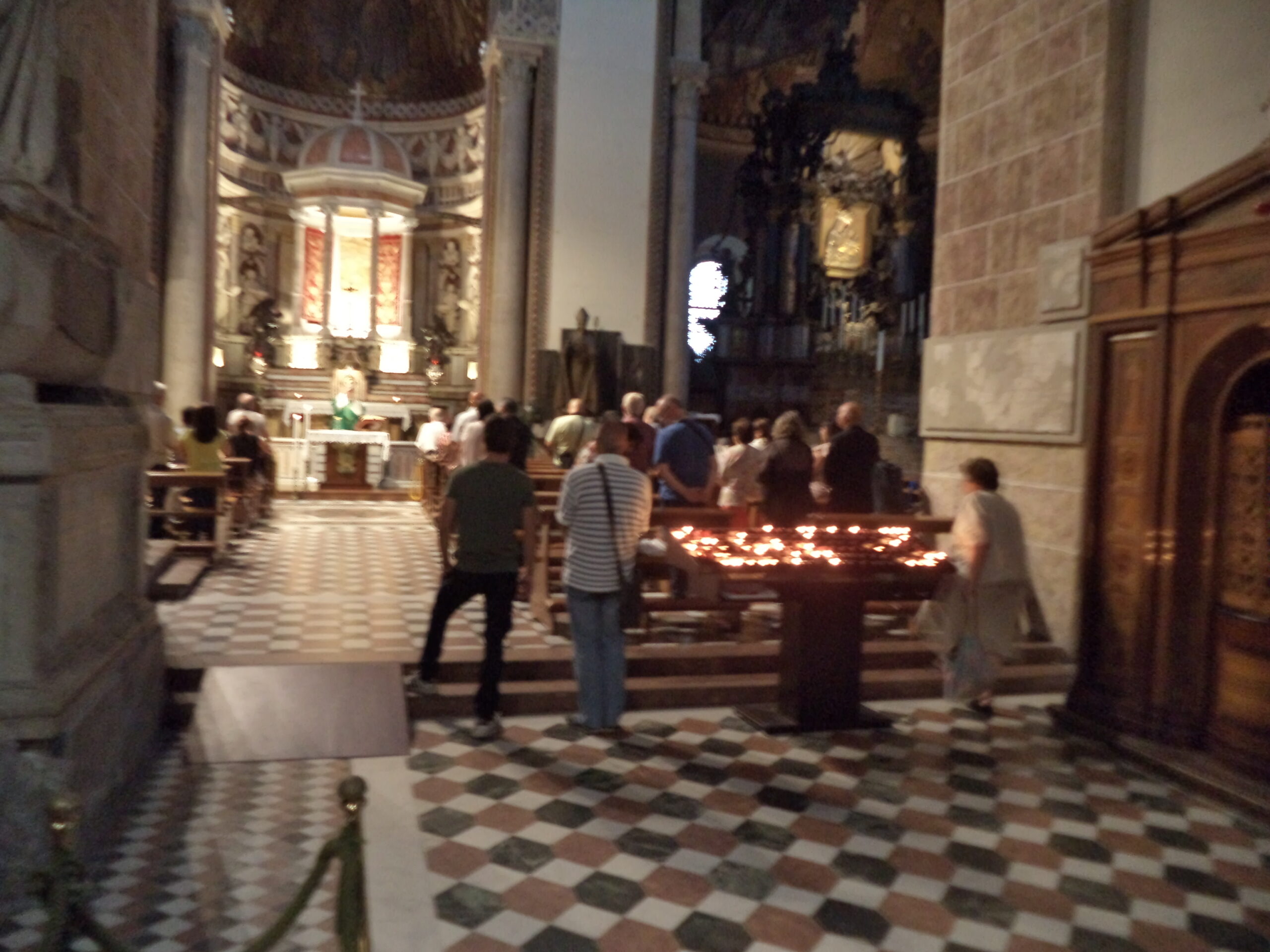
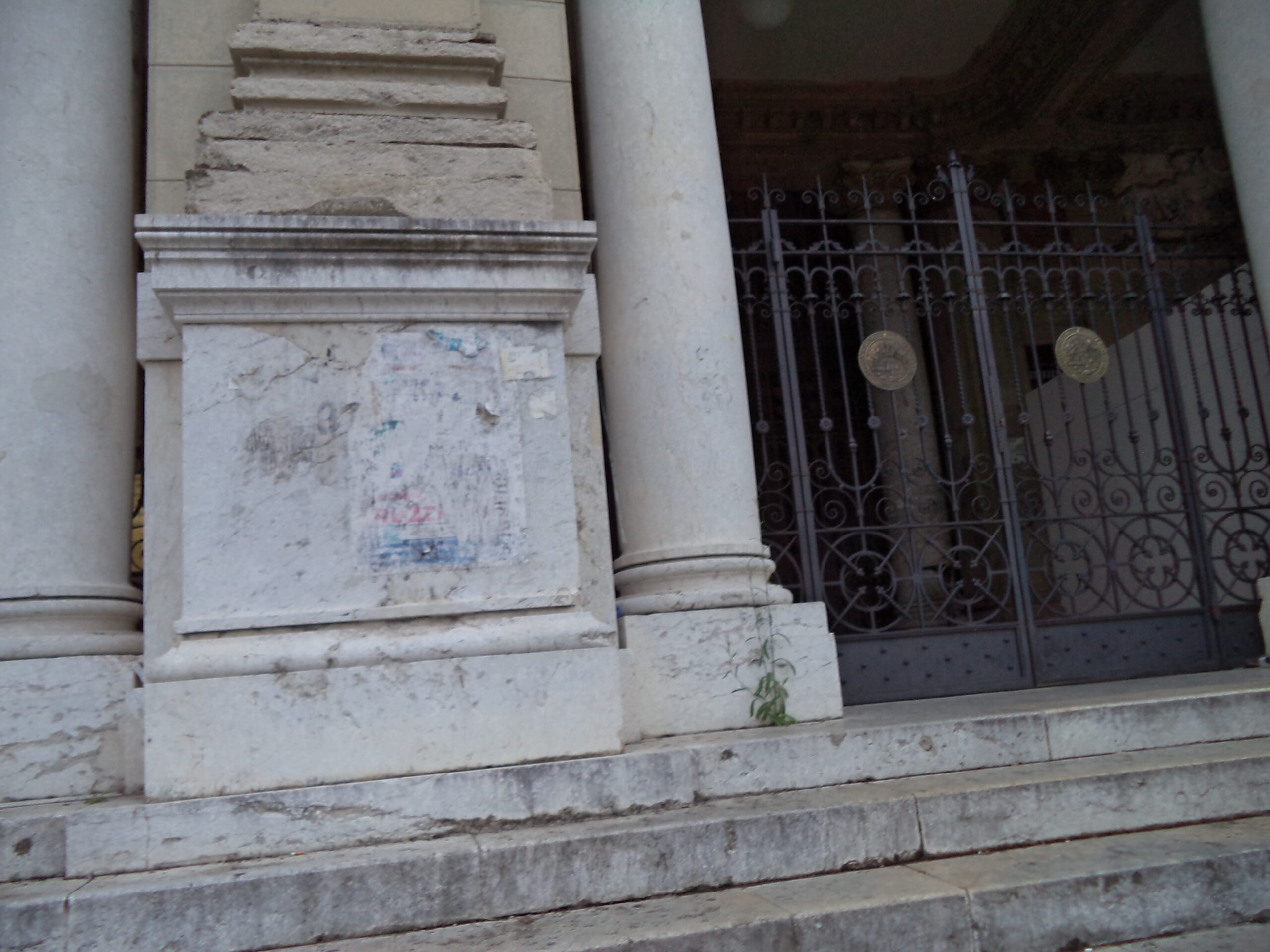
Another slightly blurred view down the side aisle showing a line of neoclassical statues in alcoves.Interior of Messina Cathedral. The photo looks across the central part of the nave. There are rows of empty chairs. Large reddish marble columns supporting Norman arches run down both sides. To the right there is a high stone pulpit accessed using a spiral metal staircase.Looking along the inside of the entrance wall within Messina Cathedral which is adorned with neoclassical decoration. The large arched main entrance doorway can be seen in the centre. Closer to the camera, a marble statue stands in an alcove. The statue is probably a saint and depicts a large bearded man dressed in a robe.Slightly blurry view towards a large elaborately decorated marble side altar inside Messina Cathedral. Marble balustrades form a barrier at the front of the altar. The floor in front is covered with geometric marble tiles in white, black and red, including a large 8-pointed star. Candles are lit on tables on the right side.A closer view of the elaborately carved side altar. There are lots of curved motifs, some with floral designs, as well as inlaid marble panels. A row of gold candlesticks sits above.The golden main altar of Messina Cathedral. The photo is blurred but clear enough to show the main details. The half-domed ceiling is decorated with a large mosaic depicting Christ seated in a throne in the centre.A large carved stone tomb inside Messina Cathedral. The tomb appears to have a nautical theme, which includes a shell motif in the centre, and a bare breasted female figure projecting from one corner. The female figure has wings, so is probably an angel, but also resembles a mermaid.A slightly blurred view of a service taking place in front of a side altar within Messina Cathedral. The photo is taken from the back with an aisle running down the centre and pews at either side half full with people standing. A priest dressed in green can indistinctly be seen standing at the altar. There is also a large stand filled with lit candles at the back.Outside a historic building in Messina. Three marble steps lead up to decorative wrought iron gates. The marble bases of two Tuscan columns can be seen on the left side.View across Piazza Duomo which is located in front of Messina Cathedral. The square is paved with rectangular stone blocks. A few people can be seen standing or sitting on benches. At the far side a large ornate marble fountain can be seen. This is the Fountain of Orion (Fontana di Orione) designed by Giovanni Angelo Montorsoli and dating from 1553. The base of the fountain is 12-sided and includes four statues depicting the rivers Nile, Tiber, Ebro, and Camaro. In the centre there is an ornately decorated column incorporating several statues. The column supports two raised basins. At the top there is a statue of Orion with his dog Sirius at his feet.The front façade of Messina Cathedral, which is clad in marble. This façade is largely symmetrical with three arched doorways: a large central doorway and two slightly smaller ones at each side. The doorways are all richly decorated with bas-relief carving. The photo is too distant to show this in detail.The bell tower and astronomical clock adjoining the left side of Messina Cathedral’s front façade. The photo shows golden statues and other decoration in several tiers going up the tower. At the bottom there is a carousel depicting the days of the week: Friday is shown by Venus driving a dove. Other parts include a carousel of the ages of life, Biblical scenes that change in each quarter of the liturgical year, and at the top, a crowned lion (the symbol of Messina Province) which at midday waves the flag of Messina, moves its tail, turns its head and roars three times.
Catania
Catania is a city on the east coast of Sicily facing the Ionian Sea. It is located at the base of Mount Etna, which is an active volcano. It is the second-largest city in Sicily, after Palermo, with a population of 297,517 for the city proper, and 1,068,563 for the metropolitan area.
Sunday, 9th September 2018
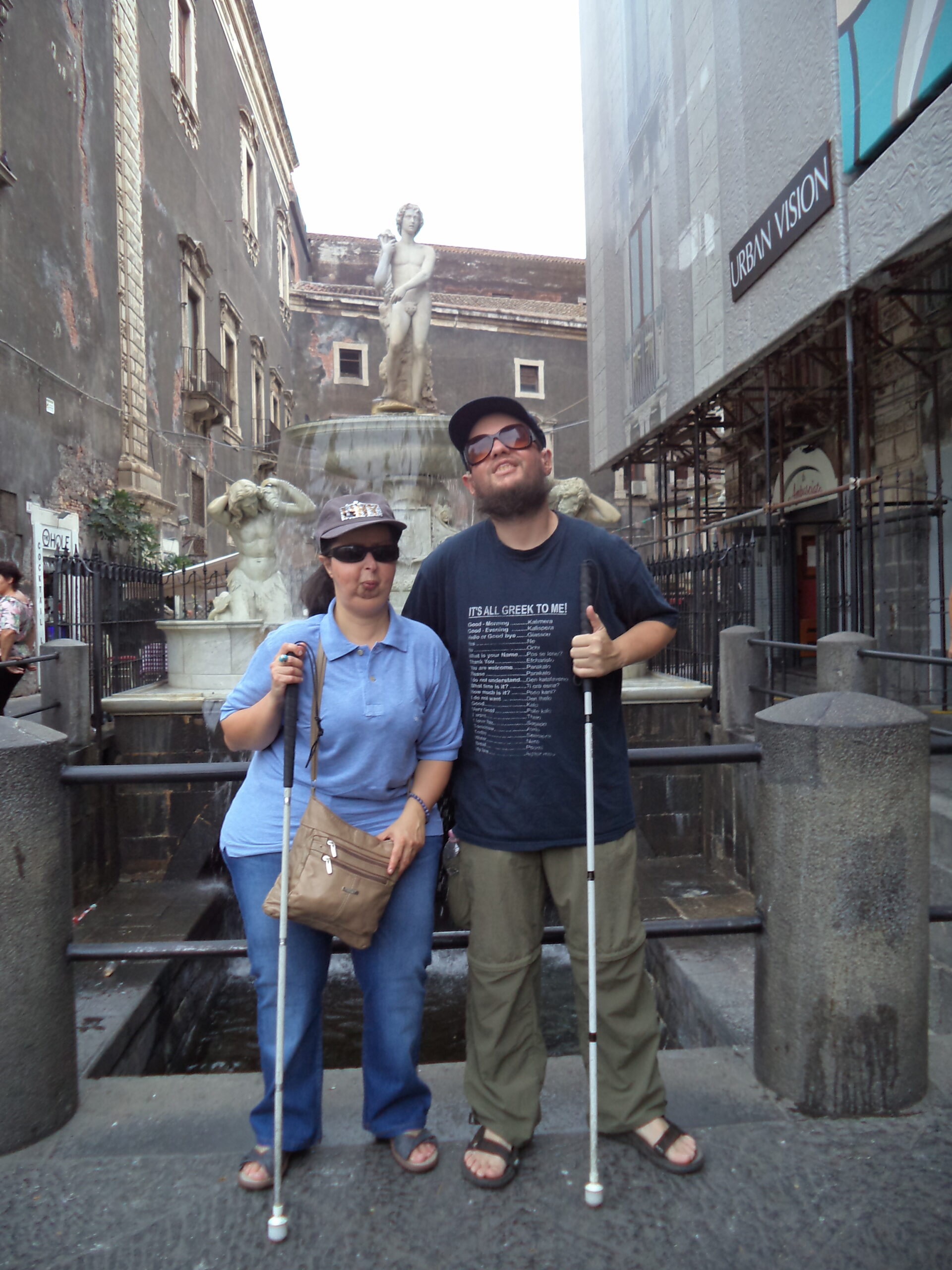
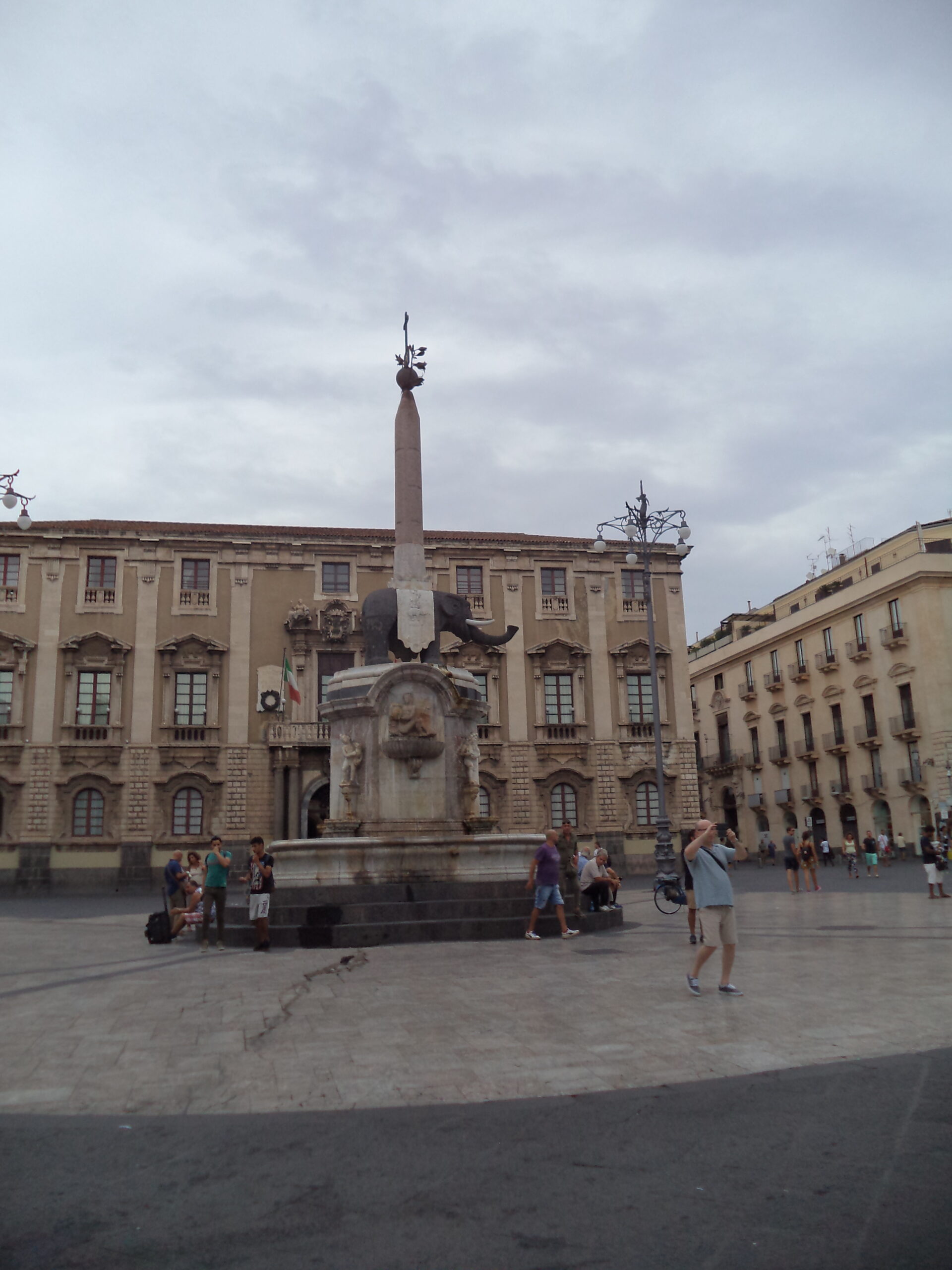
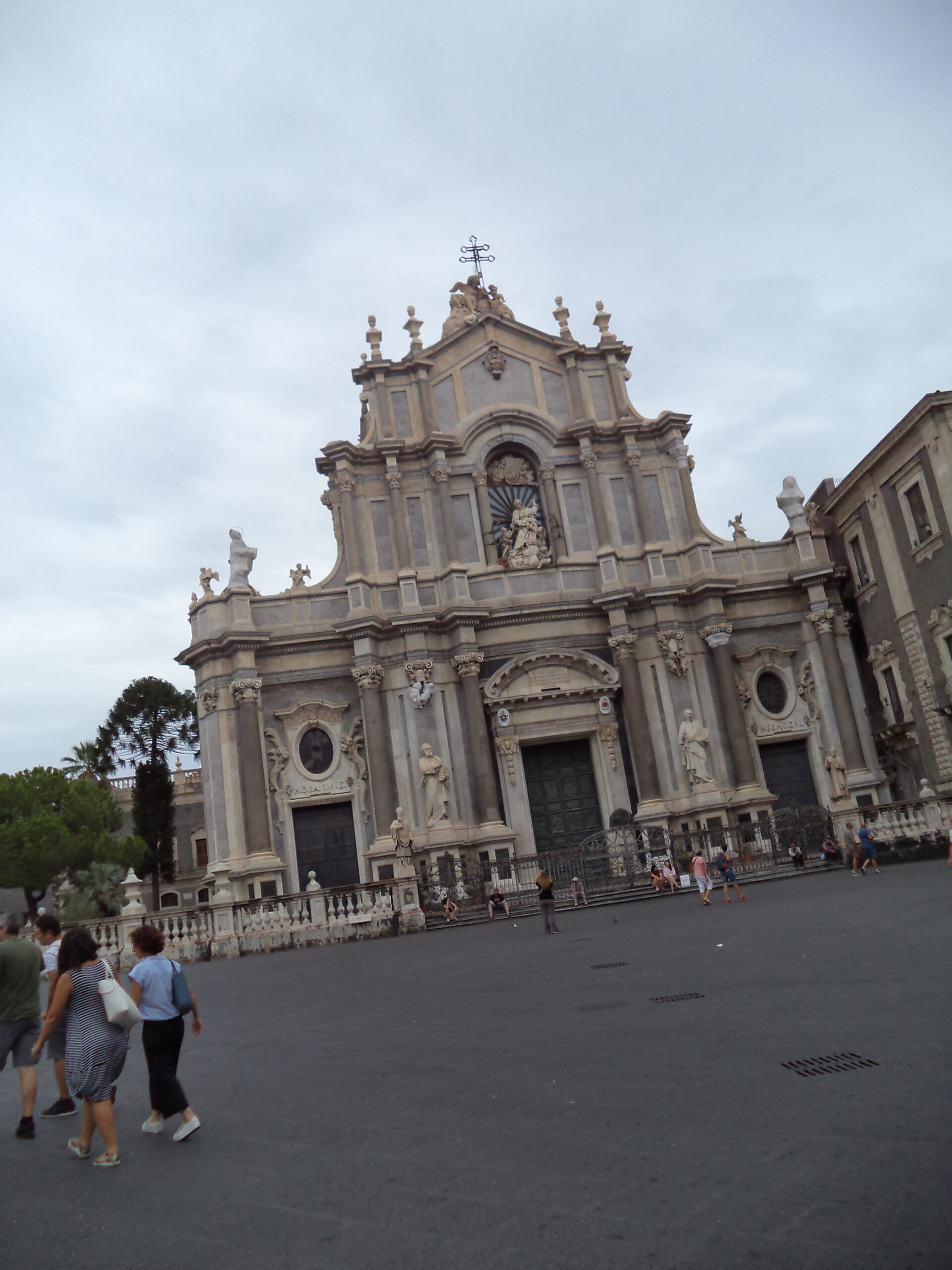
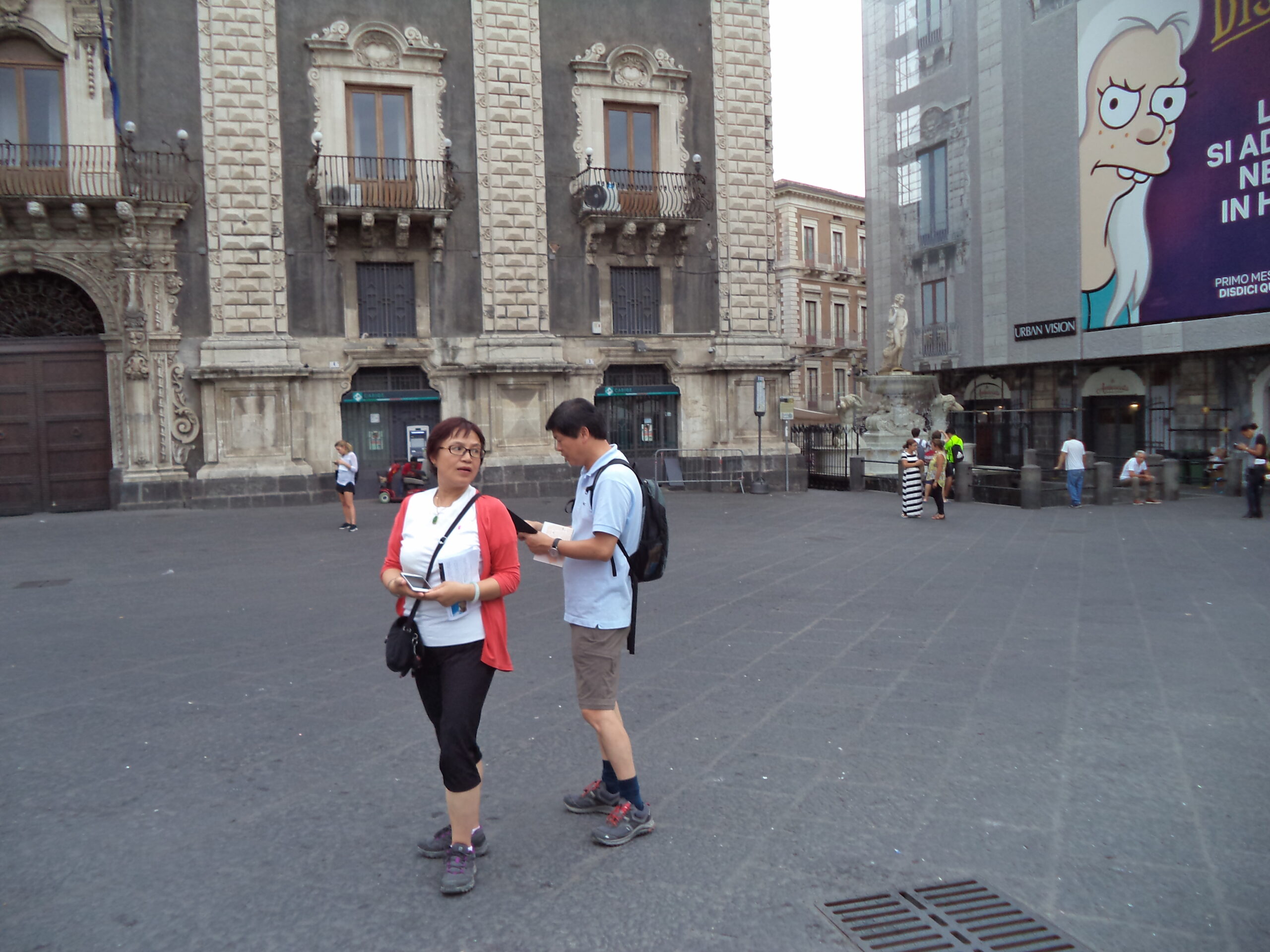
Tony and Tatiana in central Catania standing in front of the Amenano Fountain (Fontana dell’Amenano). This attractive fountain was carved in 1867 by the Neapolitan master Tito Angelini in Carrara marble. The fountain is named after the Amenano river which flows underground beneath Catania. On the top layer of the fountain stands a carved male figure: he personifies the Amenano river and holds a container from which river water flows. The water then flows into a larger pool at the base of the fountain. Two more male statues stand on the base and they depict Tritons or sea gods.The Elephant Fountain (Fontana dell’Elefante) standing in the centre of historic Piazza dell Duomo. The fountain’s central feature is an elephant carved in black basalt and standing on a pedestal. On the elephant’s back is a 3.66 metre high Egyptian-style obelisk. The fountain was designed by architect Giovanni Battista Vaccarini between 1735 and 1737. The building in the background is the late 17th century Palazzo degli Elefanti which today houses the Town Hall.The Baroque front façade of Catania Cathedral. The façade is largely symmetrical and has three levels which become narrower going up. Each level is adorned with granite Corinthian columns, possibly taken from Catania’s Roman Theatre, and statues. There are three doors, a very large central one, and smaller ones towards each side. The cathedral’s current appearance dates from 1711, when Gian Battista Vaccarini designed the Baroque façade, following a major earthquake in 1693.
Catania Cathedral’s full name is the Metropolitan Cathedral of Saint Agatha. It has been the seat of the Archbishops of Catania since 1859. The first cathedral was built here between 1078 and 1093, on the ruins of the ancient Roman Achillean Baths, by order of Roger I of Sicily. It has since been rebuilt several times because of earthquakes and eruptions of nearby Mount Etna. The current Baroque cathedral dates from after the catastrophic earthquake of 1693.
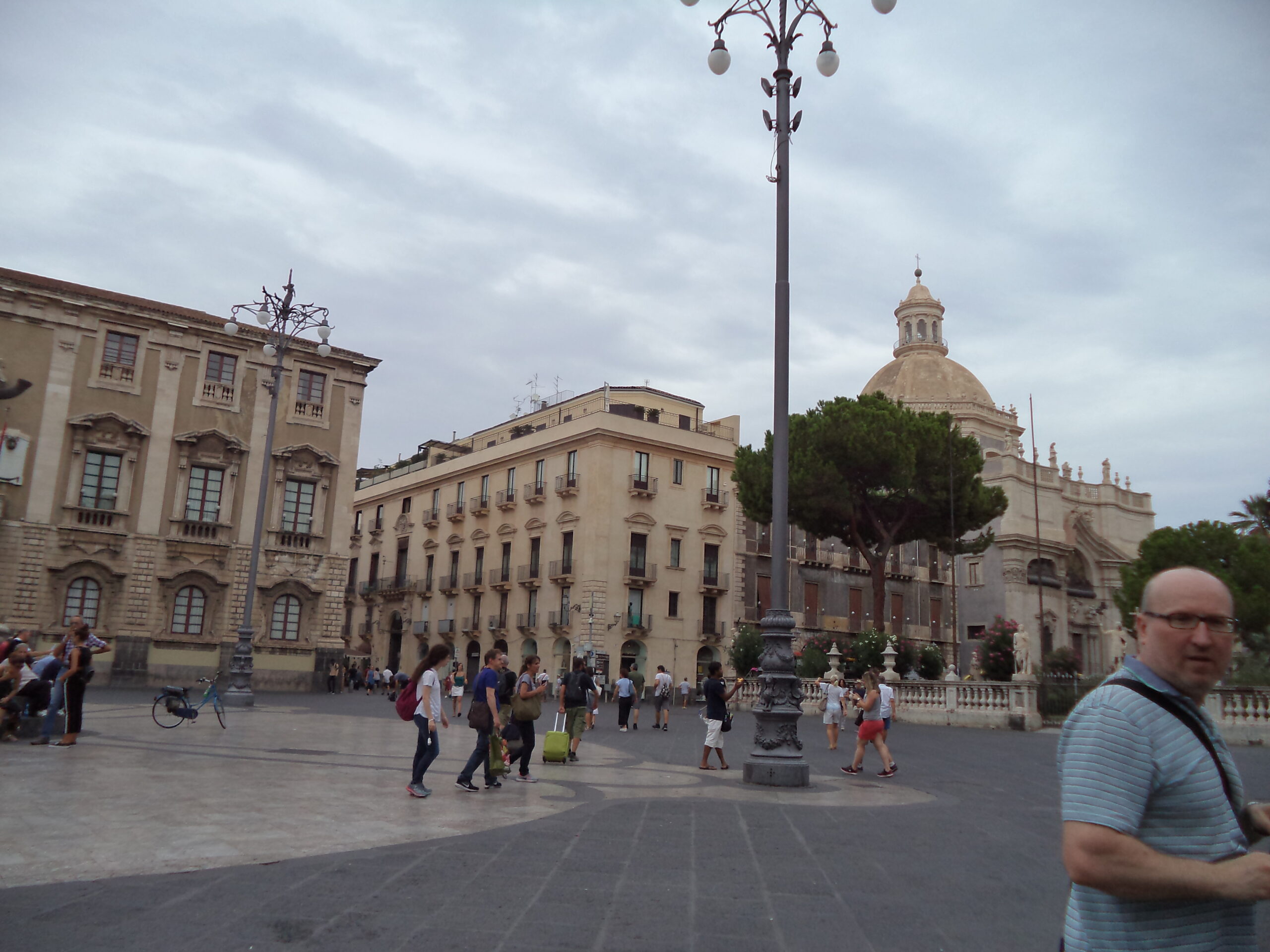
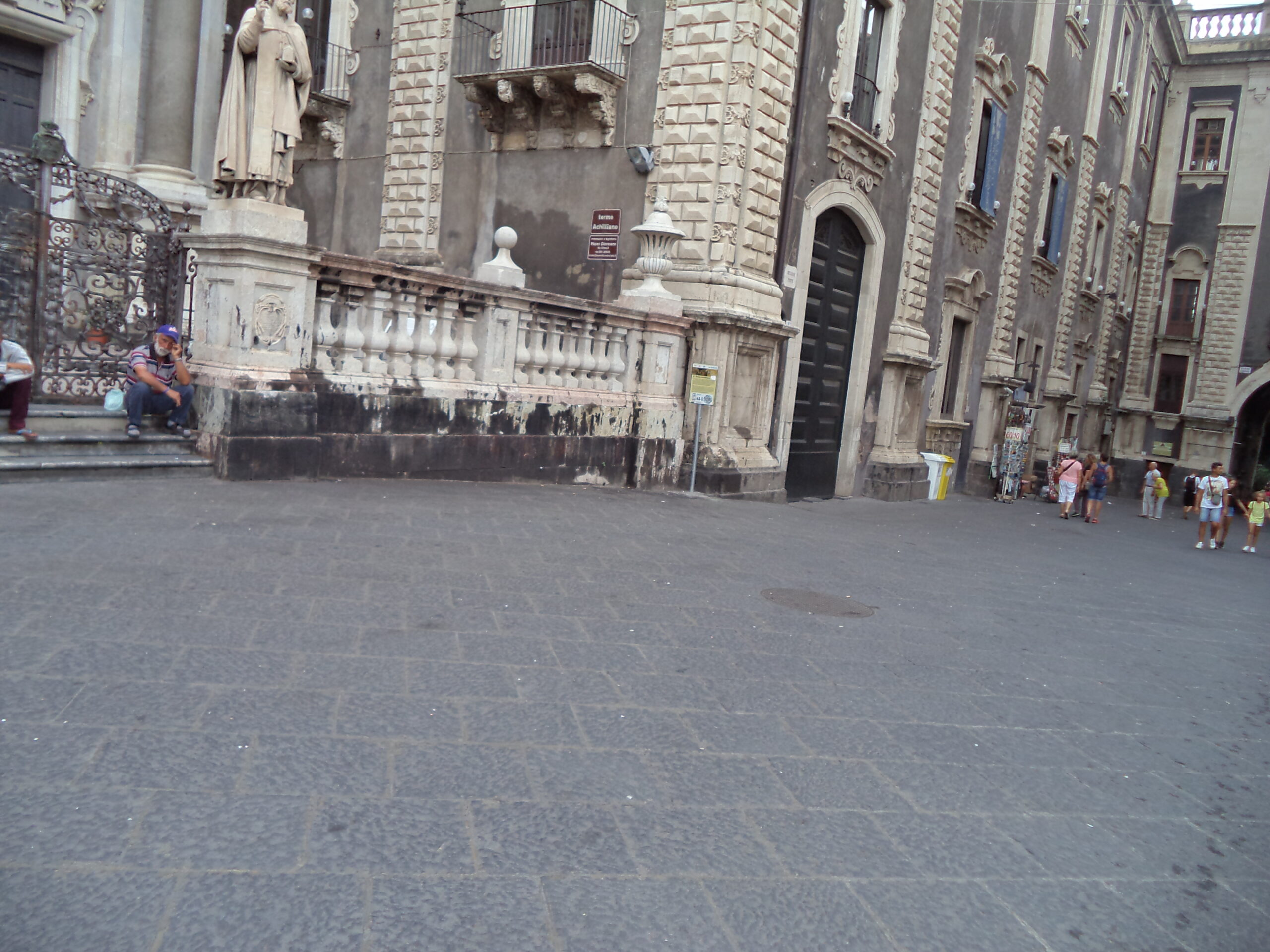
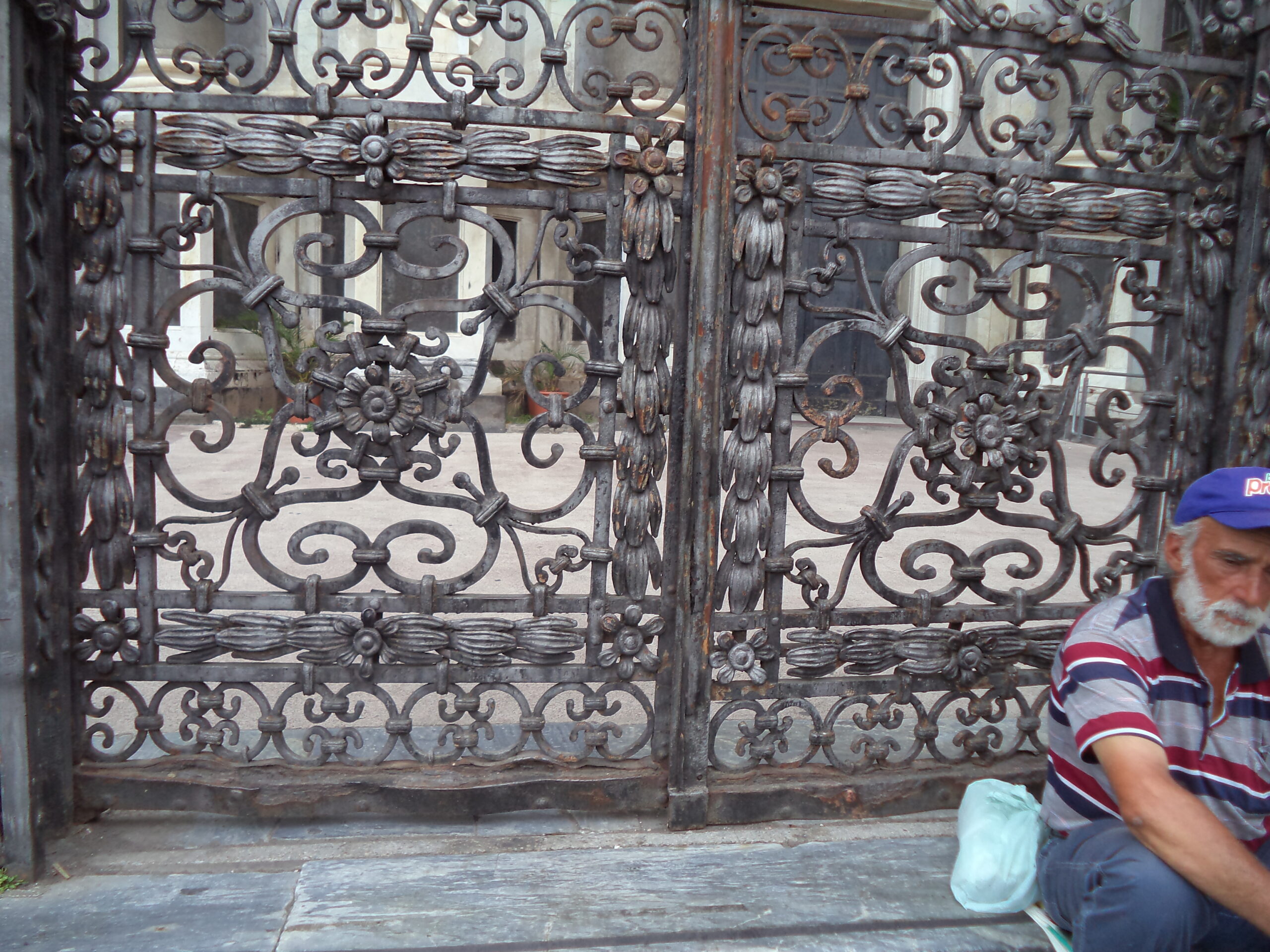
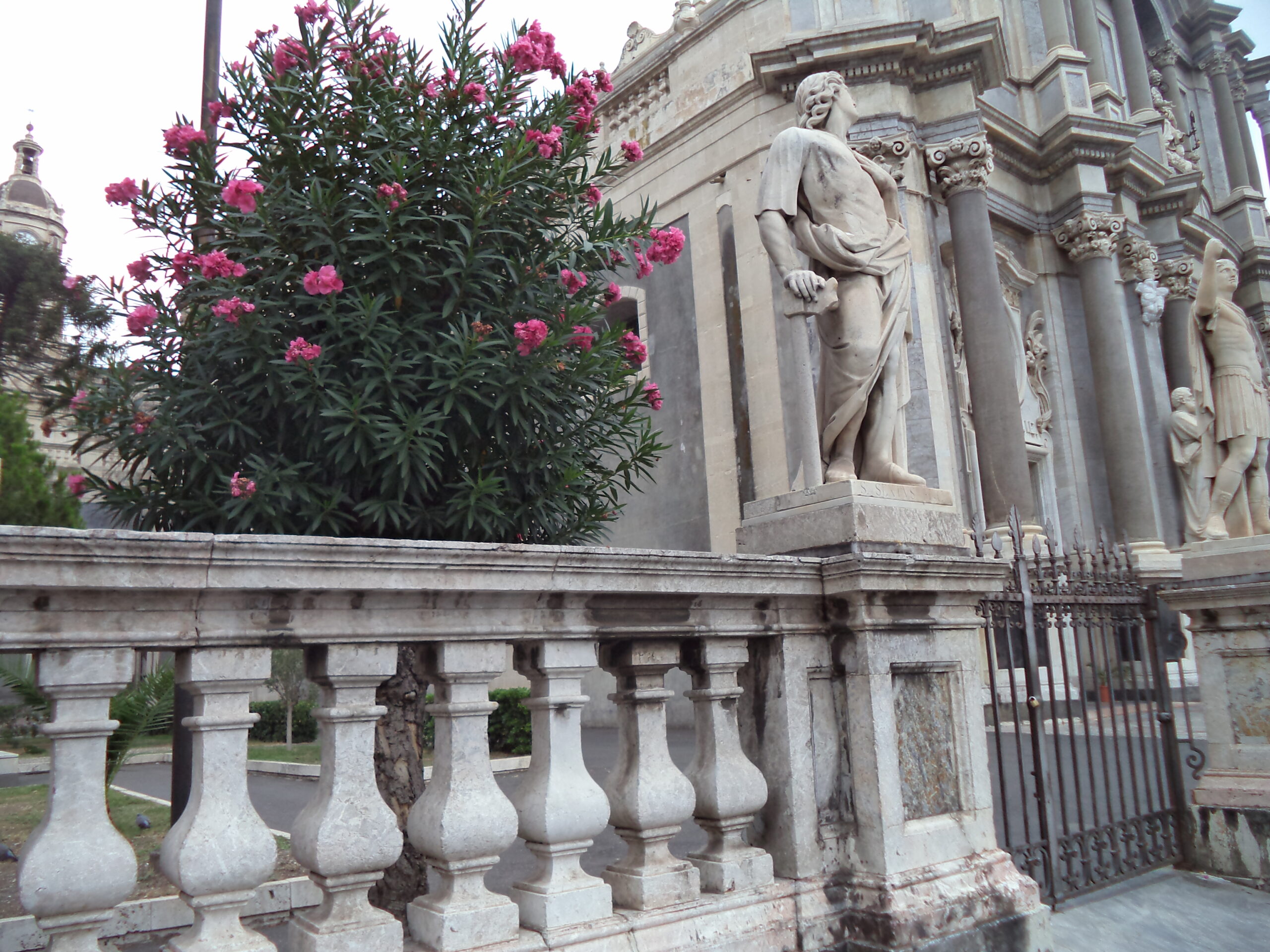
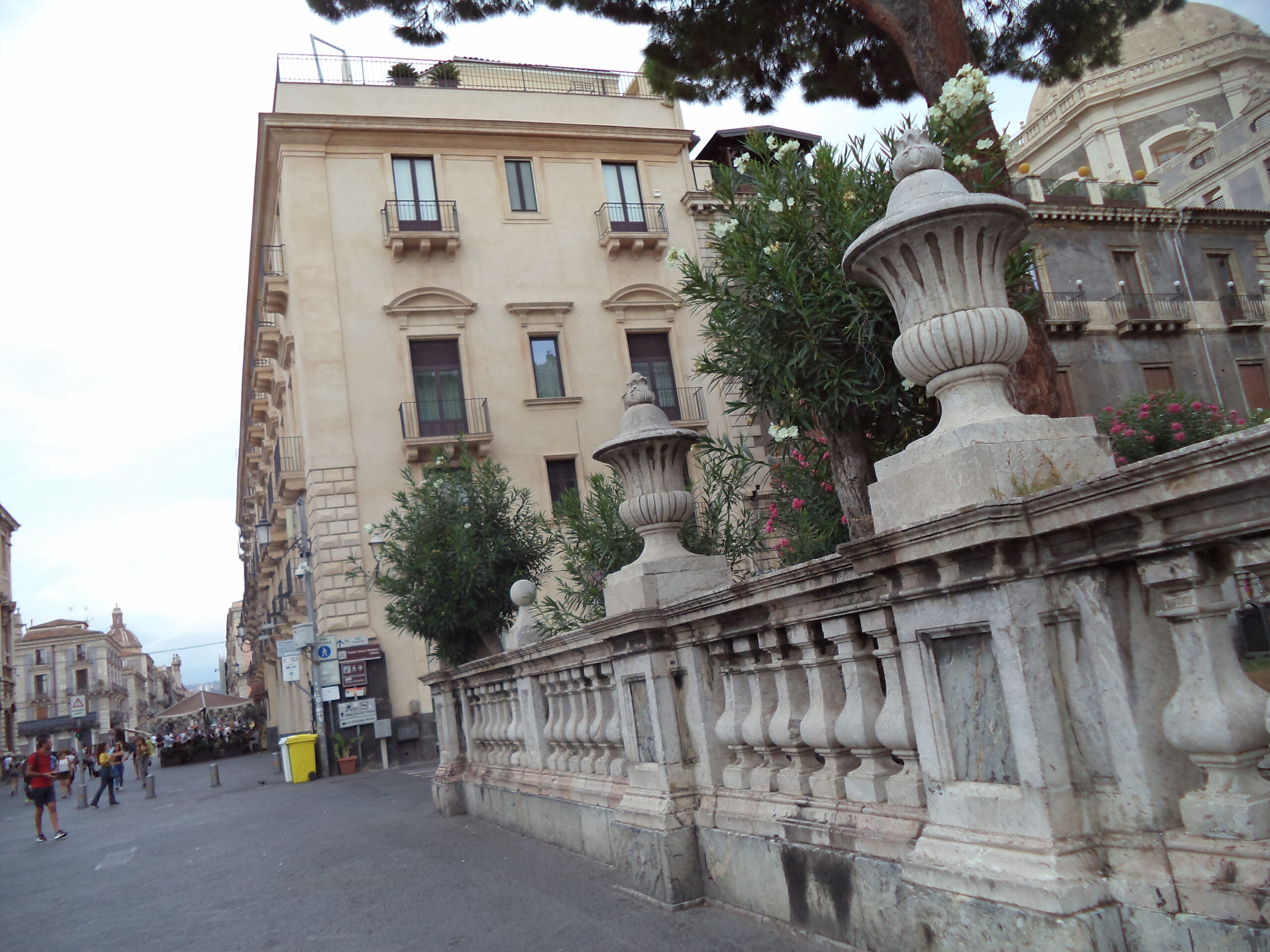
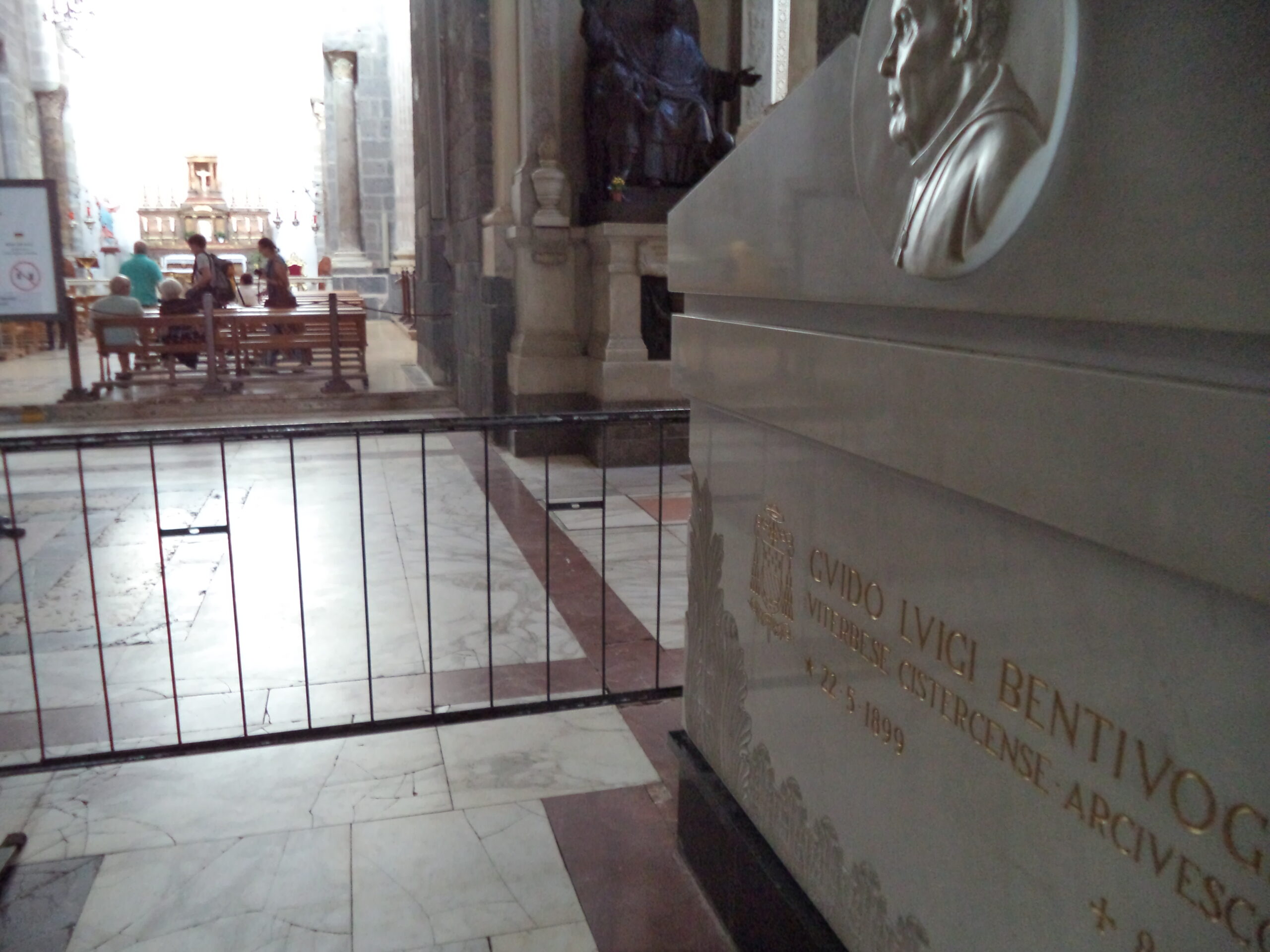
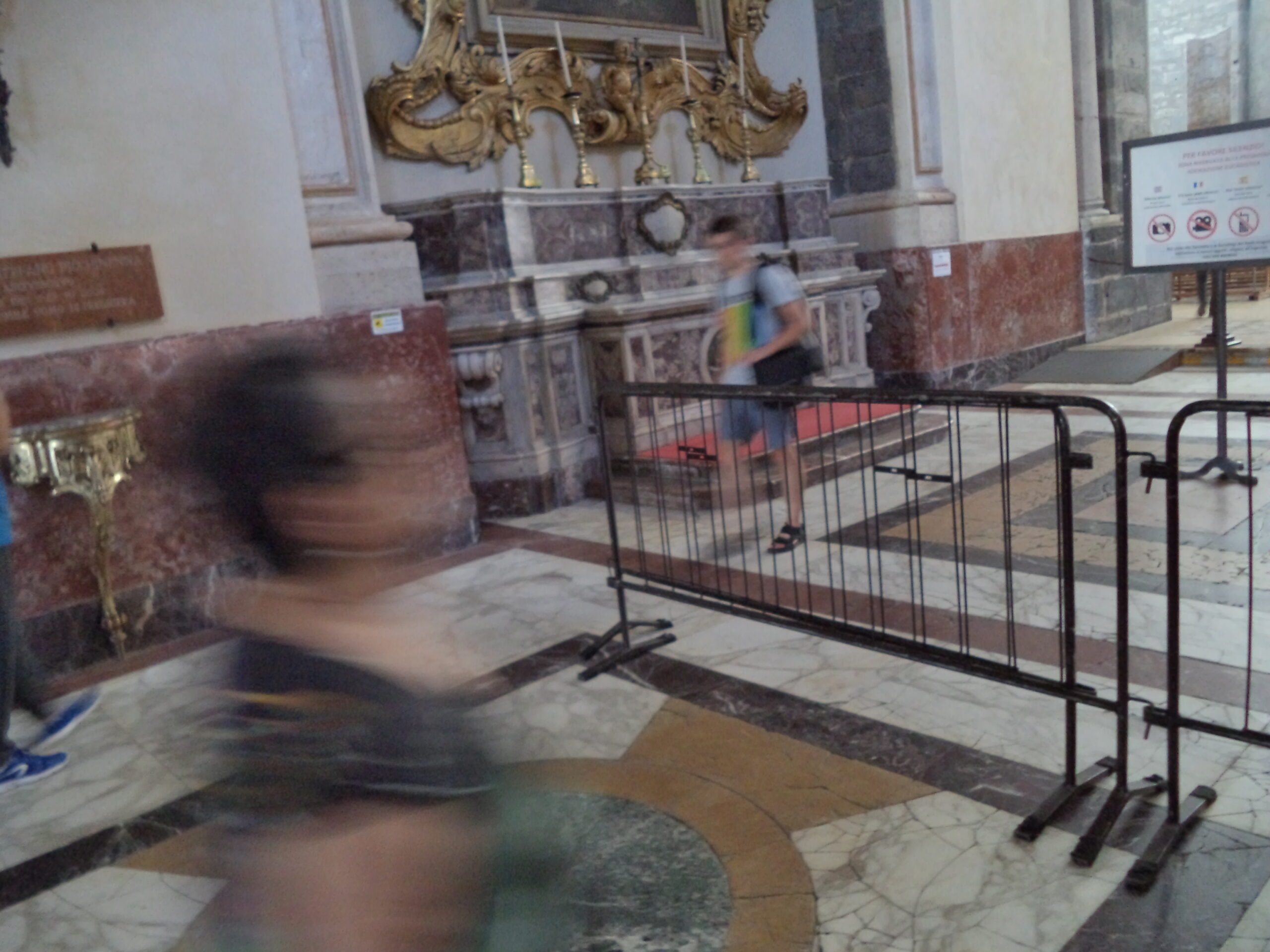
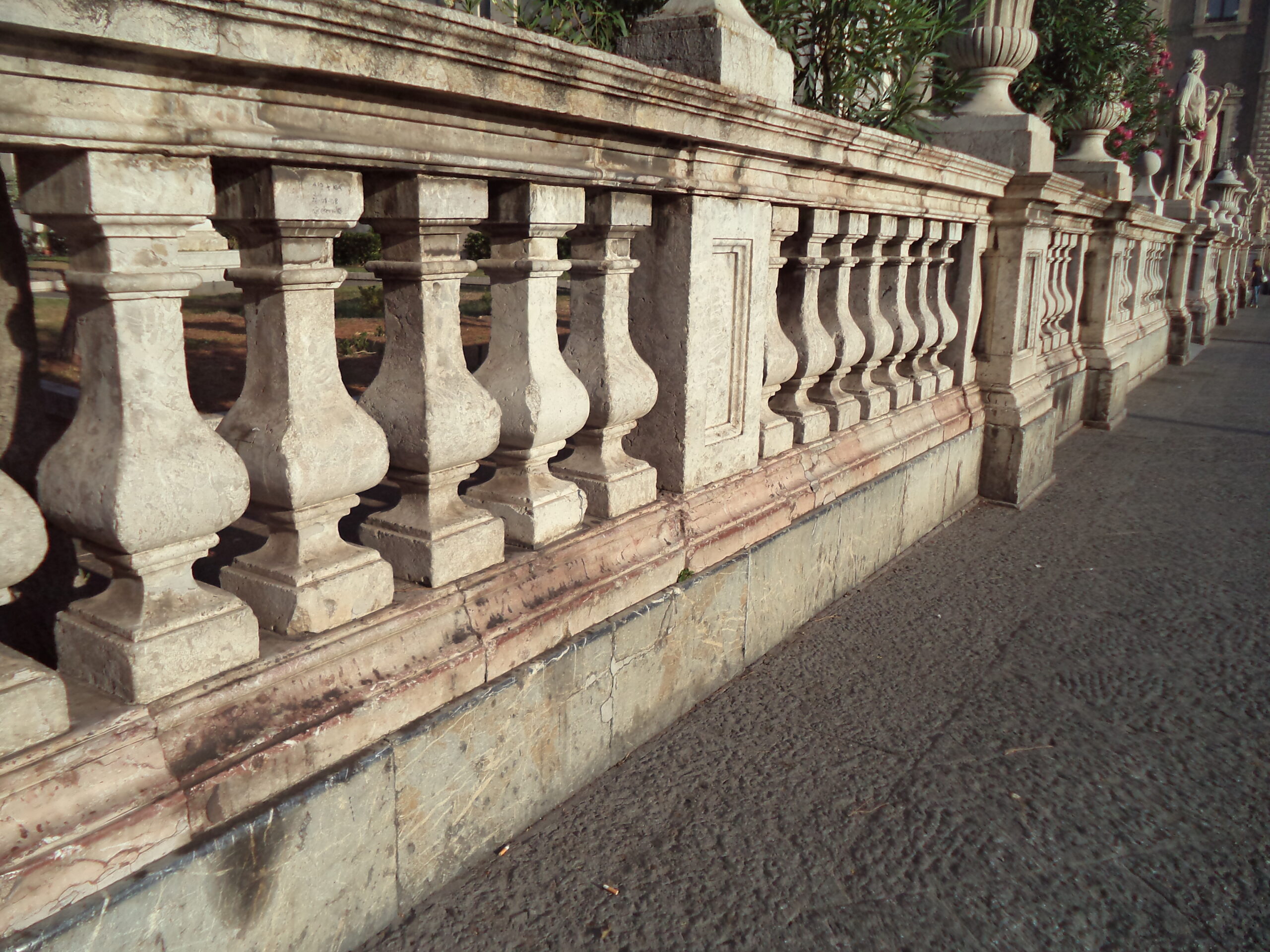
The monumental Sicilian Baroque Palazzo del Seminario dei Chierici (Palace of the Seminary of the Clerics) which faces on to Piazza dell Duomo close to the cathedral. The Amenano Fountain can also be seen on the right side. The current building, originally used for training clerics, was built after the 1693 earthquake that devastated the city. Construction began under architect Alonzo di Benedetto and was continued in 1757 by Francesco Battaglia. The building was later used as military barracks, and is today civic offices.View across the north side of historic Piazza dell Duomo. The large domed building to the right is the Abbey of St Agatha (Badia di Sant’Agata). This 18th century church stands opposite Catania Cathedral, and like the cathedral, is Baroque in style. Also like the cathedral it is dedicated to Saint Agatha, patron saint of Catania. An earlier monastery on this site was destroyed by the 1693 earthquake.The south-east side of stone-paved Piazza dell Duomo. Grand historic buildings can be seen. To the left, a small part of the cathedral is in view. A pale stone balustrade wall stands in front with a statue, likely of a saint, mounted on a large stone gate post at the near end. It has an ornate metal gate attached. The large Baroque building on the right is part of the Palazzo del Seminario dei Chierici (Palace of the Seminary of the Clerics). This wing of the building today houses the Museum of Catania Diocese. The arch just visible further to the right is the 18th-century Uzeda Gate (Porta Uzeda). This provides a southern exit from Piazza dell Duomo.Ornate wrought iron gates with intricate floral and geometric patterns. This is one of several gates outside Catania Cathedral. An elderly man with a white beard and a blue cap is sitting on a step at the bottom.Stone balustrade wall at the north side of Catania Cathedral. A pair of classical-style statues stand on pedestals, these may depict saints, and are just two of the many statues that adorn the front of the cathedral. Some of the cathedral’s granite Corinthian columns can also be seen. Beyond the balustrade wall there is a small cathedral garden. Standing prominently in the foreground is a tree bush covered with bright pink flowers.Looking the other way along the stone balustrade wall that encloses the cathedral garden. Decorative stone urns sit on top of the wall’s pillars. Trees and bushes, some covered with bright flowers, can be seen within.Another view across busy Piazza dell Duomo towards the historic Palazzo del Seminario dei Chierici (Palace of the Seminary of the Clerics) on the south side. A yellow open-sided tourist minibus is parked in front. The Elephant Fountain (Fontana dell’Elefante) is again visible to the right.Inside Catania Cathedral. A large marble tomb belonging to Guido Luigi Bentivoglio stands immediately to the right. Guido Luigi Bentivoglio was Archbishop of Catania from 1952 to 1974. He died in 1978. In front people can be seen sitting on pews and beyond an altar is indistinctly visible.Another view inside Catania Cathedral. Possibly looking towards a side wall, which includes a mauve-purple marble altar with gold candlesticks on top. The elaborate golden frame of a large painting can be seen above (the painting itself is out of shot). The adjoining walls and floor are also clad in marble.Large doorway into Catania Cathedral with several visitors entering and exiting the building. The door has a rectangular profile with a classical-style stone surround. There are large marble columns rising at the sides. There is also a large marble statue on a pedestal. It depicts a man dressed in robes and holding a book (unfortunately his head is out of view). This might be Saint Birillus. To the right, part of the larger central door, can also be seen.Another view along the balustrade wall outside Catania Cathedral. The wall’s pillars are topped with decorative urns and statues.
Monday, 10th September 2018
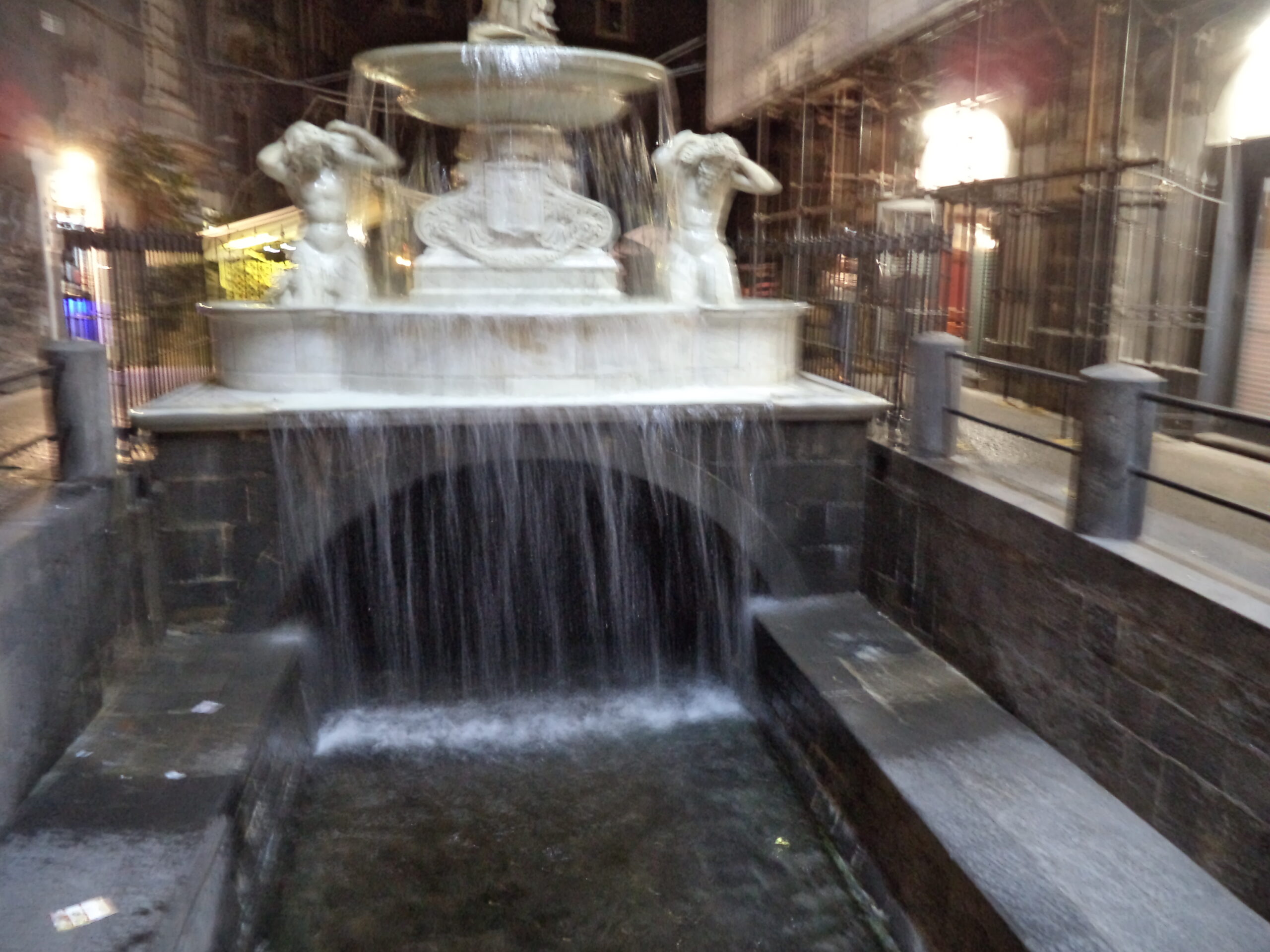
Evening view across Piazza dell Duomo, the main square of Catania. The historic buildings around the edges of the square are lit up in the semi-darkness.Good view of the Amenano Fountain (Fontana dell’Amenano) taken during the evening. The picture shows the lower part of the fountain. Two male figures carved in marble are depicted in a crouched position, they are in classical style, and represent Tritons or sea gods. Water flows over these figures from an upper bowl down into a larger bowl at the base and from here the water flows below street level into a channel along which the Amenano river flows. Today the Amenano river mostly flows underground, but a short section is visible here. The river (in size more like a stream) emerges from a stone arch.Tatiana stood at the base of a large lamp post located in Piazza dell Duomo during the evening. The pedestal of the lamp post is elaborately decorated with floral motifs and also dragons. One of these metal dragons can prominently be seen looking towards the camera with its wings open at the sides. The square is busy with people in the background.A slightly blurry view of Piazza dell Duomo in the evening. In the centre of the shot people are dancing in pairs. Around the edges people are standing and sitting watching the dancers. Historic buildings are lit-up in the background.
Ortigia, Syracuse
Syracuse is a city on the east coast of Sicily. It is the fourth most populous city in Sicily with a population of 115,636 in 2025. The city’s history stretches back to ancient times. It is the birthplace of the mathematician Archimedes, who led its defence during the Roman siege in 212 BC. For centuries, it served as the capital of Sicily, until the Muslim invasion of 878, which led to its decline in favour of Palermo. The city was made a UNESCO World Heritage Site in 2005.
Ortigia is a small island on which the historical centre of the city of Syracuse is located. The island is separated from the mainland by a narrow channel. Two bridges provide access.
Thursday, 13th September 2018
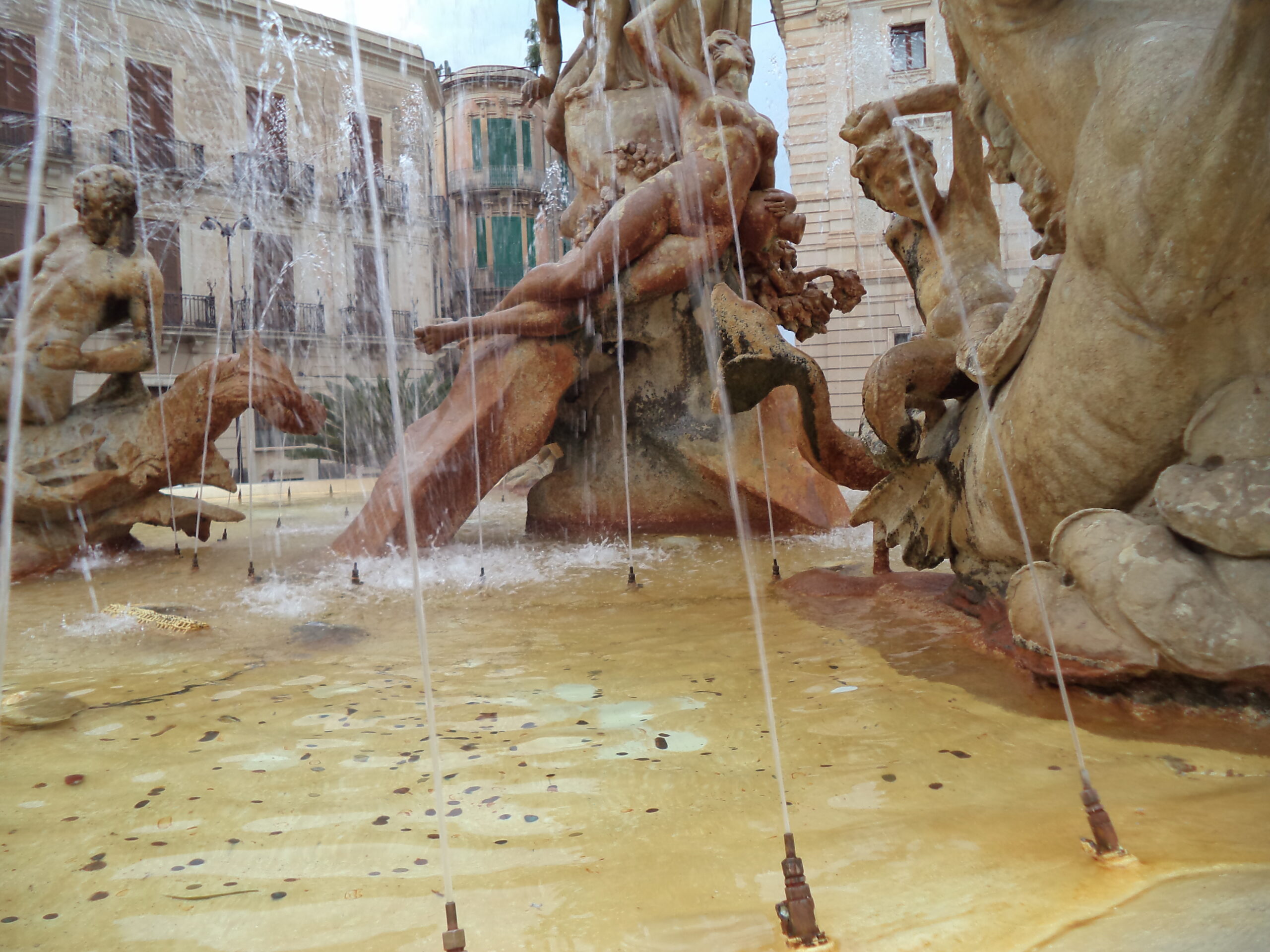
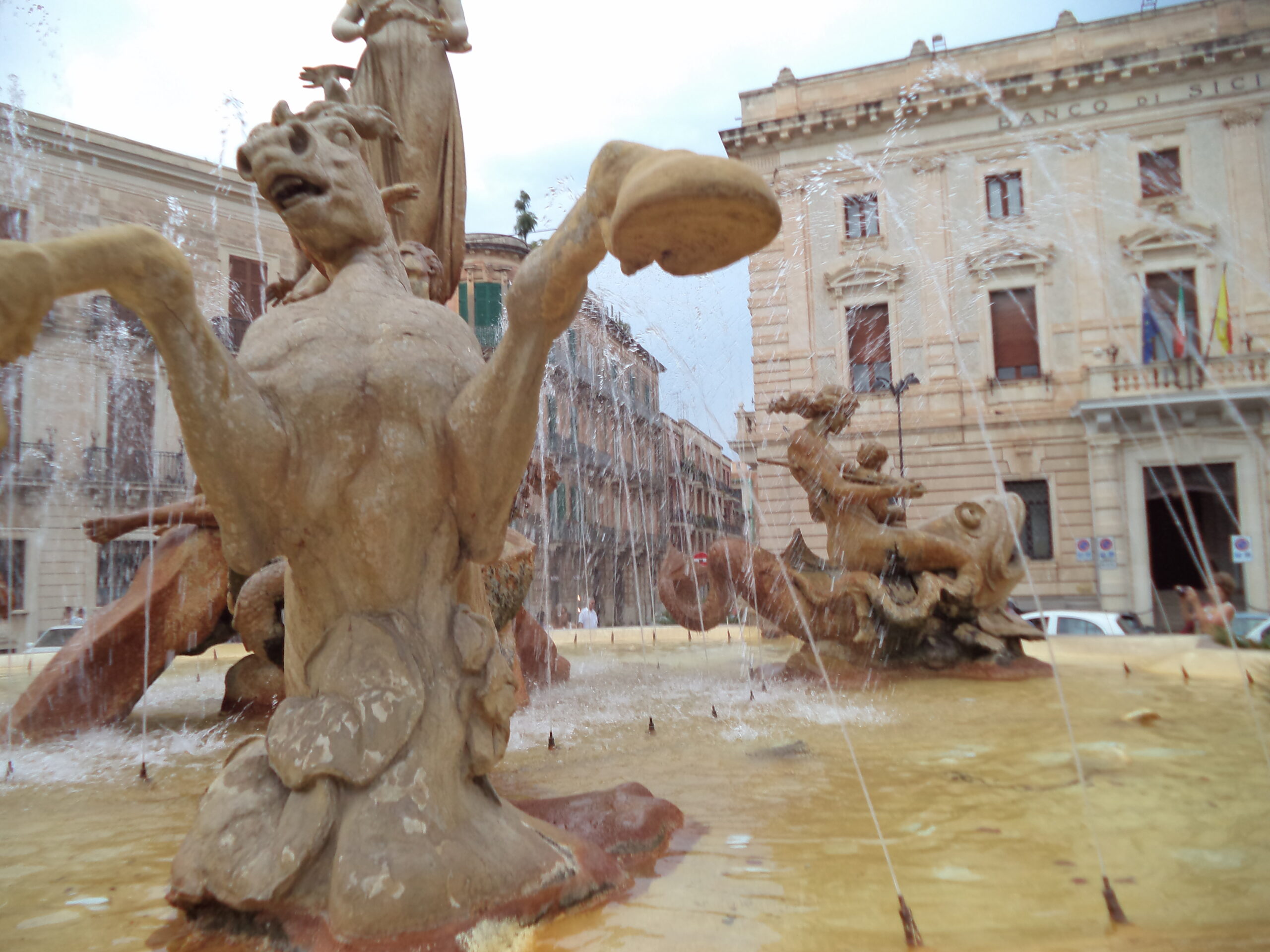
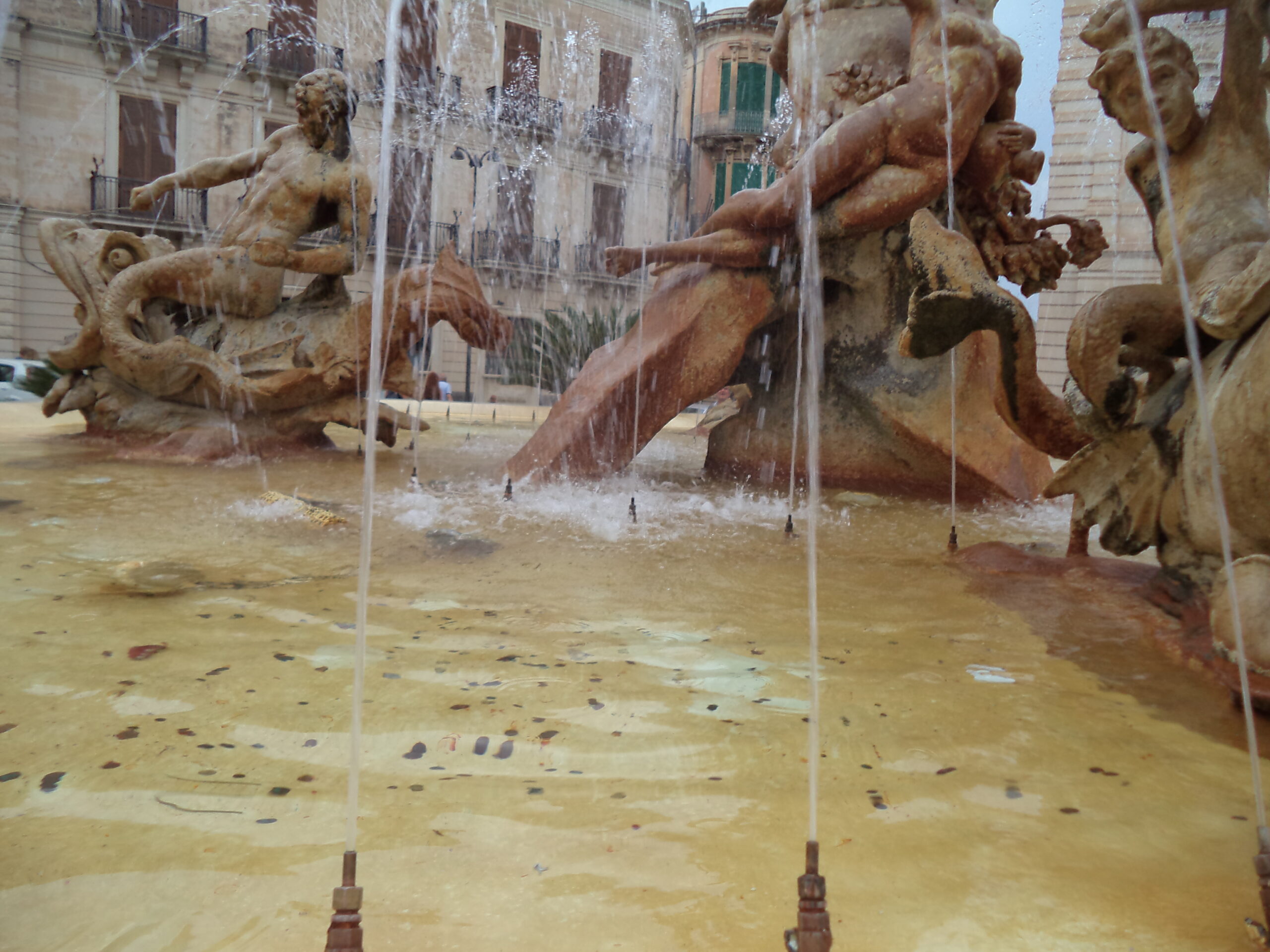
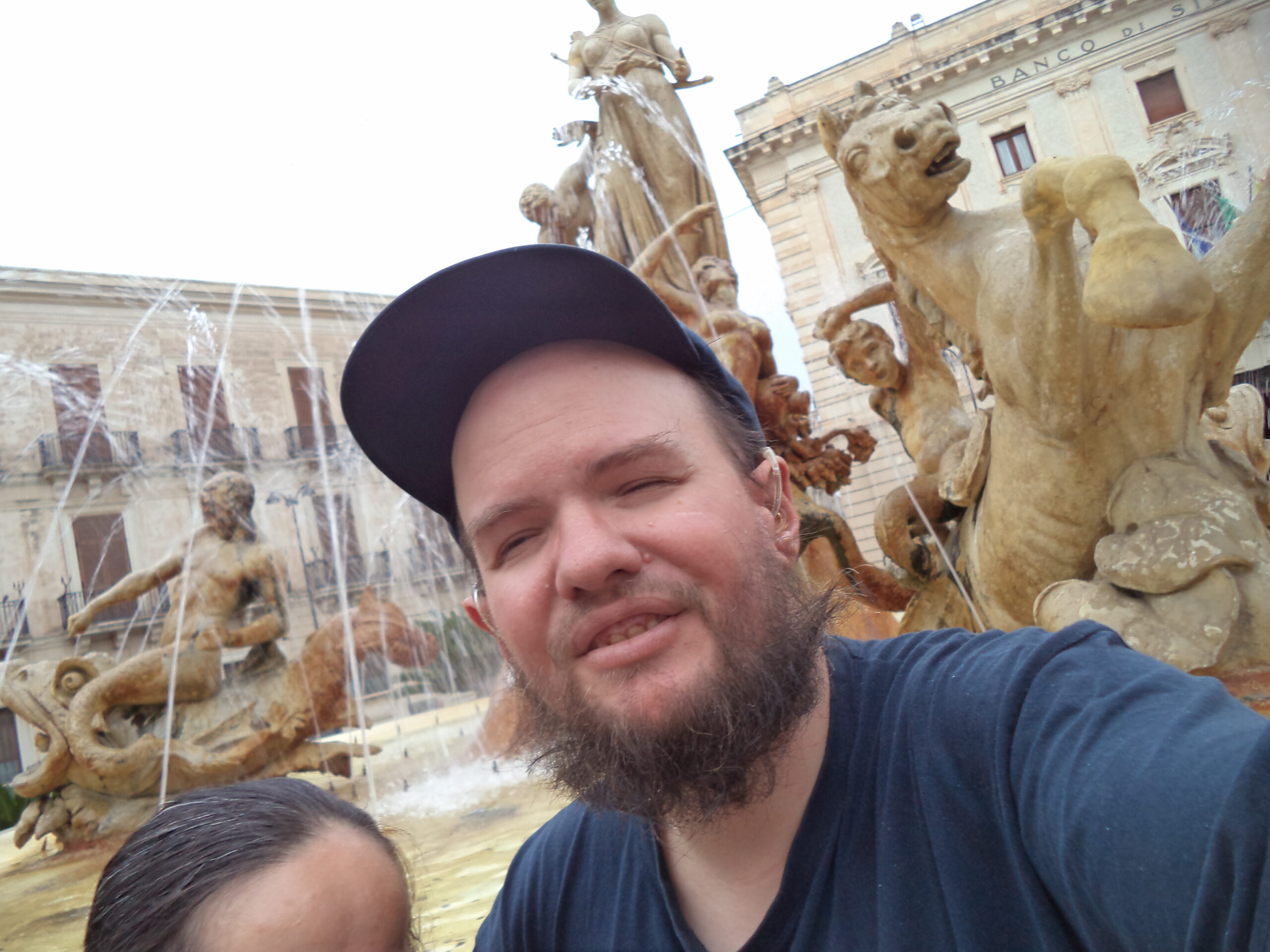
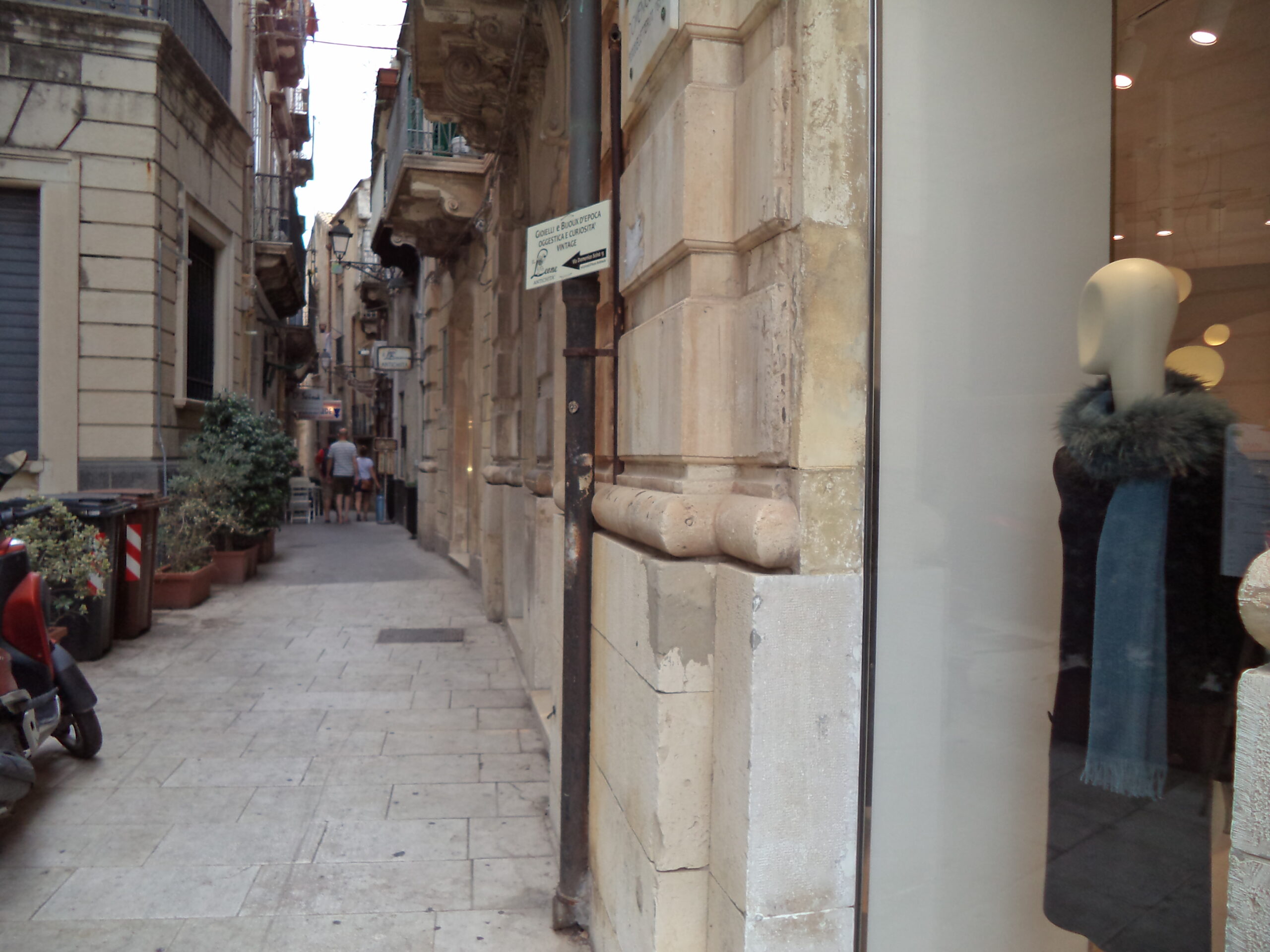
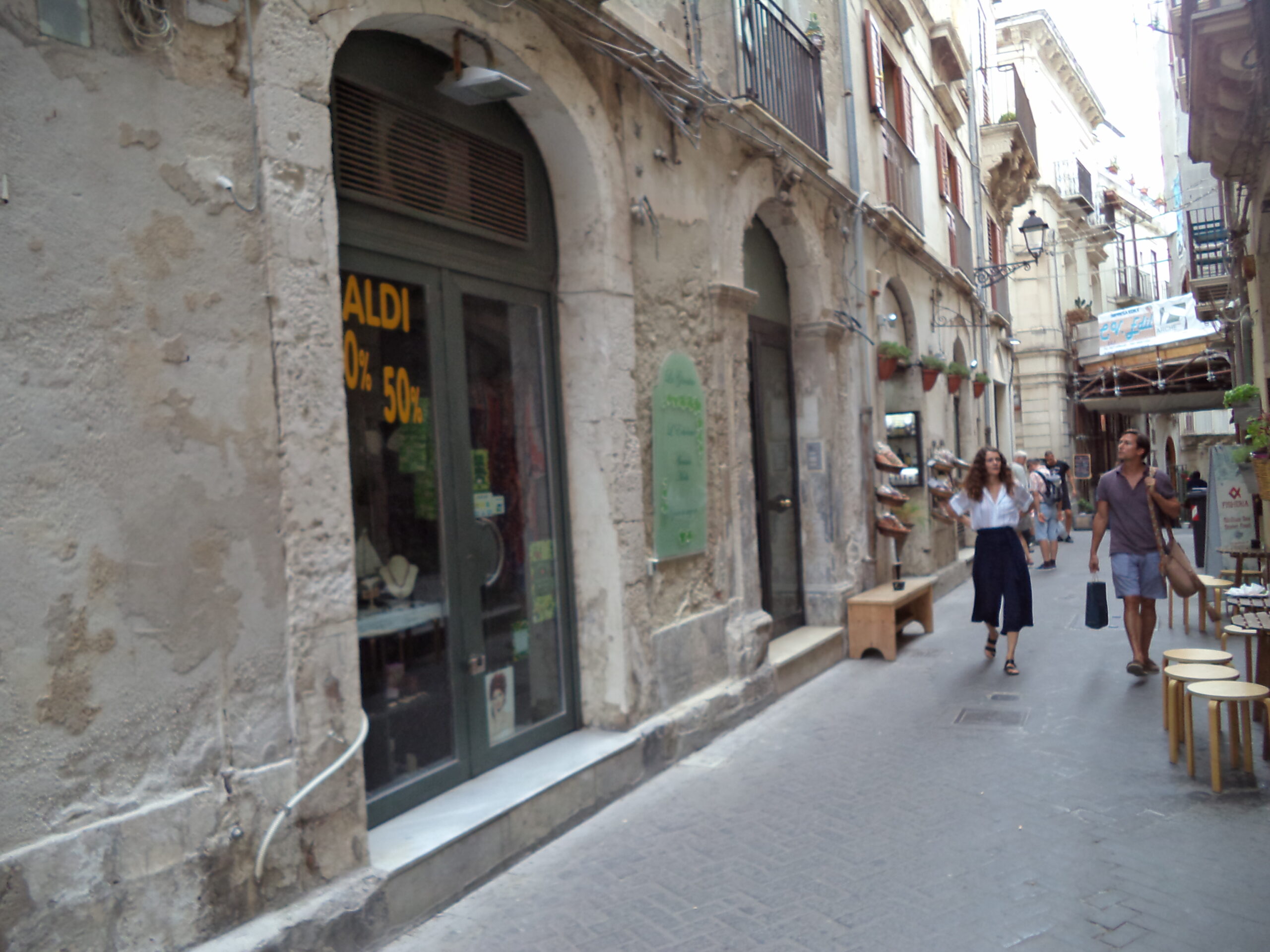
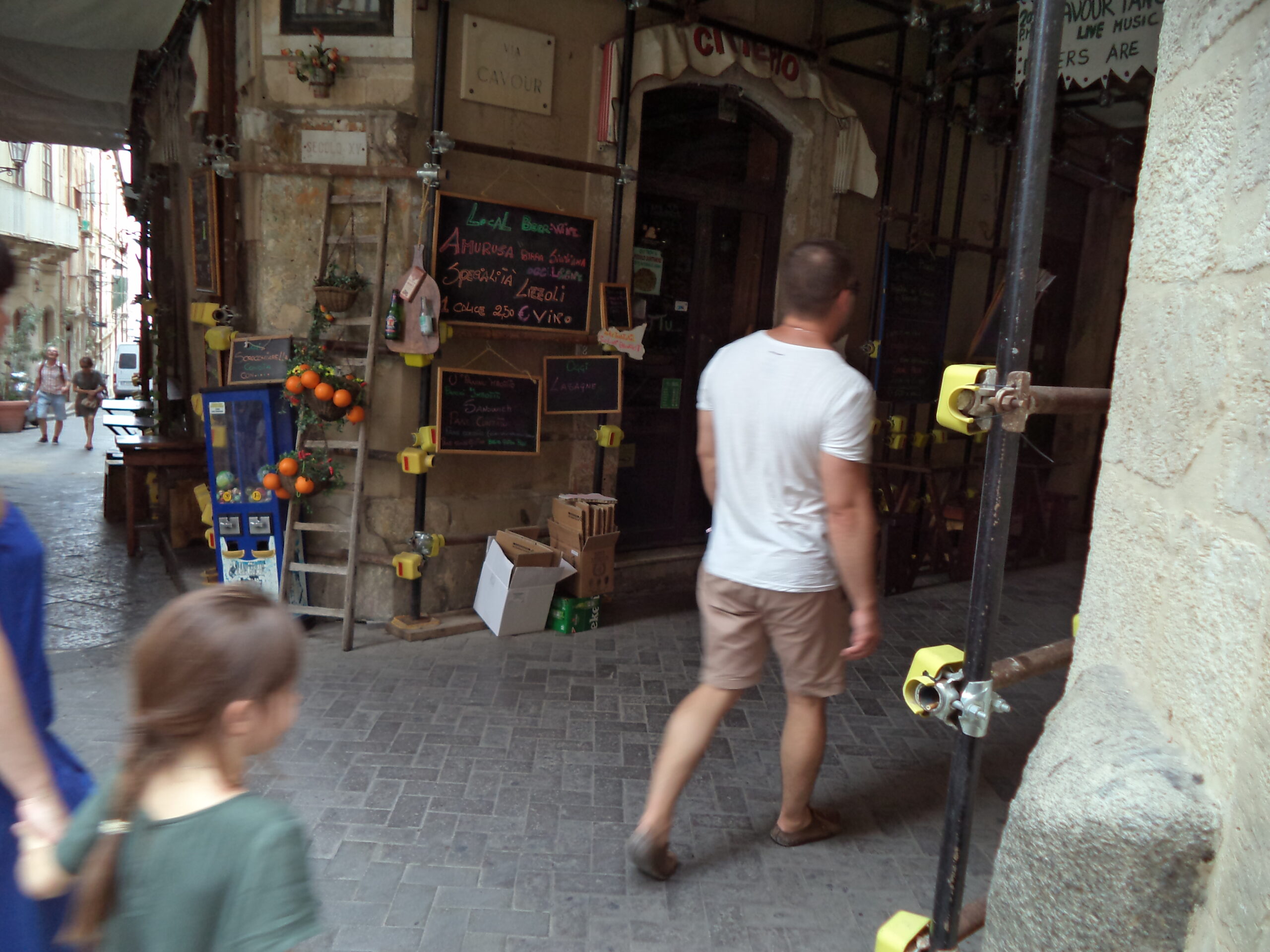
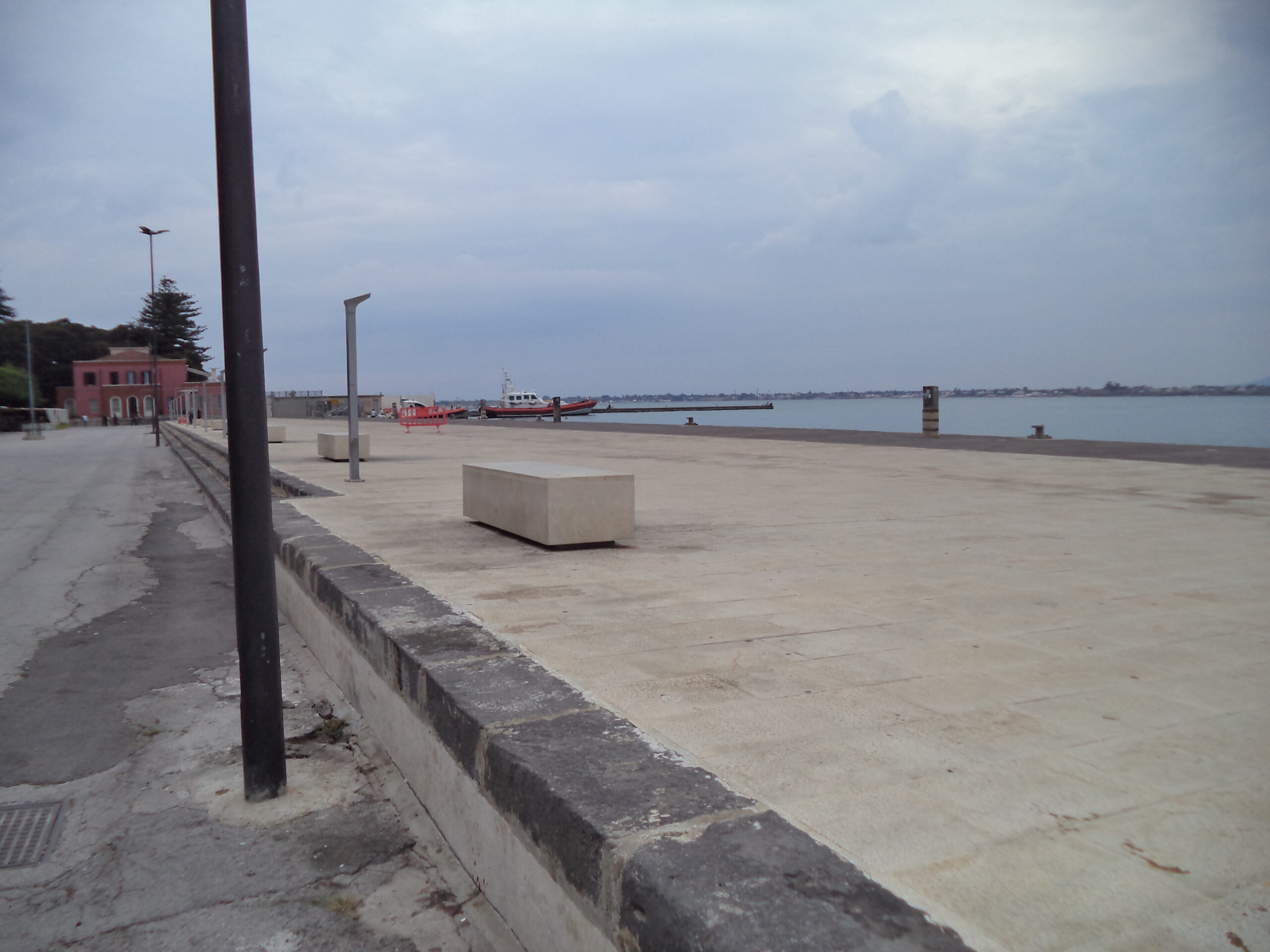
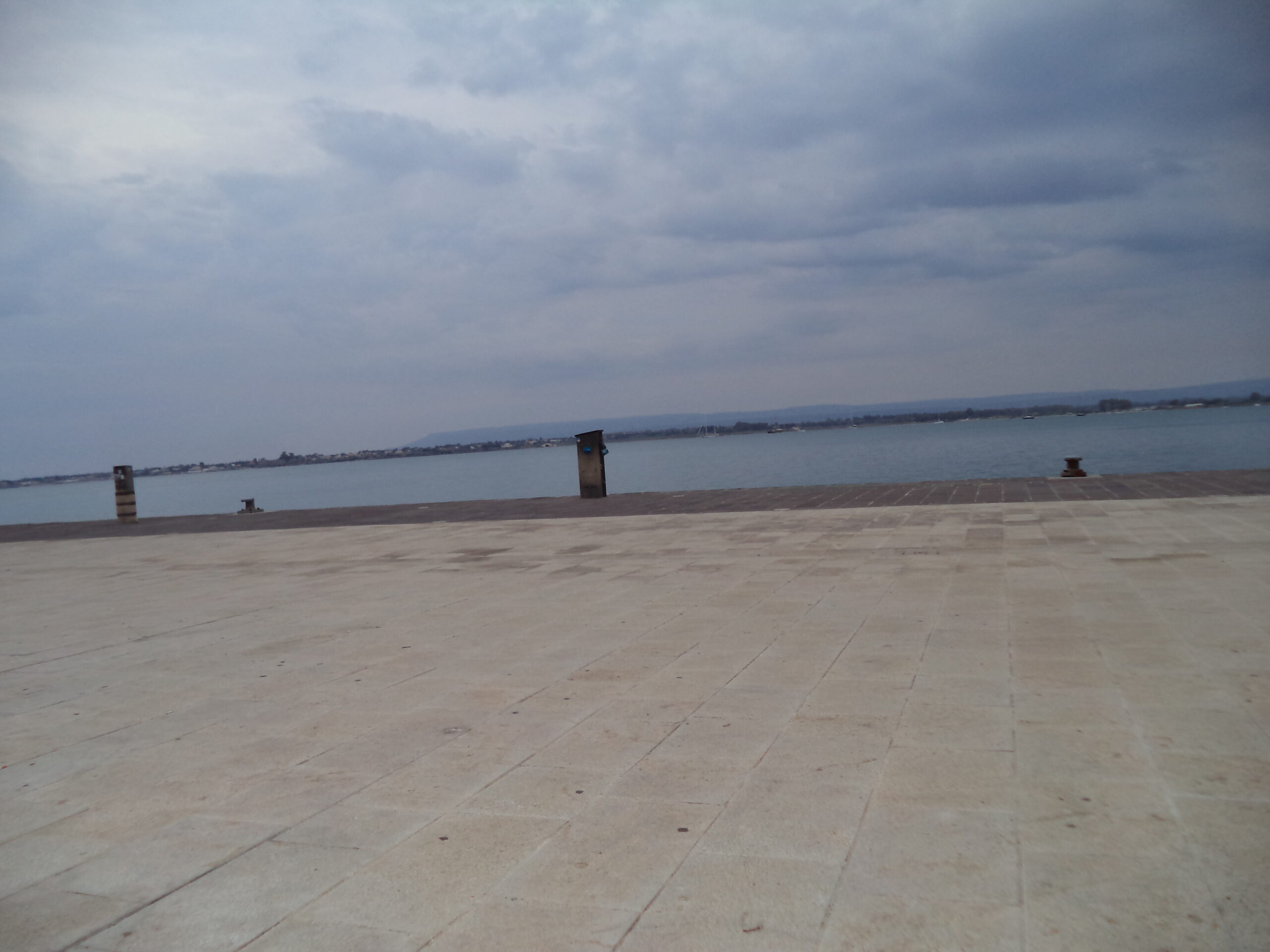
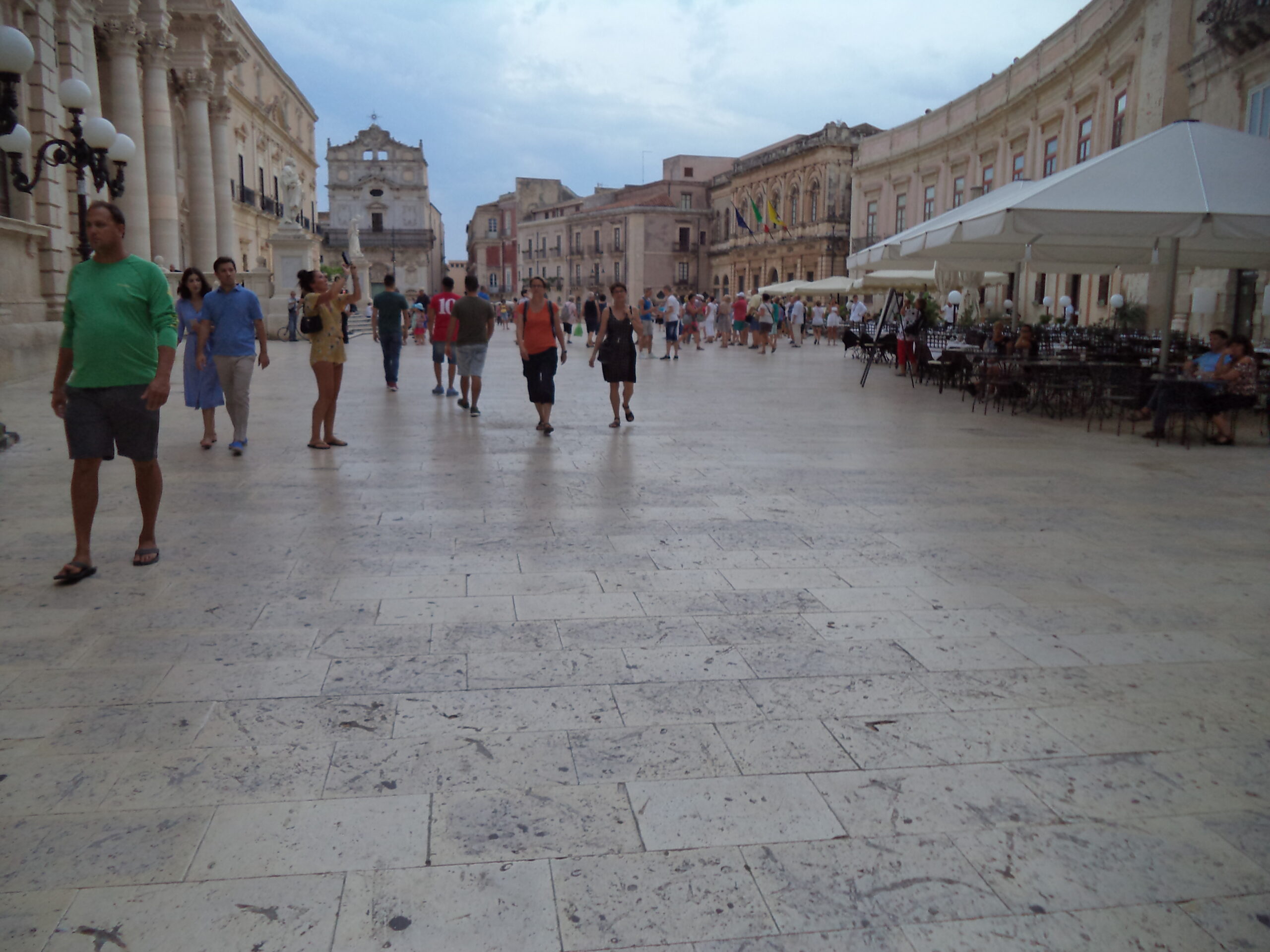
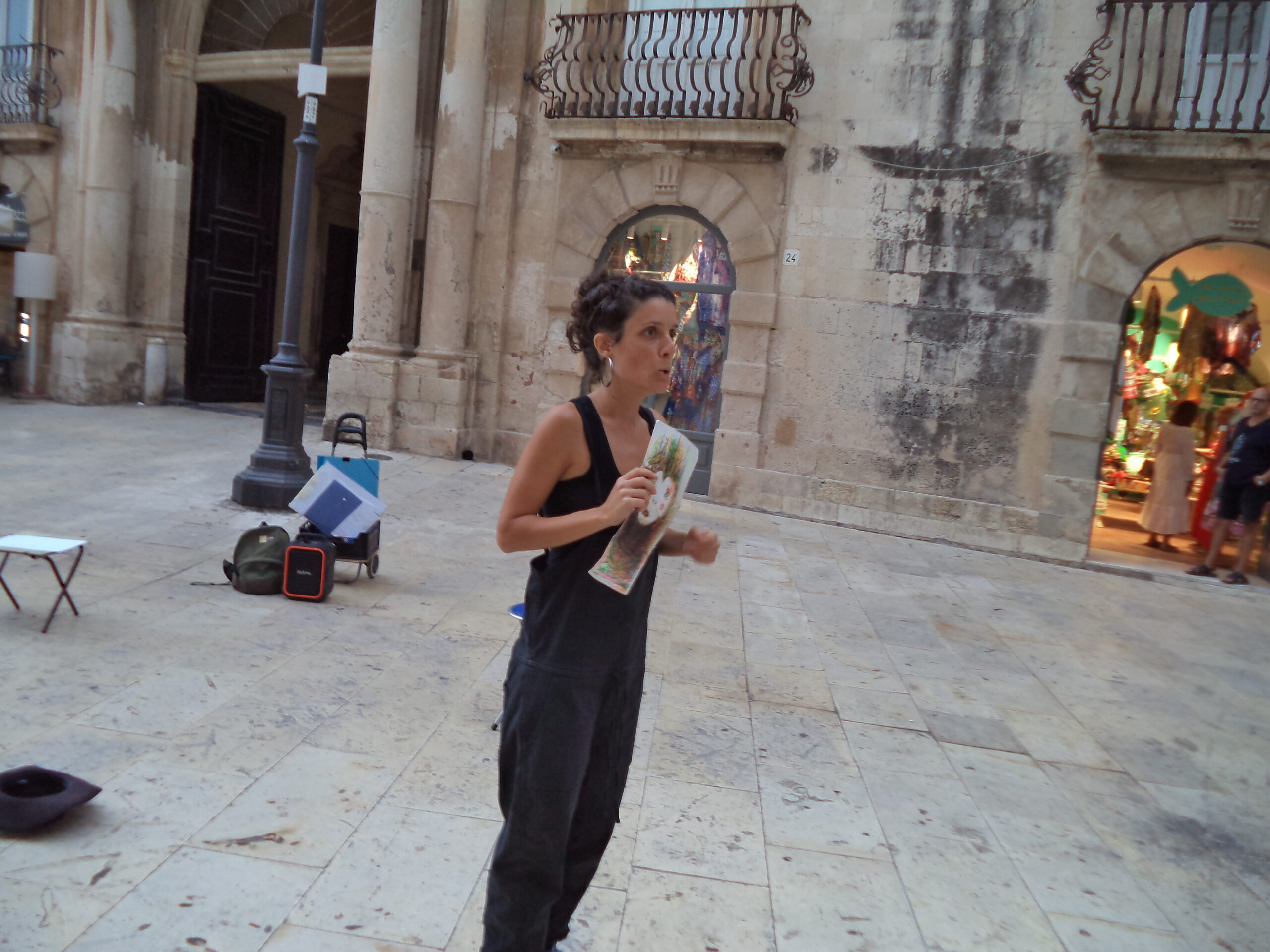
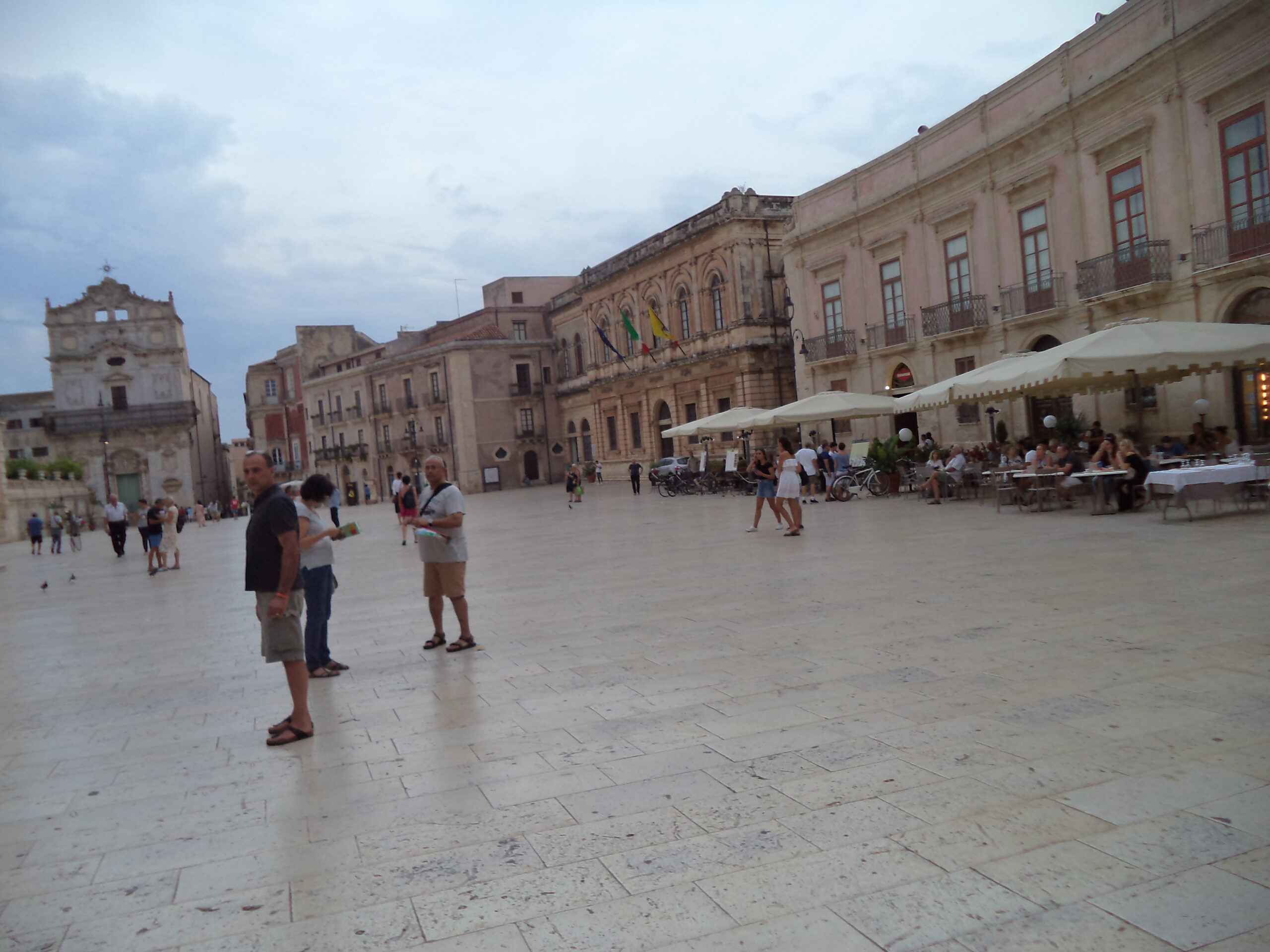
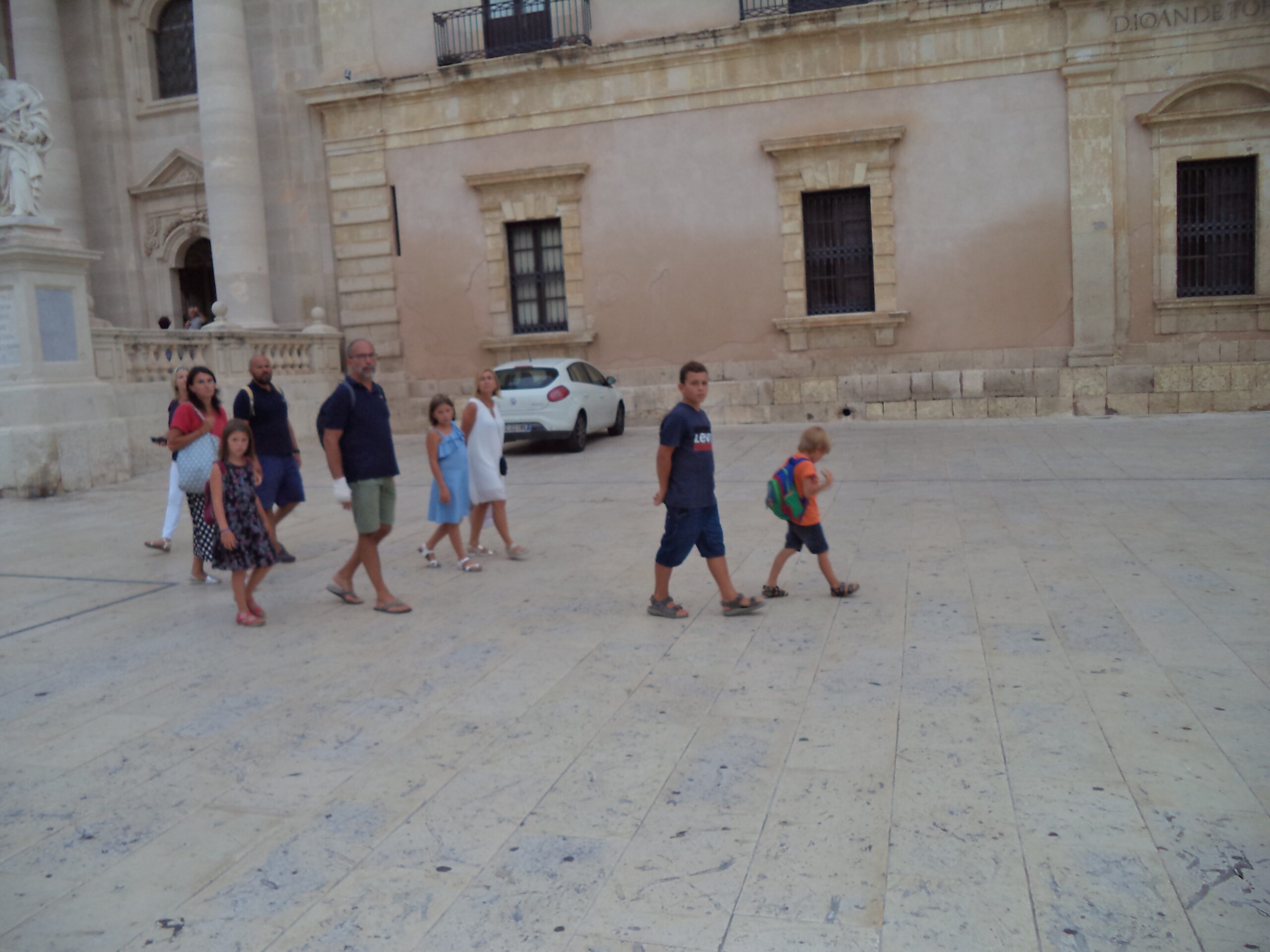
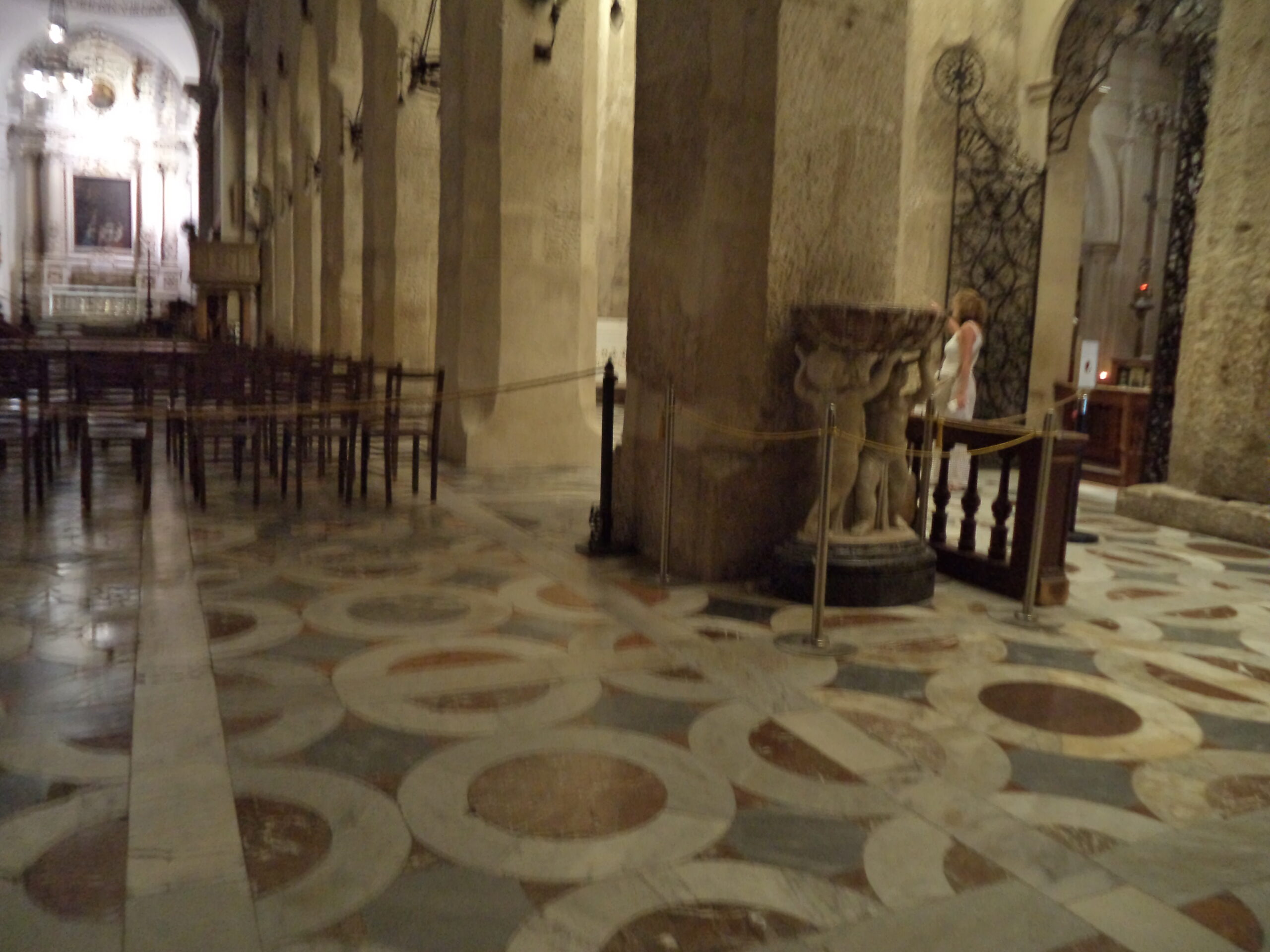
The Fountain of Diana in the centre of Piazza Archimede. This large fountain was designed by Giulio Moschetti in 1907. It pays homage to the goddess Diana (Artemis in Greek mythology). She is goddess of the countryside and nature, hunters, wildlife, childbirth, crossroads, the night, and the Moon. Diana is depicted atop a pedestrial in the centre of the fountain: only the pedestal is visible in this photo. Around Diana various other mythical figures are depicted with some of them riding on horses or sea monsters. These other figures include Arethusa and Alpheus. To the right a Triton can be seen riding a sea horse.Another view of the atmospheric Fountain of Diana in Piazza Archimede. In the foreground a sea horse is depicted, its front legs rearing up out of the water. Further back to the right, a nude female figure holding a baby is carved sitting on top of a giant fish.The Fountain of Diana. There is a large circular pool with jets of water spraying upwards. A Triton riding a sea horse is visible to the right and to the left another Triton is riding a sea monster. The Triton is depicted as a merman, with the upper body of a human, and the tailed lower body of a fish. In the centre is a pedestal with a statue of Diana out of view at the top.Tony and Tatiana in front of the Fountain of Diana. Only the top of Tatiana’s head is in view. In the background most of the statue of Diana (or Artemis) can be seen on top of the central pedestal. Diana is carved holding a bow and arrow.A narrow side-street on Ortigia, the historic centre of Syracuse. A mannikin can be seen in a clothes shop window in the foreground. Many of the buildings house shops and small businesses at street level. There are narrow stone balconies on the upper storeys.A narrow side-street on Ortigia, the historic centre of Syracuse. A mannikin can be seen in a clothes shop window in the foreground. Many of the buildings house shops and small businesses at street level. There are narrow stone balconies on the upper storeys.At the junction of two narrow streets in Ortigia. A family are passing by in front. To the right the street is covered by scaffolding. There is a cafe or bar in the building ahead. There are chalkboards advertising offers or specialities. An old wooden ladder is decoratively placed against a wall with baskets attached.Sea front promenade on Ortigia. The wide promenade is paved with slabs. At the far end is a red painted building. A pair of small boats are moored nearby. The sea appears calm. The coast south of Syracuse can be seen spread-out in the distance.Another shot from the wide, empty seafront promenade. View across the bay located to the south-west of Ortigia.A street-side counter belonging to a café or restaurant. Stacks of plates and table mats sit on top. Food is visible through the glass front of the counter including a burger and a pineapple. The lower part of the counter has black panels decorated with line-drawn food illustrations like cherries, fish and cupcakes.View across busy Piazza Duomo on Ortigia, the island that forms the historic centre of Syracuse. Syracuse Cathedral (Duomo di Siracusa) is the building with Corinthian columns partially visible to the left. This High Sicilian Baroque façade dates from 1725 to 1753 and was designed by Andrea Palma. The cathedral was rebuilt after the major earthquake in 1693. Another Baroque church is more clearly visible straight ahead at the south end of the square. This is the Church of Santa Lucia alla Badia. A church and monastery has existed here since at least the mid-15th century. The present church was completed in 1703 following the 1693 earthquake. The building is today deconsecrated and is used for special exhibitions and functions.A young woman standing in Piazza Duomo. She is holding a drawing and appears to be some sort of street artist or performer. There is a folding stool and a black hat on the ground behind her. An historic stone building can be seen in the background.Another view across Piazza Duomo. The Church of Santa Lucia alla Badia is again visible ahead. There are outdoor restaurant tables shaded by including grand residences or palazzi surround the square.Looking towards the east side of Piazza Duomo. A small part of Syracuse Cathedral can be seen to the left including a statue of St Peter standing on a plinth at the end of a stone balustrade. Corinthian columns can also be seen. A group of adults and children are passing by in front.Inside Syracuse Cathedral looking down the nave with the altar vaguely visible ahead. A row of substantial stone columns supporting Norman arches can be seen to the right of the nave. Further to the right side, a large elaborate wrought iron door leading into a side chapel can be seen. In front of the nearest large column is a stone font: two small children are sculpted holding up a large bowl. The marble floor forms a geometric pattern of circles and straight lines. There are rows of wooden chairs.
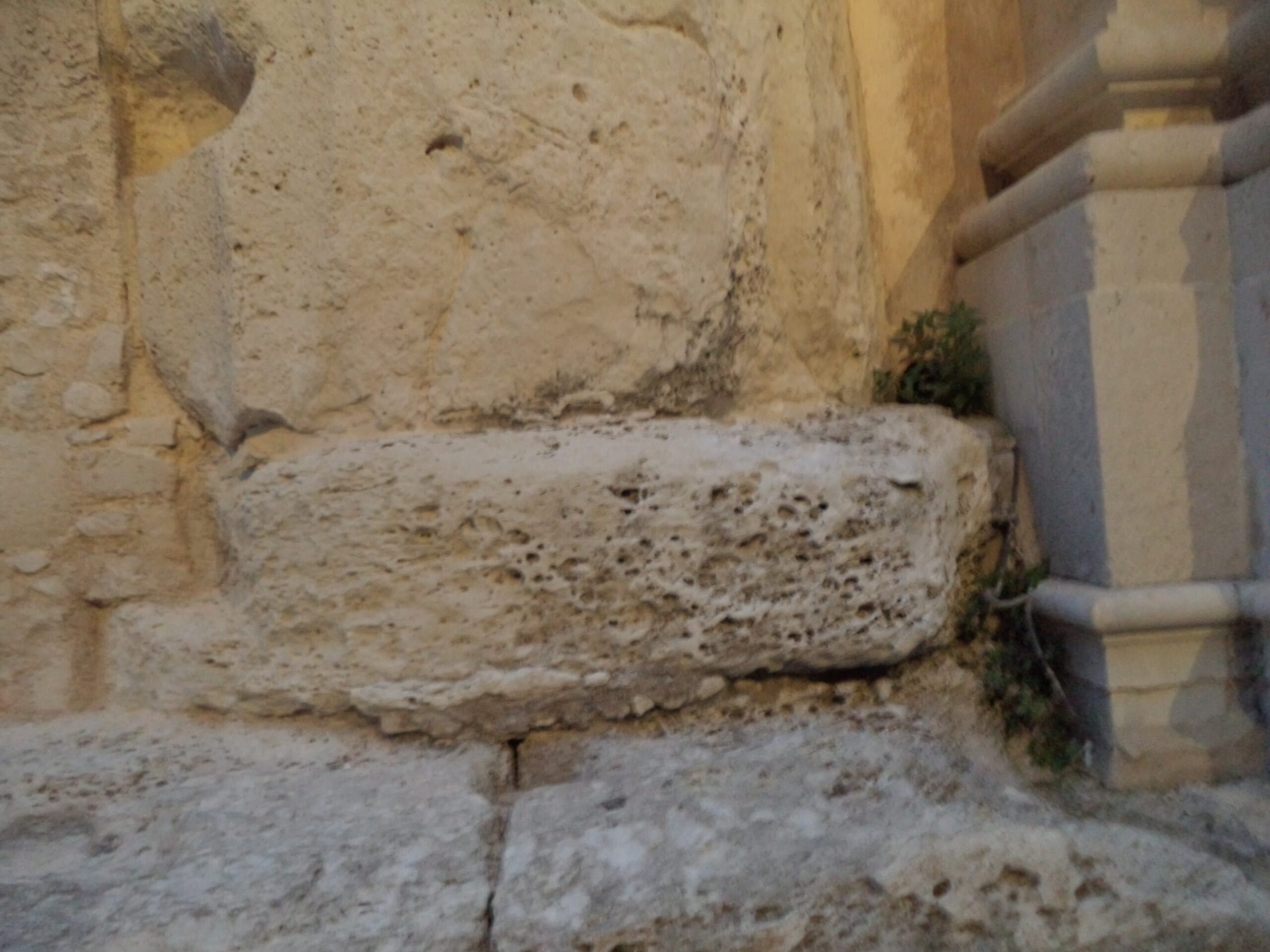
The structure on which Syracuse Cathedral is built was originally a Greek Doric temple dating back to the 6th century BC. The first church was constructed here by Saint Bishop Zosimo of Syracuse in the 7th century. The building was converted into a mosque in 878, and then made back into a church after Norman count Roger I of Sicily retook the city in 1086. The cathedral was rebuilt with a new façade following the severe earthquake of 1693.
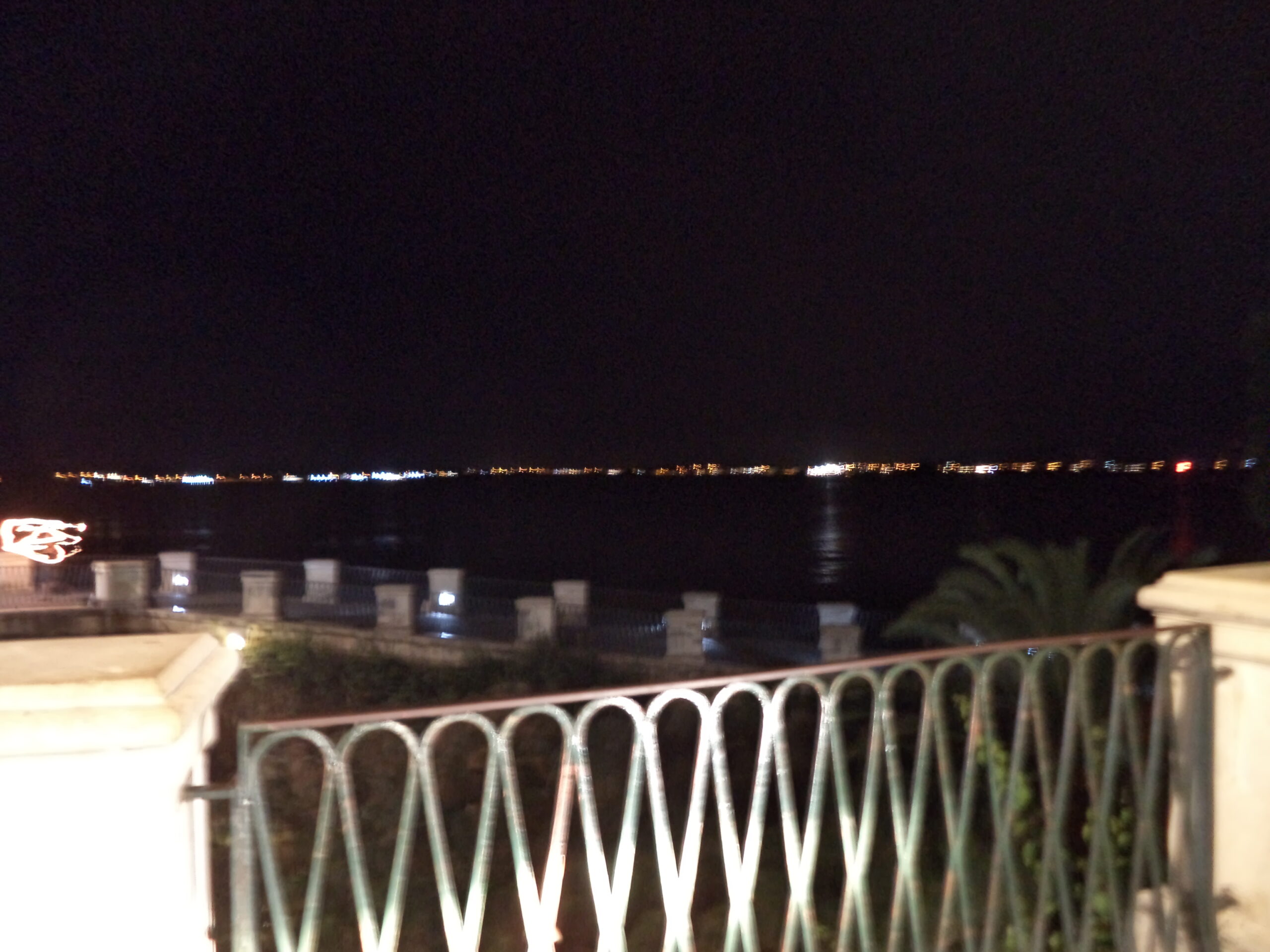
View of the bases of two massive worn and weathered stone columns inside Syracuse Cathedral. These likely date back to the Greek temple that once stood on this site.Looking up from the nave of Syracuse Cathedral. A row of tall Norman arches can be seen. Within the centre of each arch wrought-iron chandeliers hang. Statues can vaguely be seen along the adjoining side aisle.Large weathered pale stone blocks at the base of Syracuse Cathedral’s outside walls. A few small green plants are growing in a shaded corner. These blocks may originate from the Greek temple that once stood on this site.Night time sea view from Ortigia. A line of distant lights on the opposite side of the bay illuminate the horizon and reflect on the water which appears almost black in darkness. There is a terrace in the foreground with walls and railings.
Ragusa
Ragusa is a city built on a wide limestone hill between two deep valleys. It is the 6th-largest city in Sicily with a population of 73,778 in 2025. The city is part of a UNESCO World Heritage Site along with seven other cities in the Val di Noto region of south-eastern Sicily.
Saturday, 15th September 2018
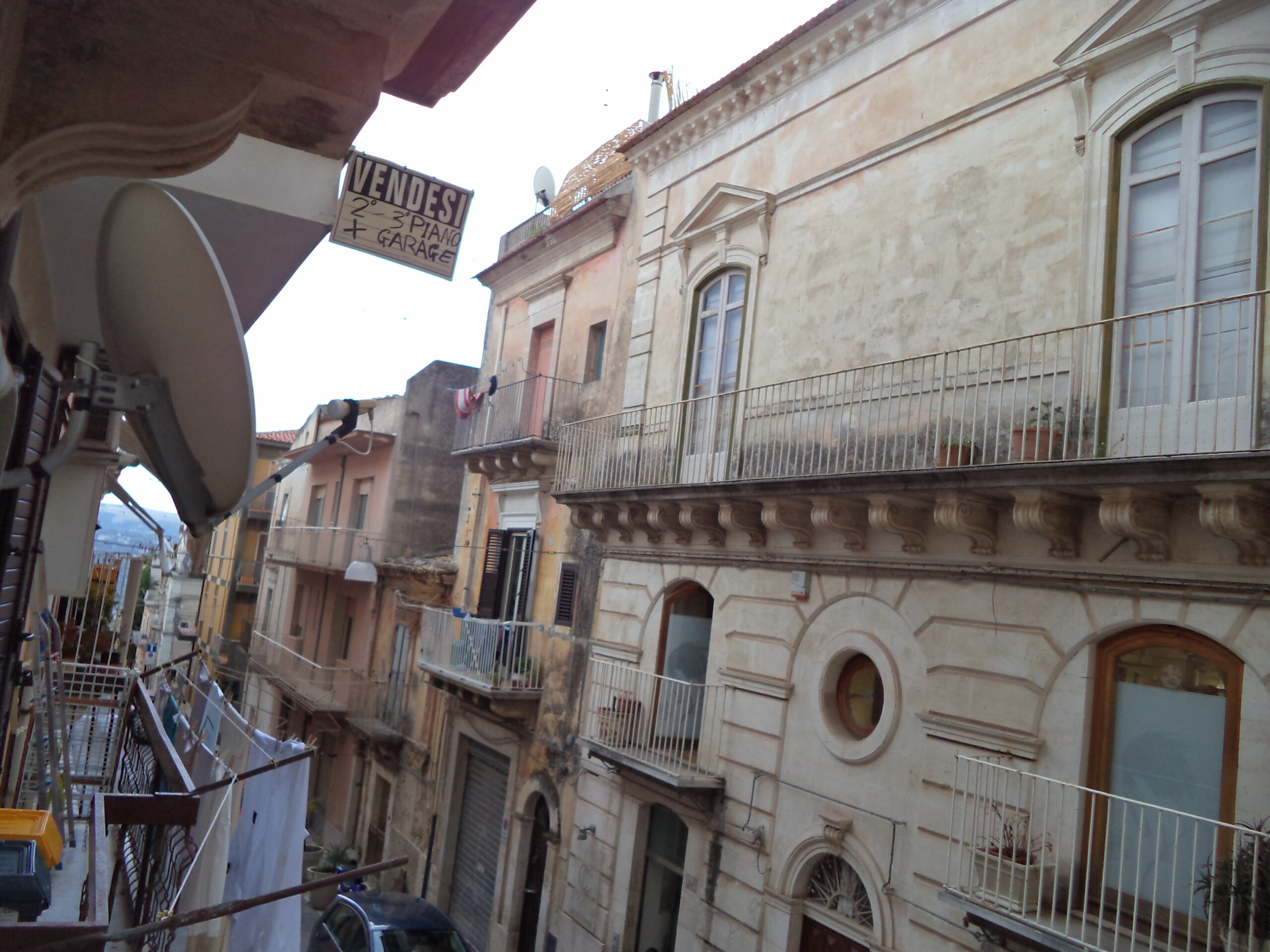
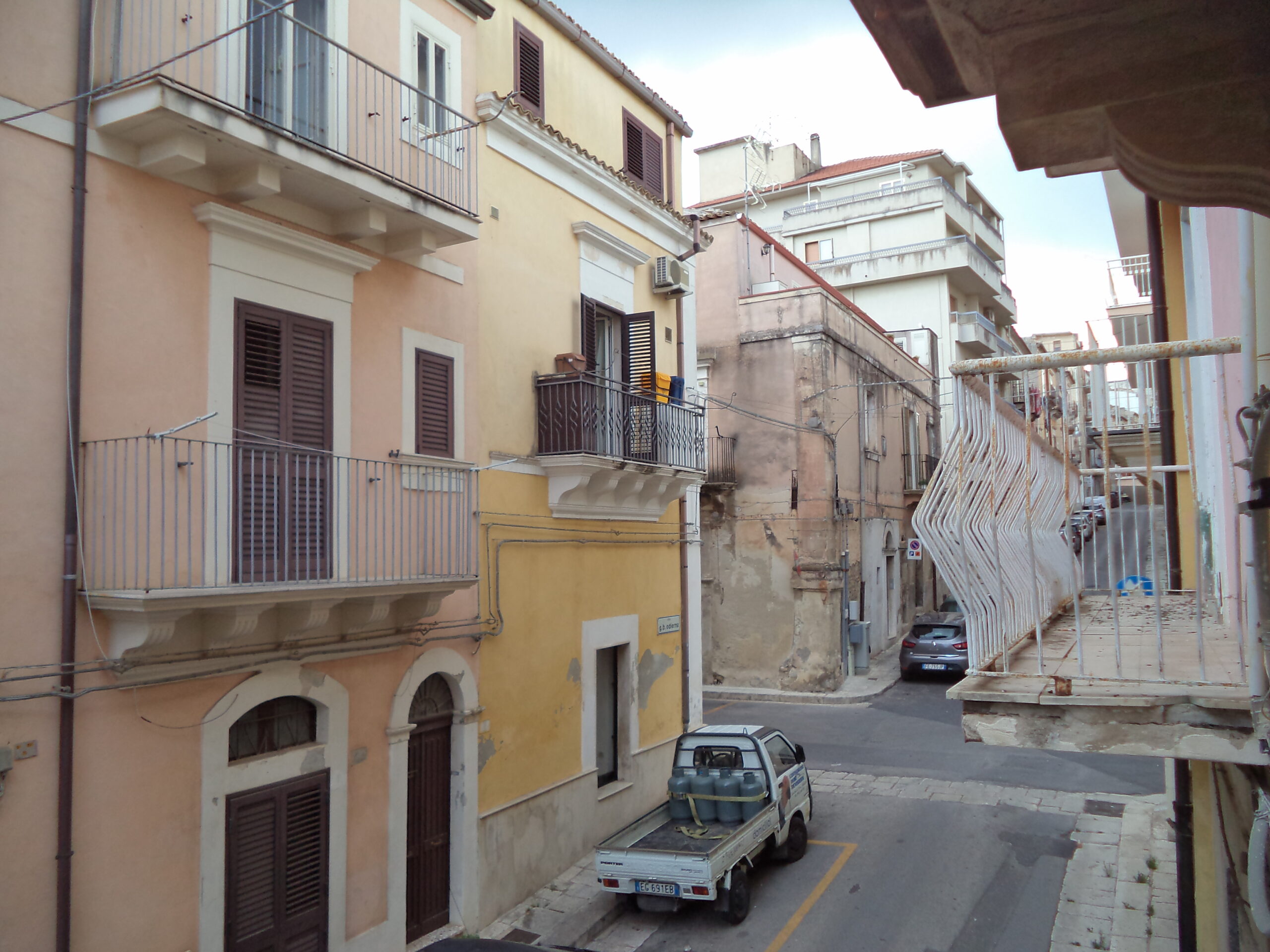
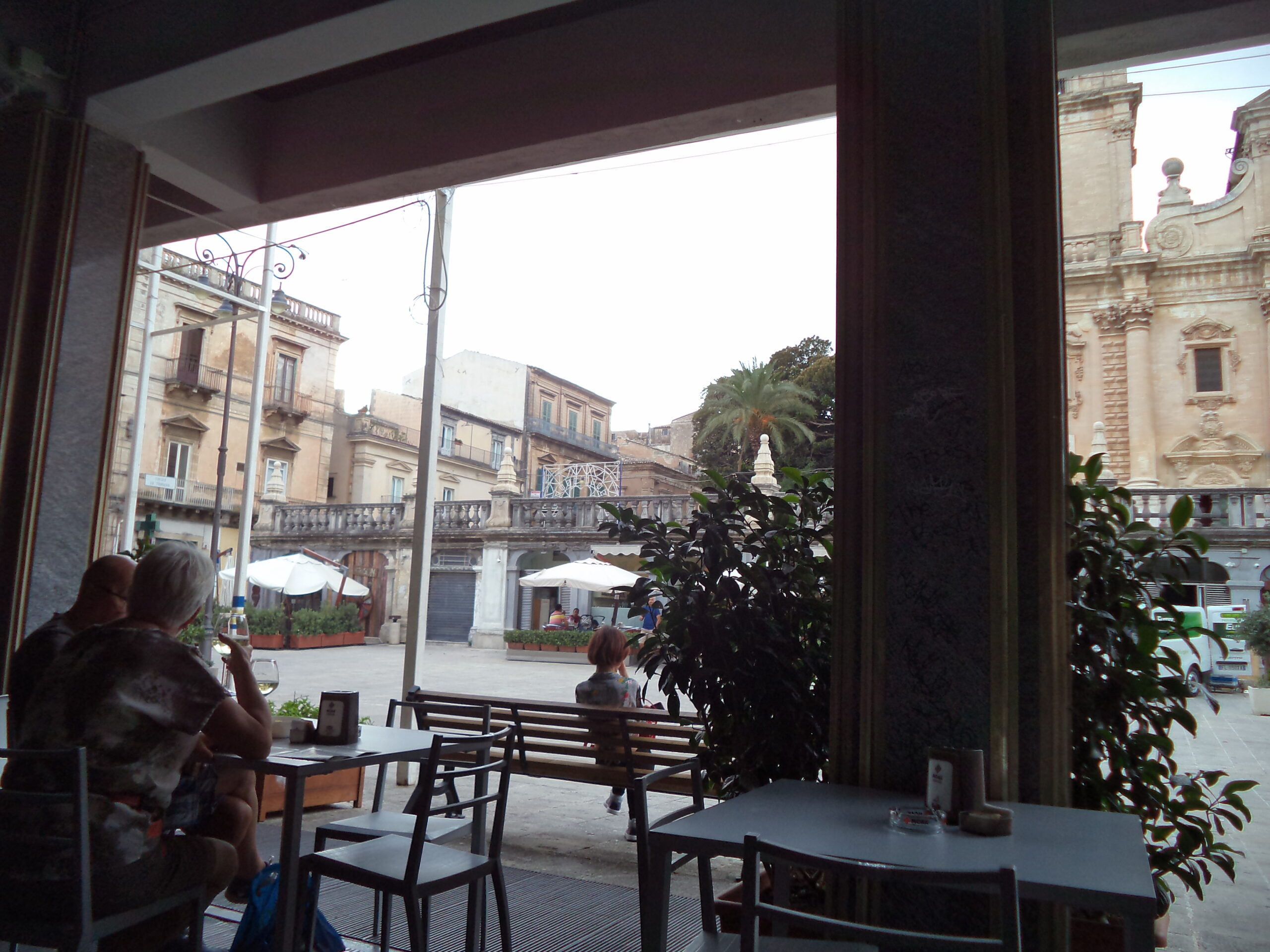
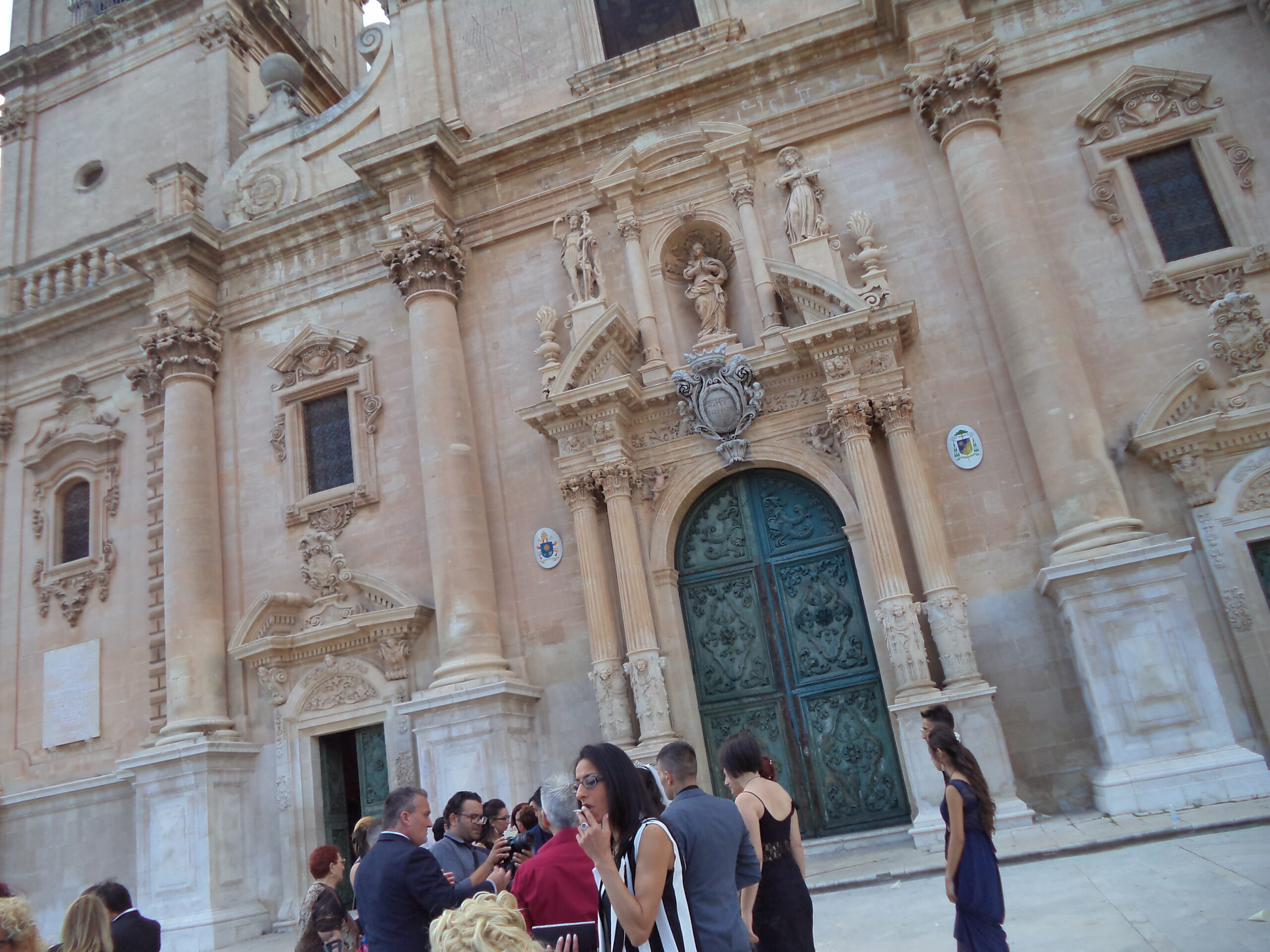
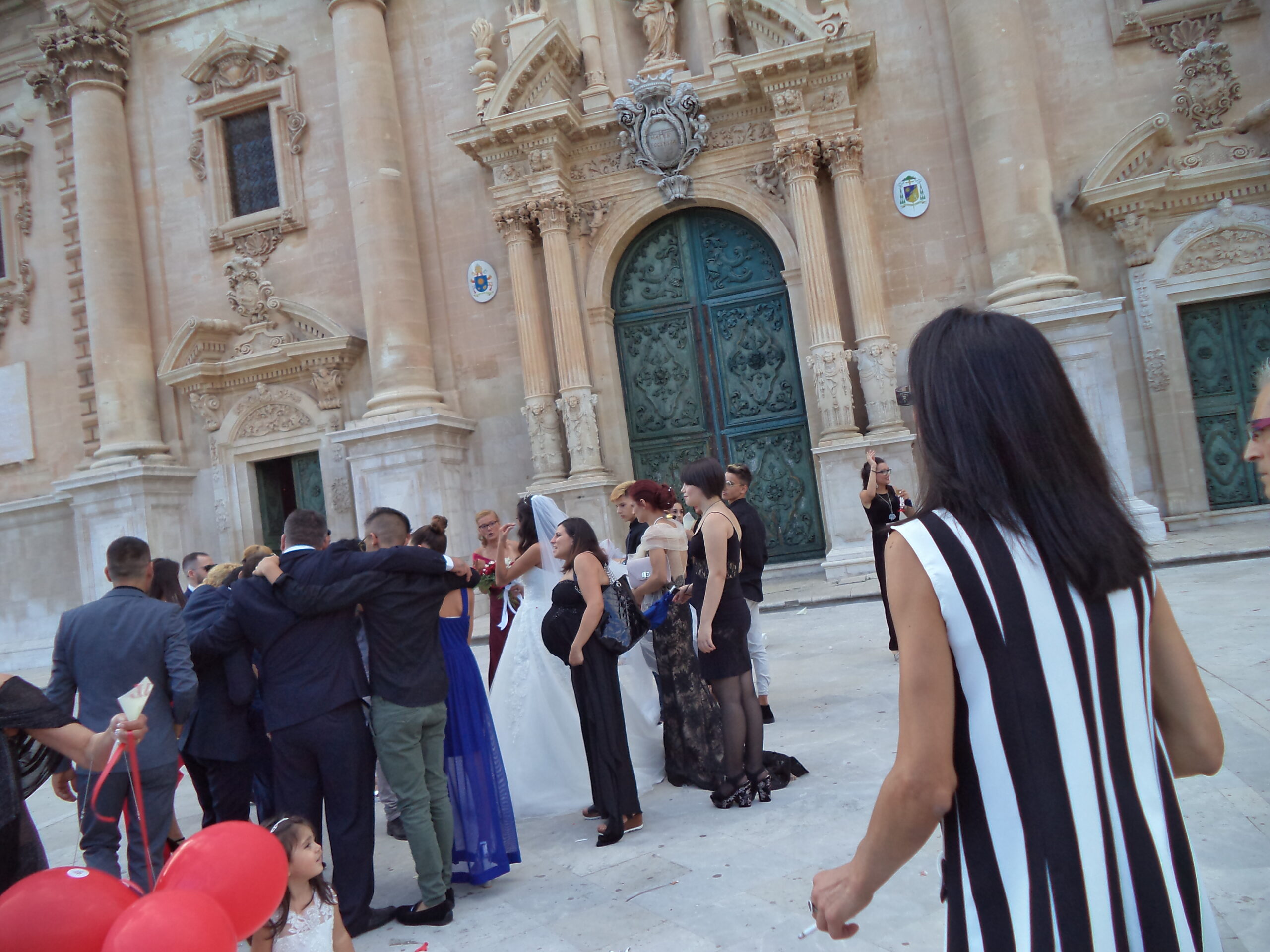
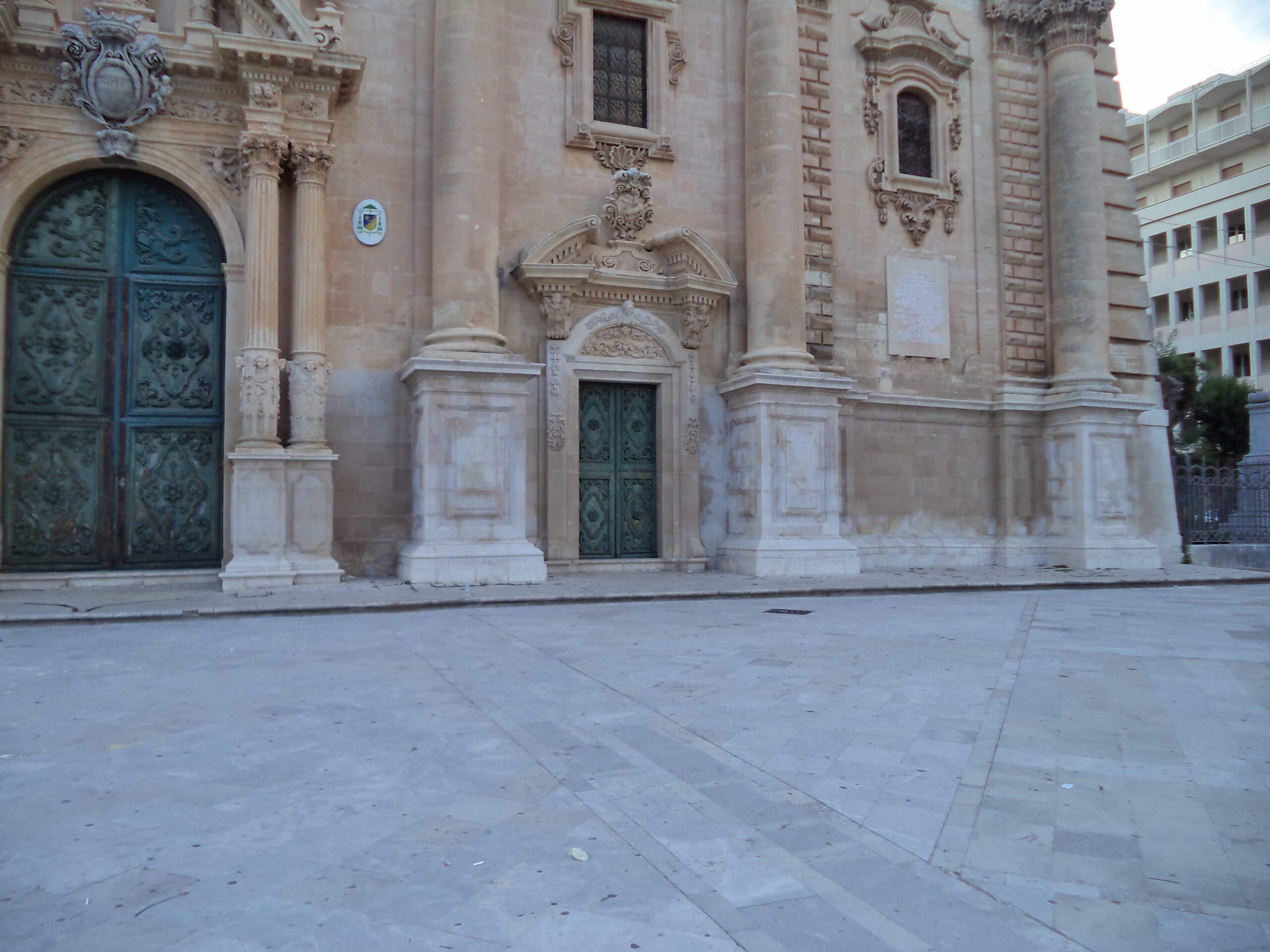
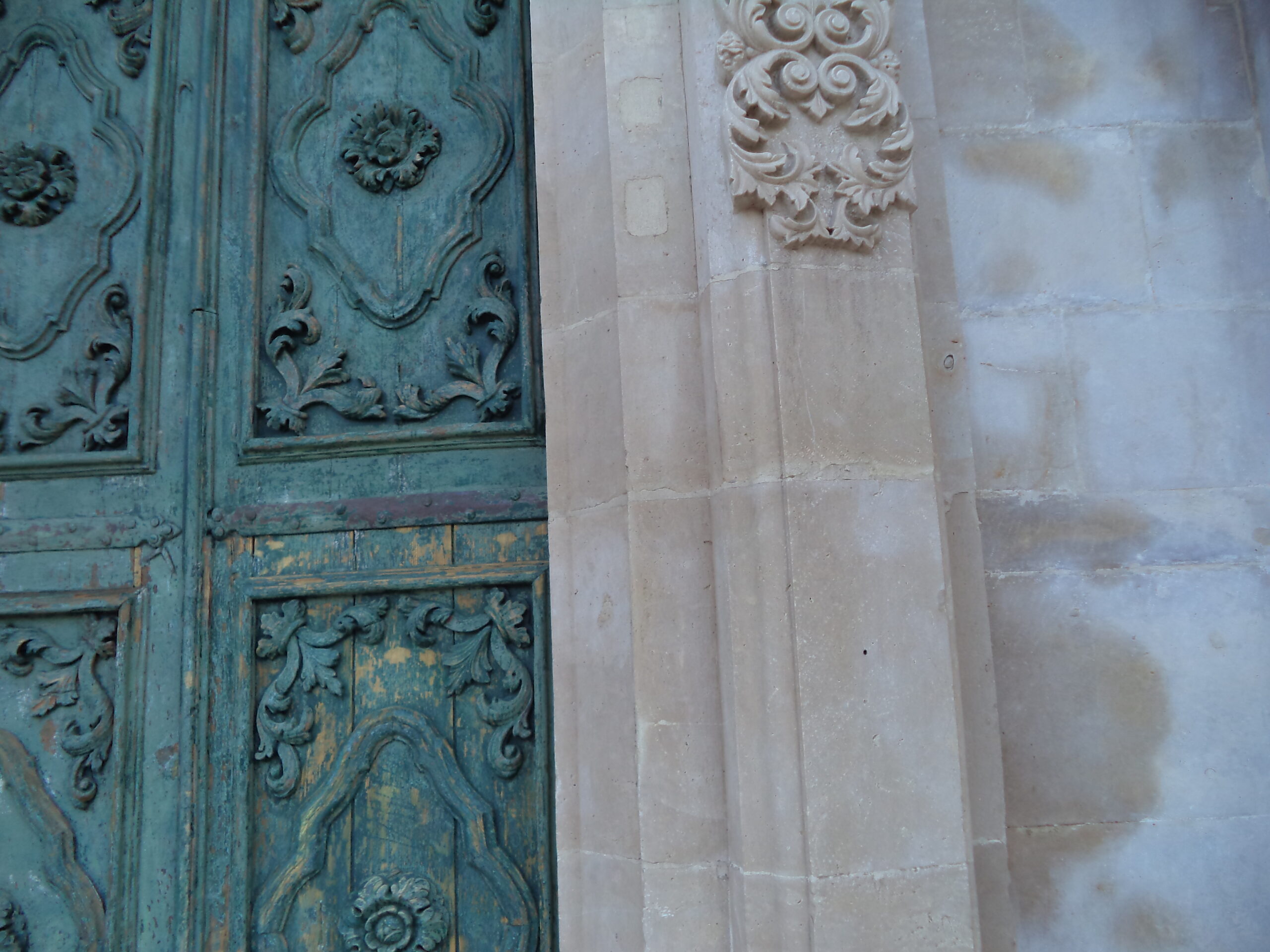
View from a balcony at the hotel where Tony and Tatiana stayed. Looking downhill along a fairly narrow residential street. The houses are mostly three storeys high and most have balconies. Washing is drying from some of the balconies.Looking the other way, uphill along the residential street from the hotel balcony. The balconies belonging to adjoining houses and apartments can be seen. The houses opposite are painted in pastel colours in yellow and pink. View from a cafe overlooking Piazza San Giovanni, a square sited in front of Ragusa Cathedral. The front of the cathedral is raised up on a terrace above and only a small part of the front façade is visible. People can be seen sitting on benches or at cafe tables in the square.The Baroque front façade of Ragusa Cathedral (also known as the Cathedral of San Giovanni Battista). The cathedral is dedicated to Saint John the Baptist and was constructed after the 1693 Sicily earthquake. An earlier church dedicated to John the Baptist at a different location was destroyed by the earthquake. The church became a cathedral in 1950. The photo shows the lower part of the façade including the large main doorway. The cathedral is elaborately decorated with Corinthian columns, statues and floral decoration around the windows. The arched main doorway has two Corinthian columns at each side and a carved motif or crest above with cherubs at the sides and a crown on top. Above this there is more carved stonework including three statues. In the foreground, a group of people are assembled, they are part of a wedding party.Another shot of Ragusa Cathedral with a wedding group assembled in the square in front. The bride can be seen dressed in a white gown with a veil. Other people are dressed formally in suits and dresses. Someone is holding red balloons in the foreground.The Baroque front façade of Ragusa Cathedral. The shot is looking towards the right side, showing the main doorway, and another smaller panels containing a curved geometric design. The doors are painted turquoise-green. The massive bases belonging to Corinthian columns jut out at ground level.Another view of Ragusa Cathedral’s side door. The door has four panels with a flower carved in the centre of each and leaf designs in the corners. Some of the carved stonework around the door can also be seen. This is again a curvy design resembling leaves.