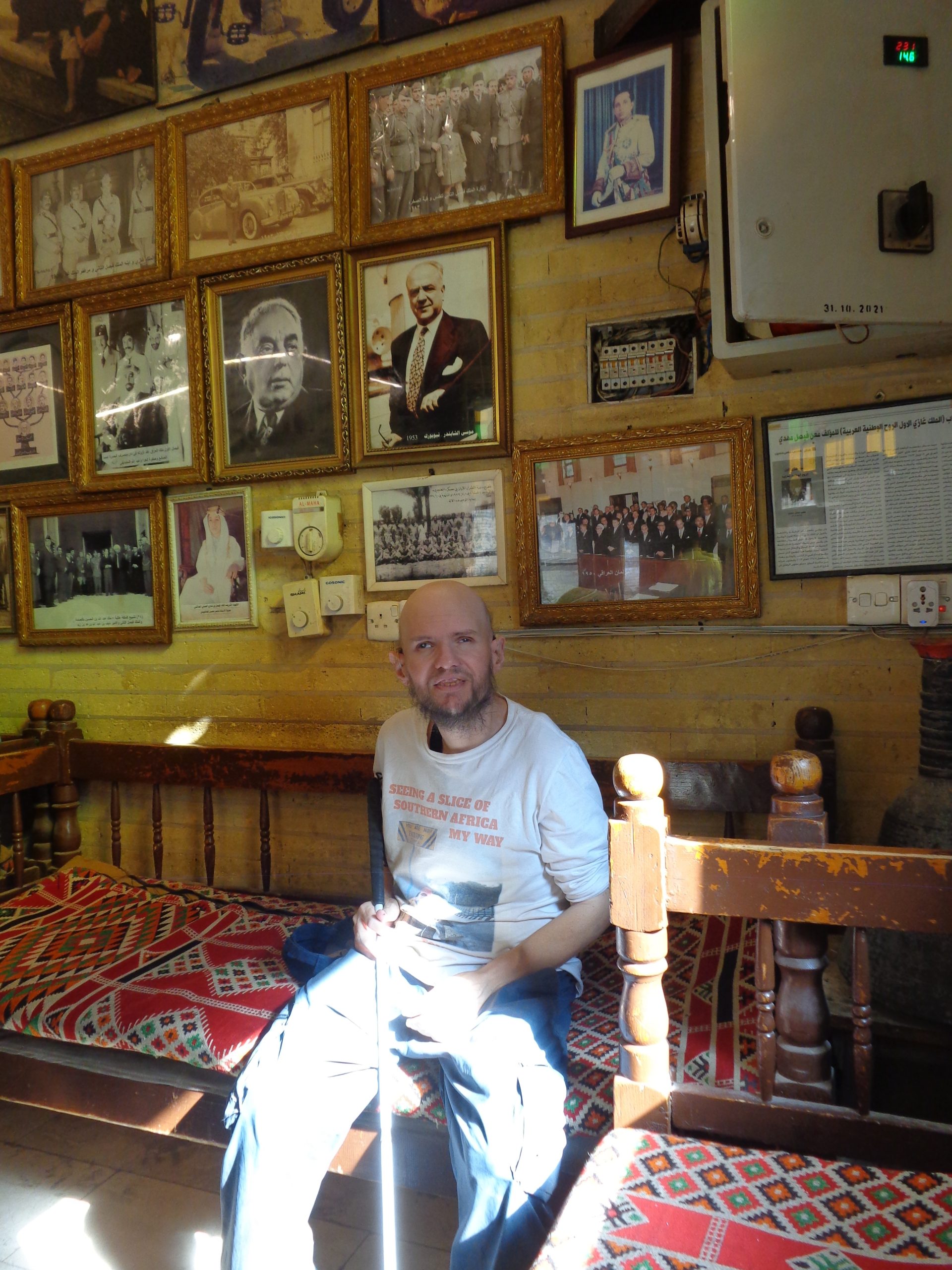
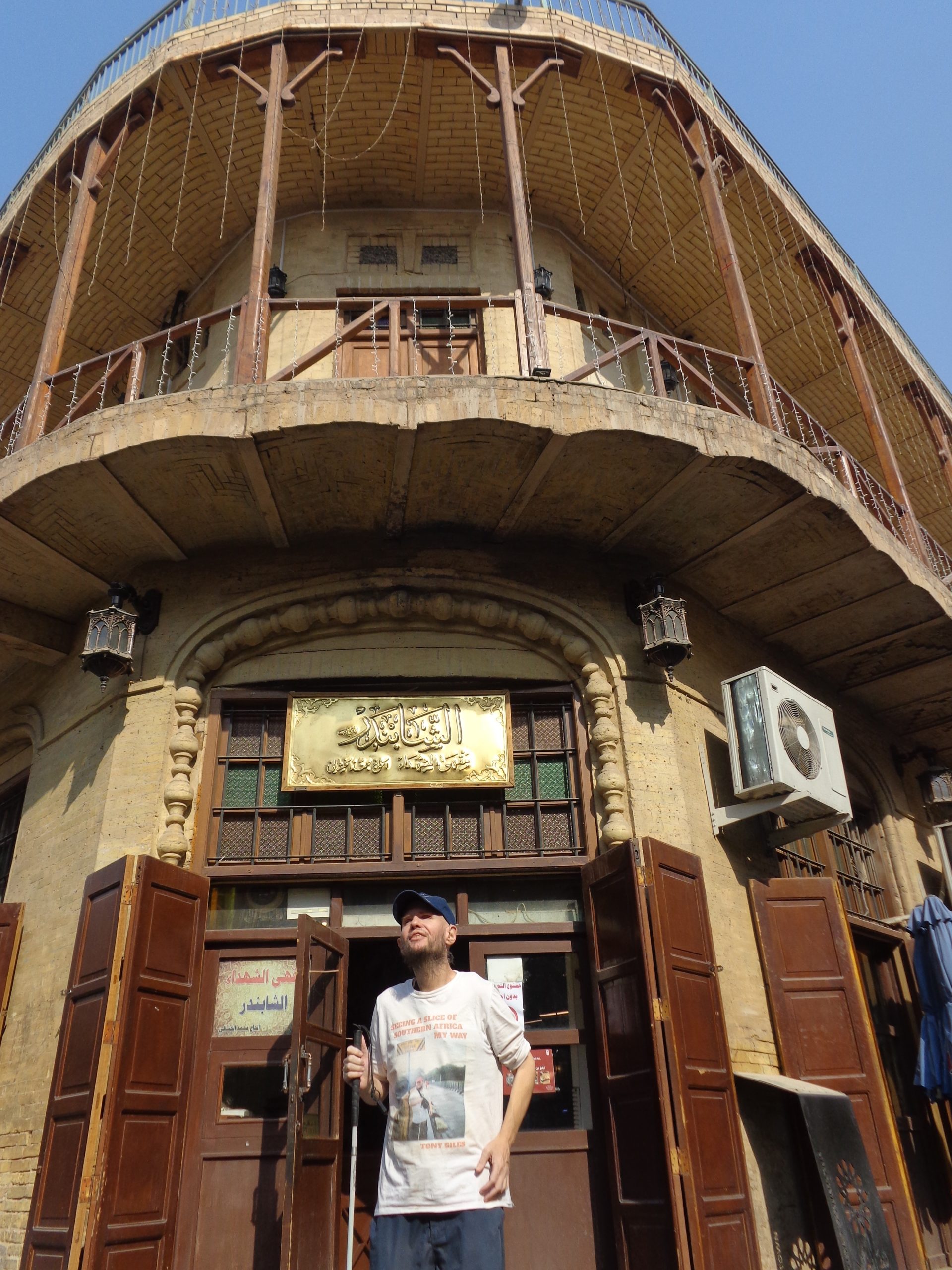
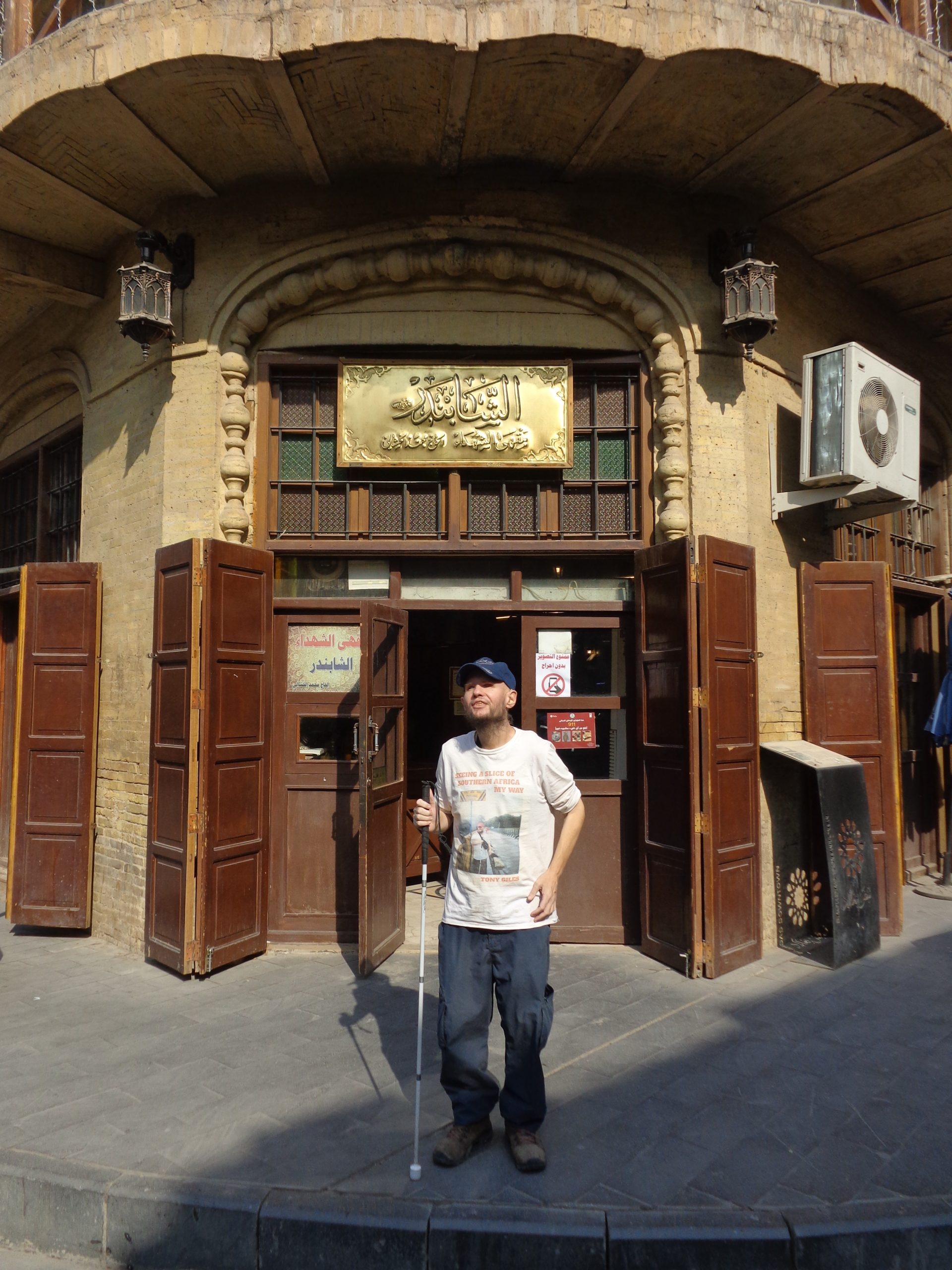
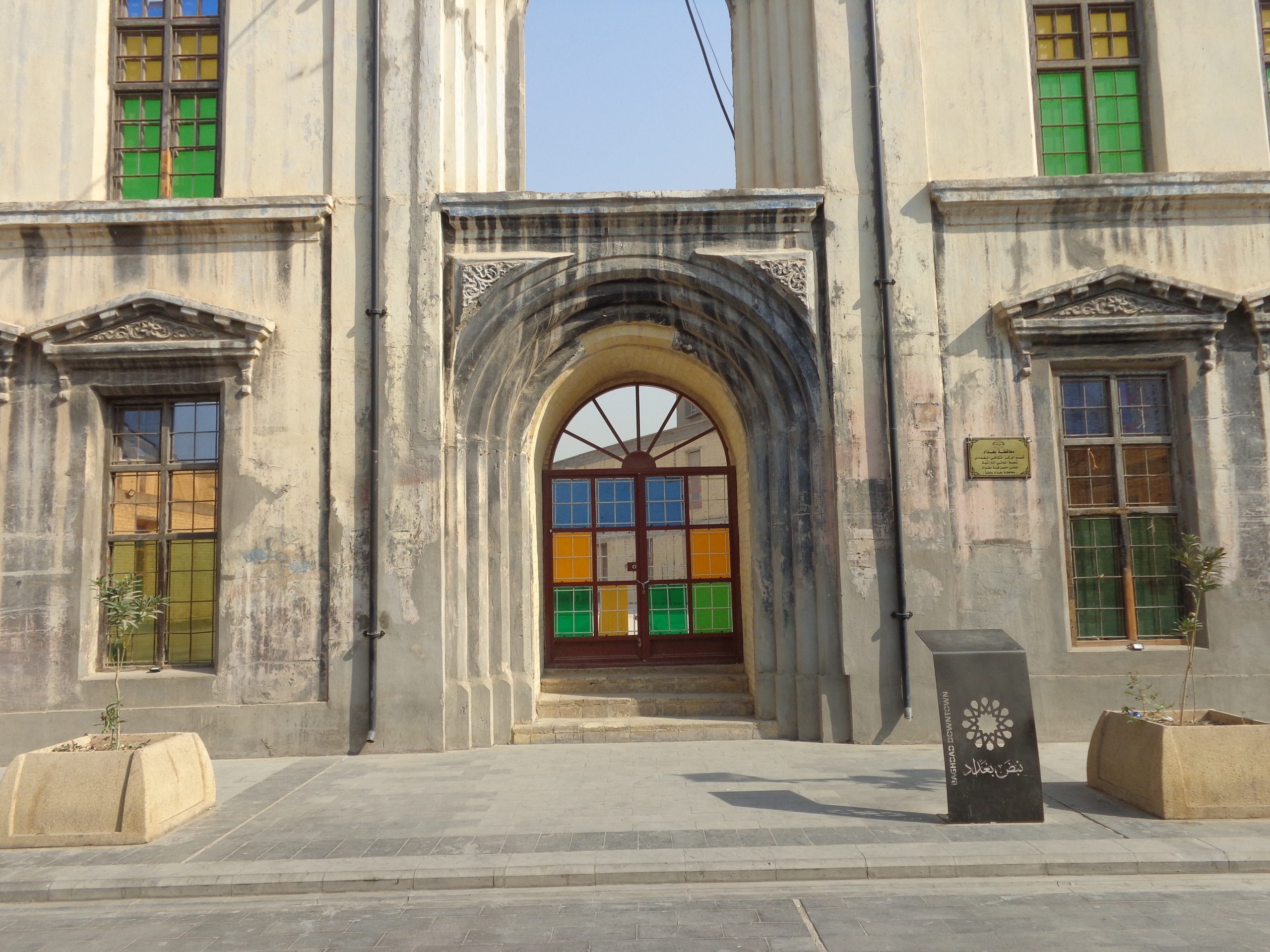
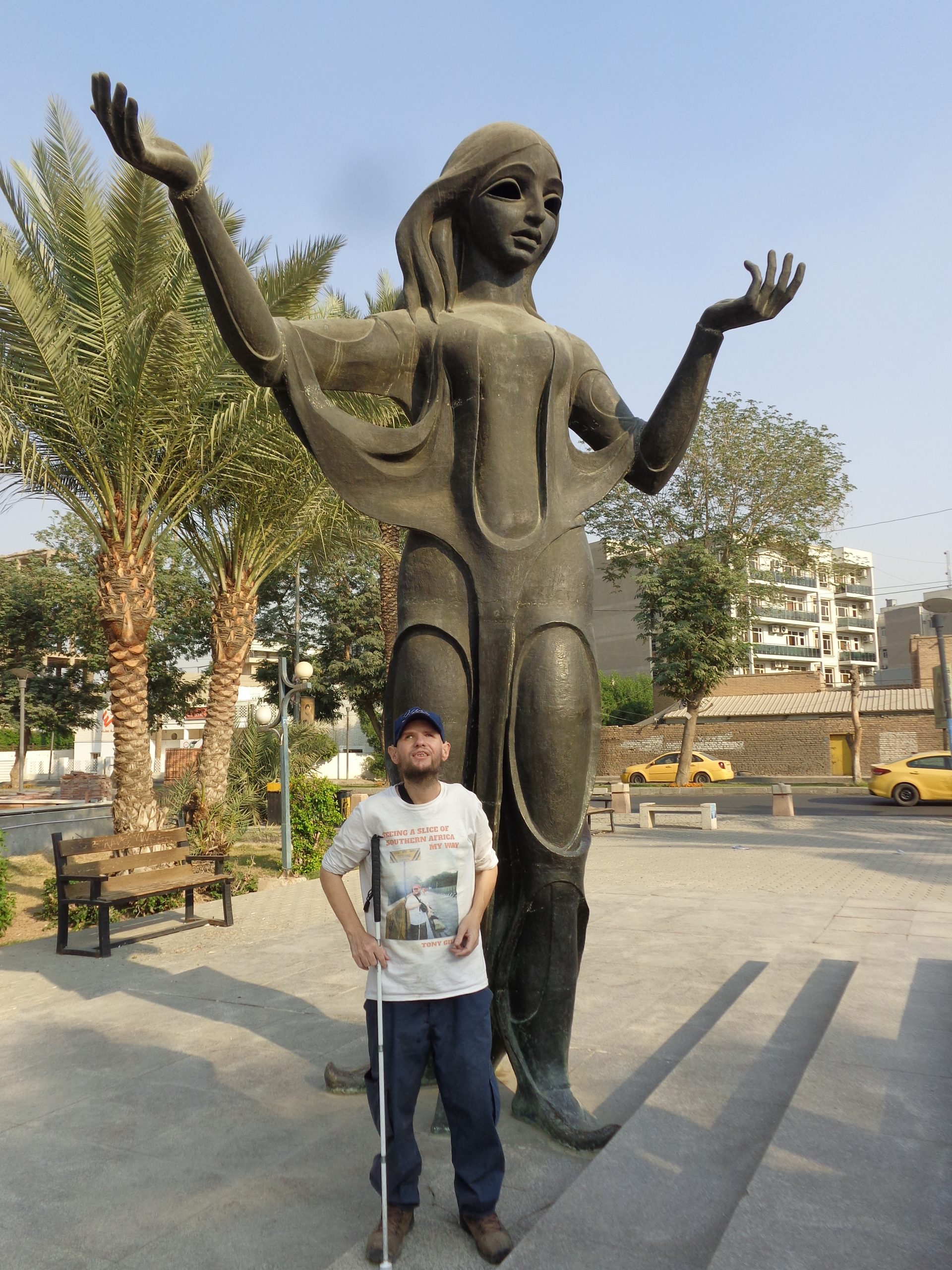
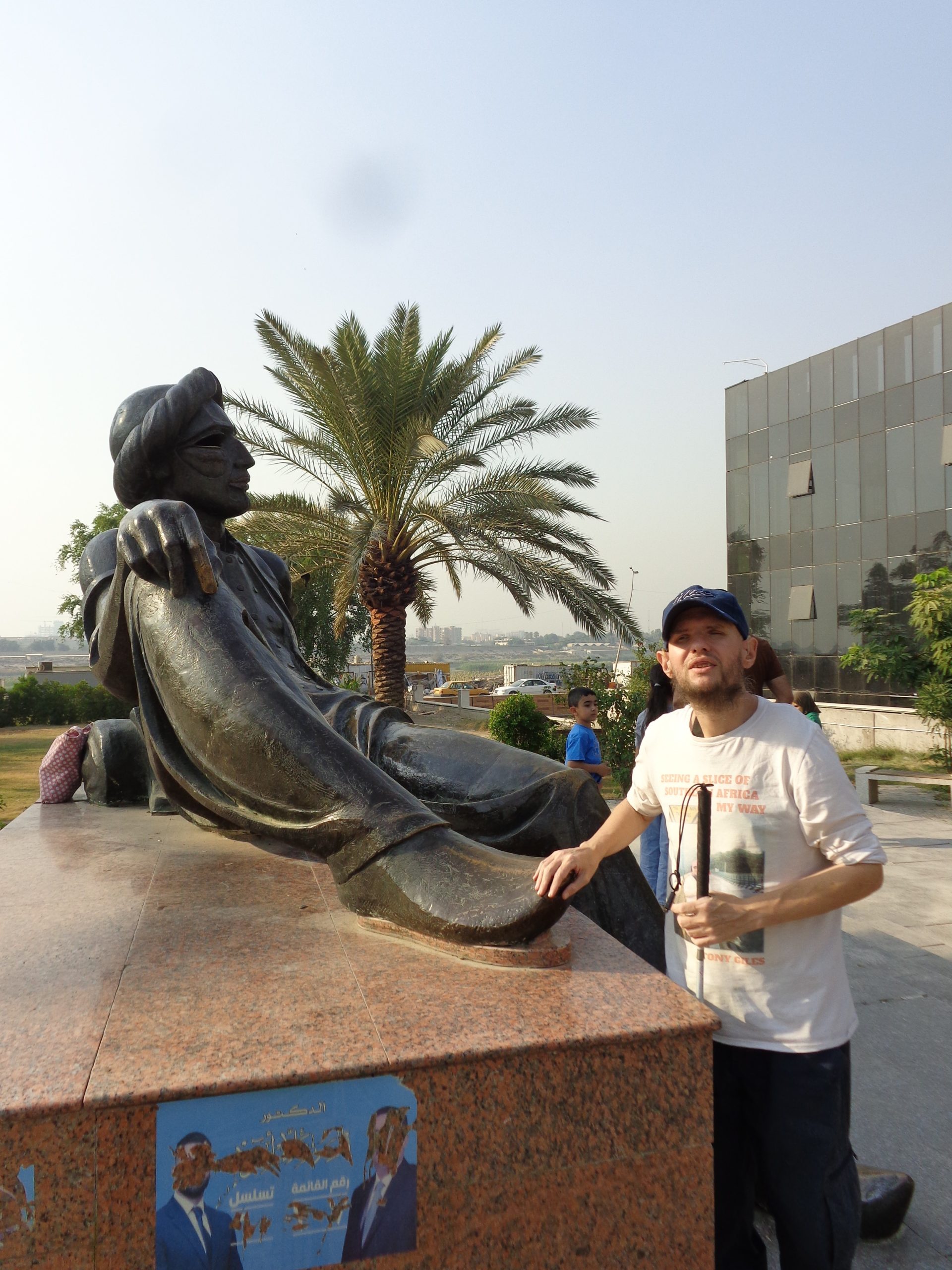
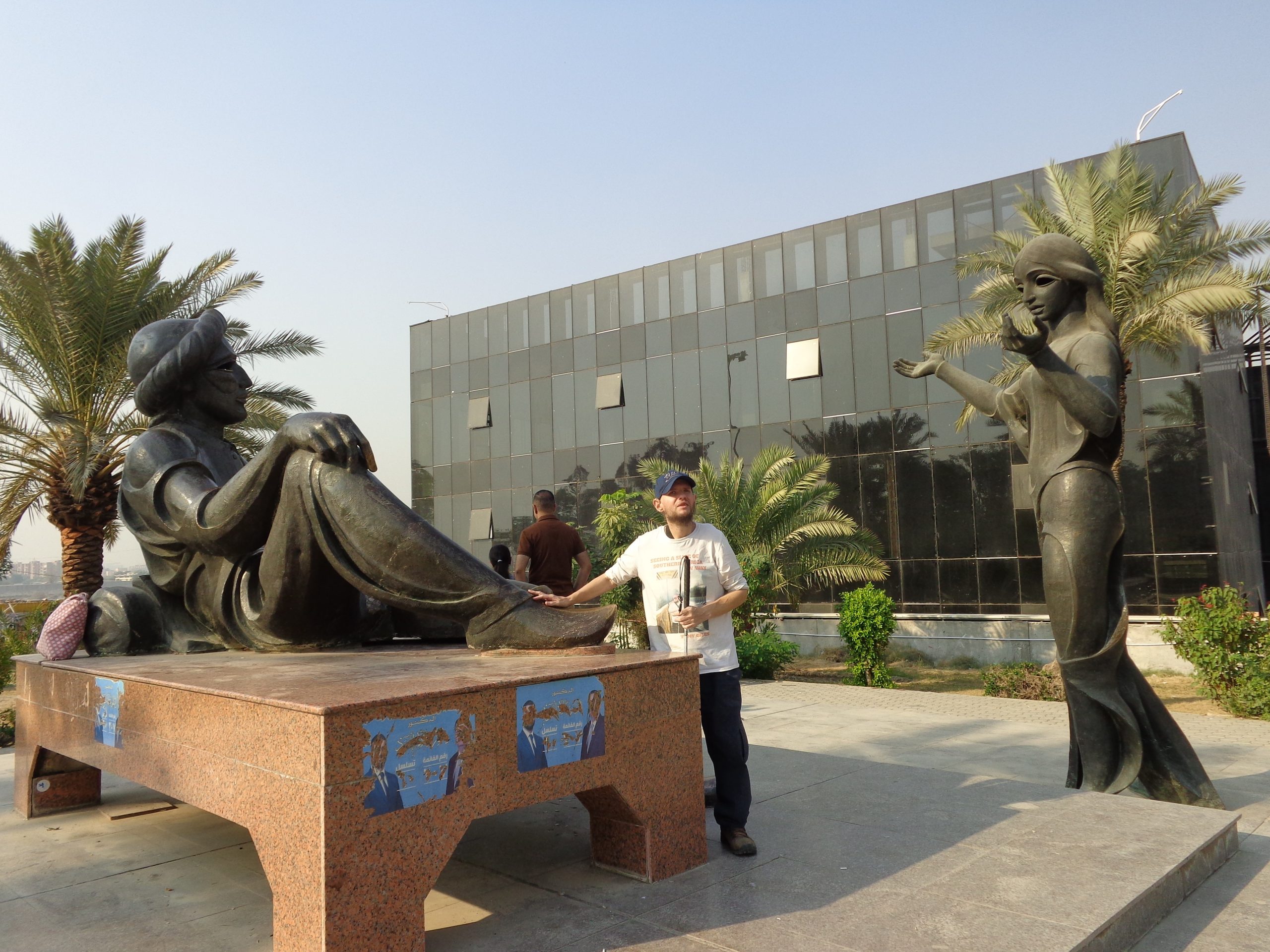
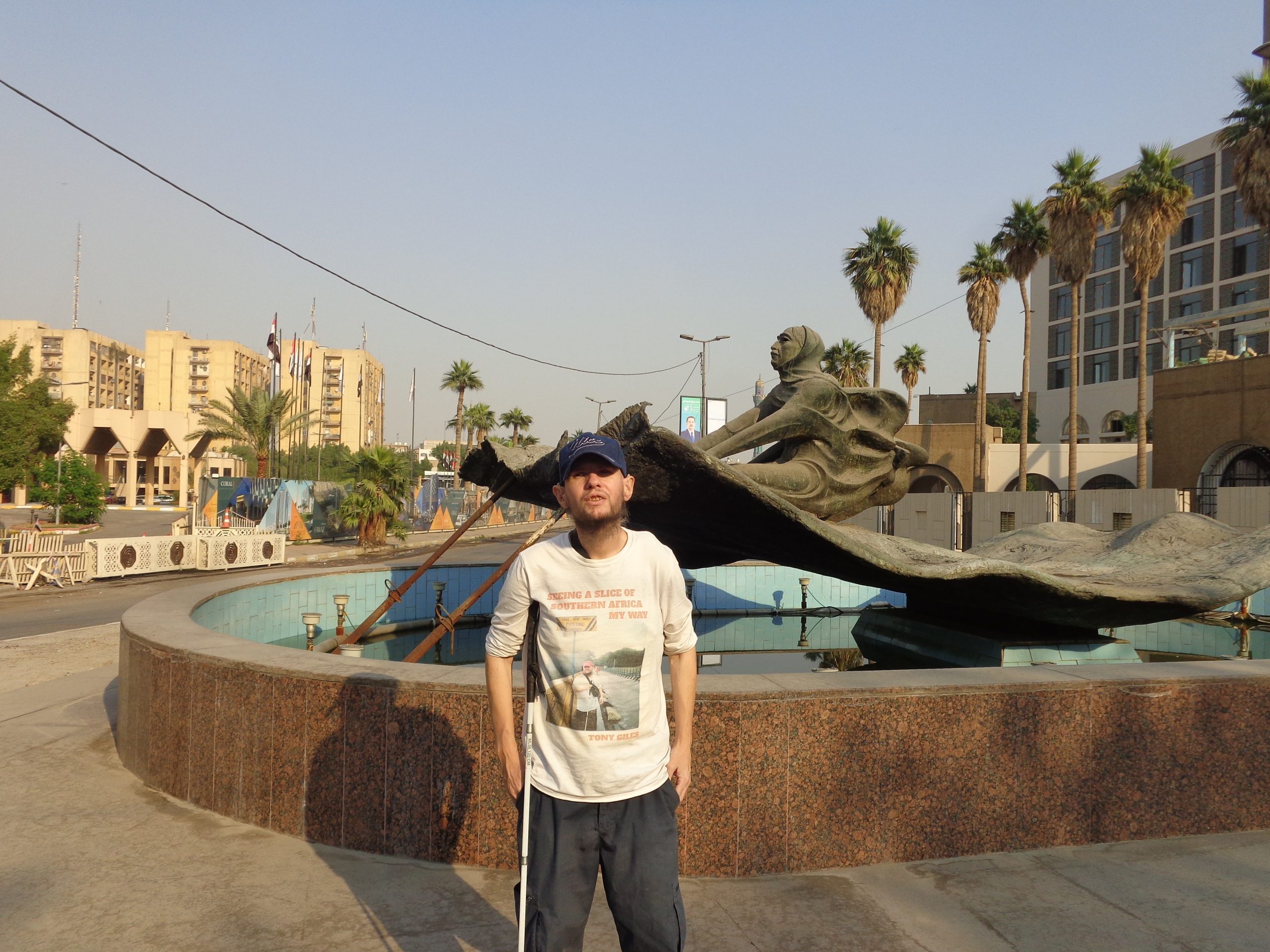
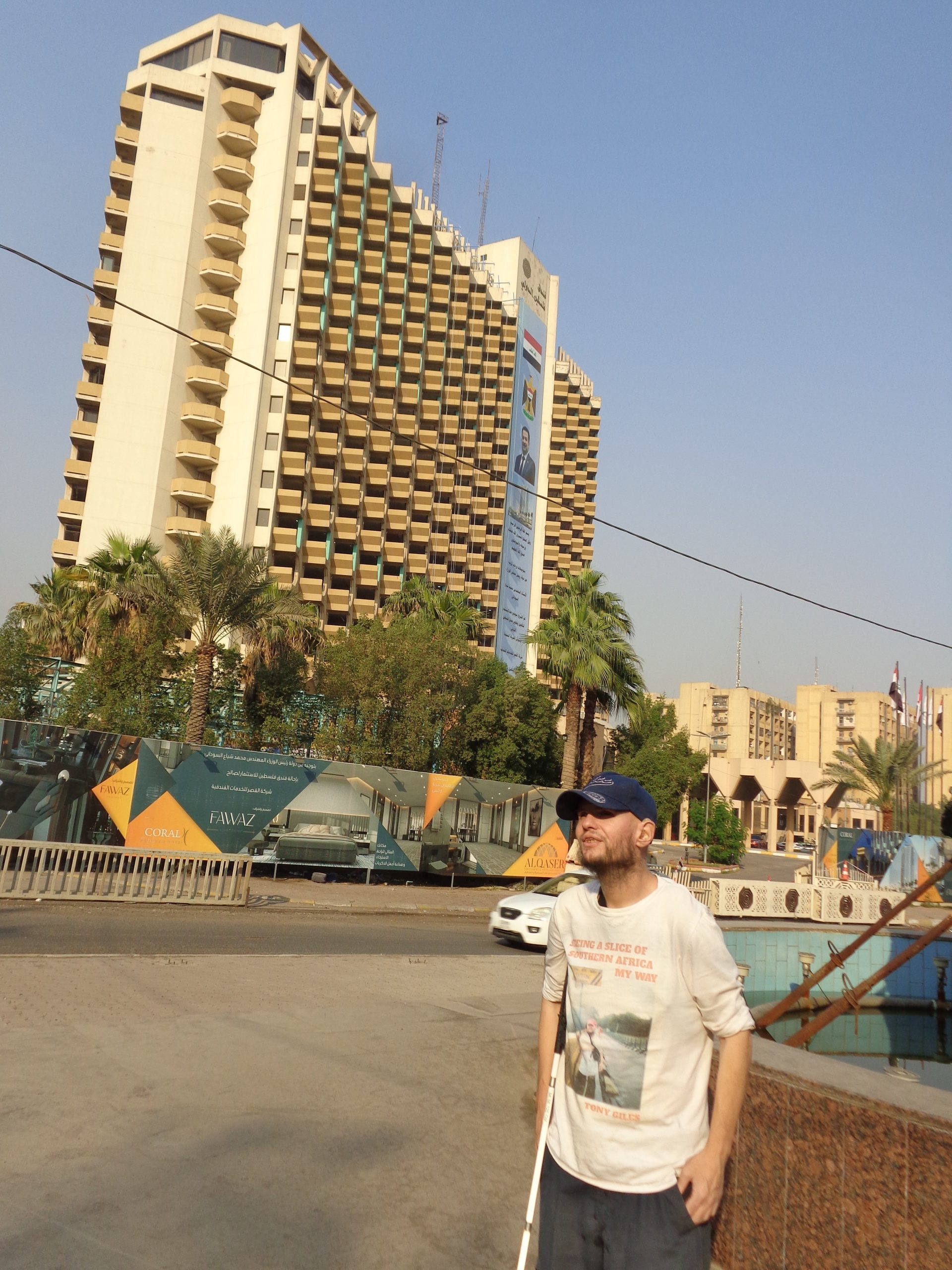
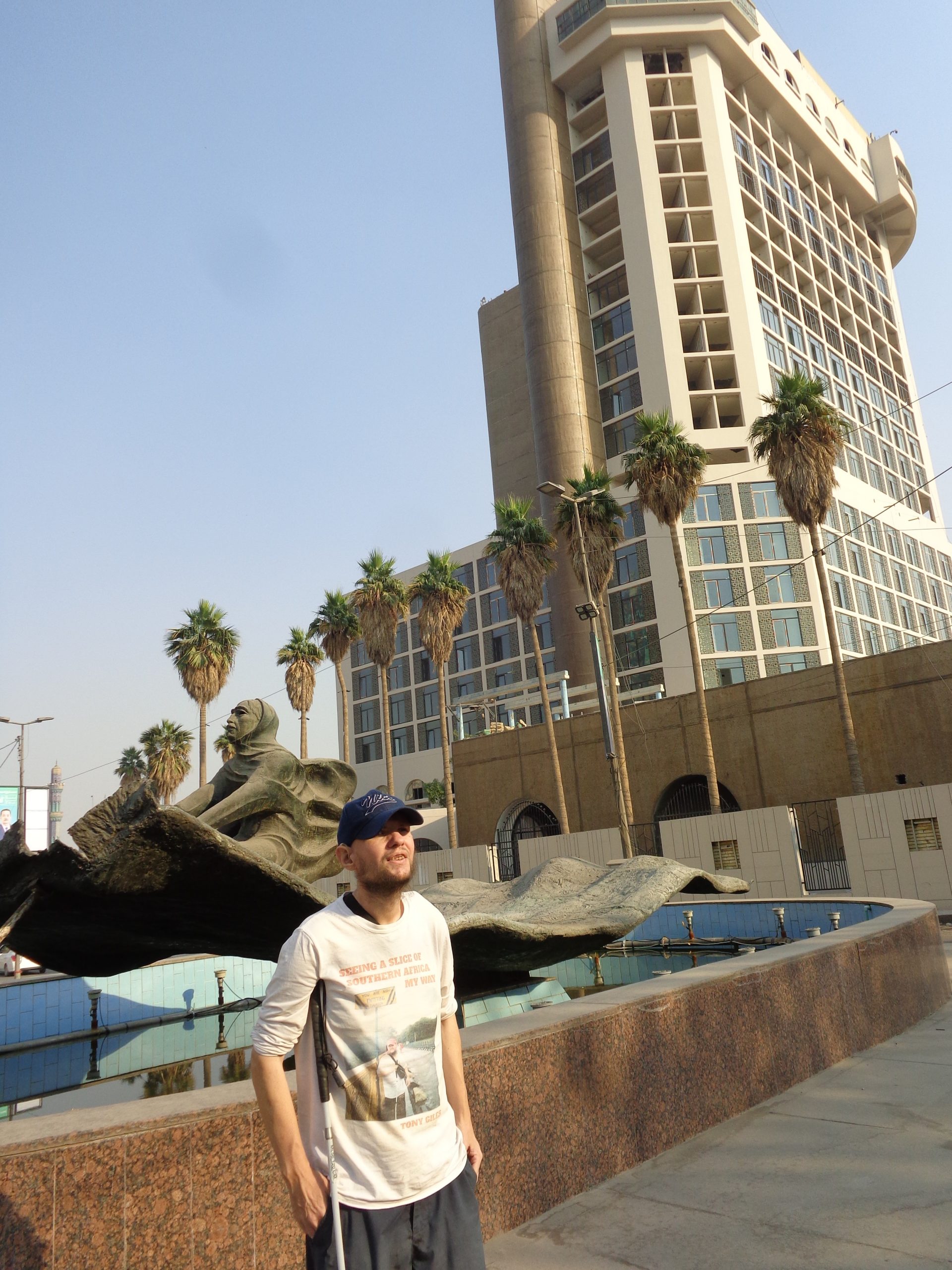
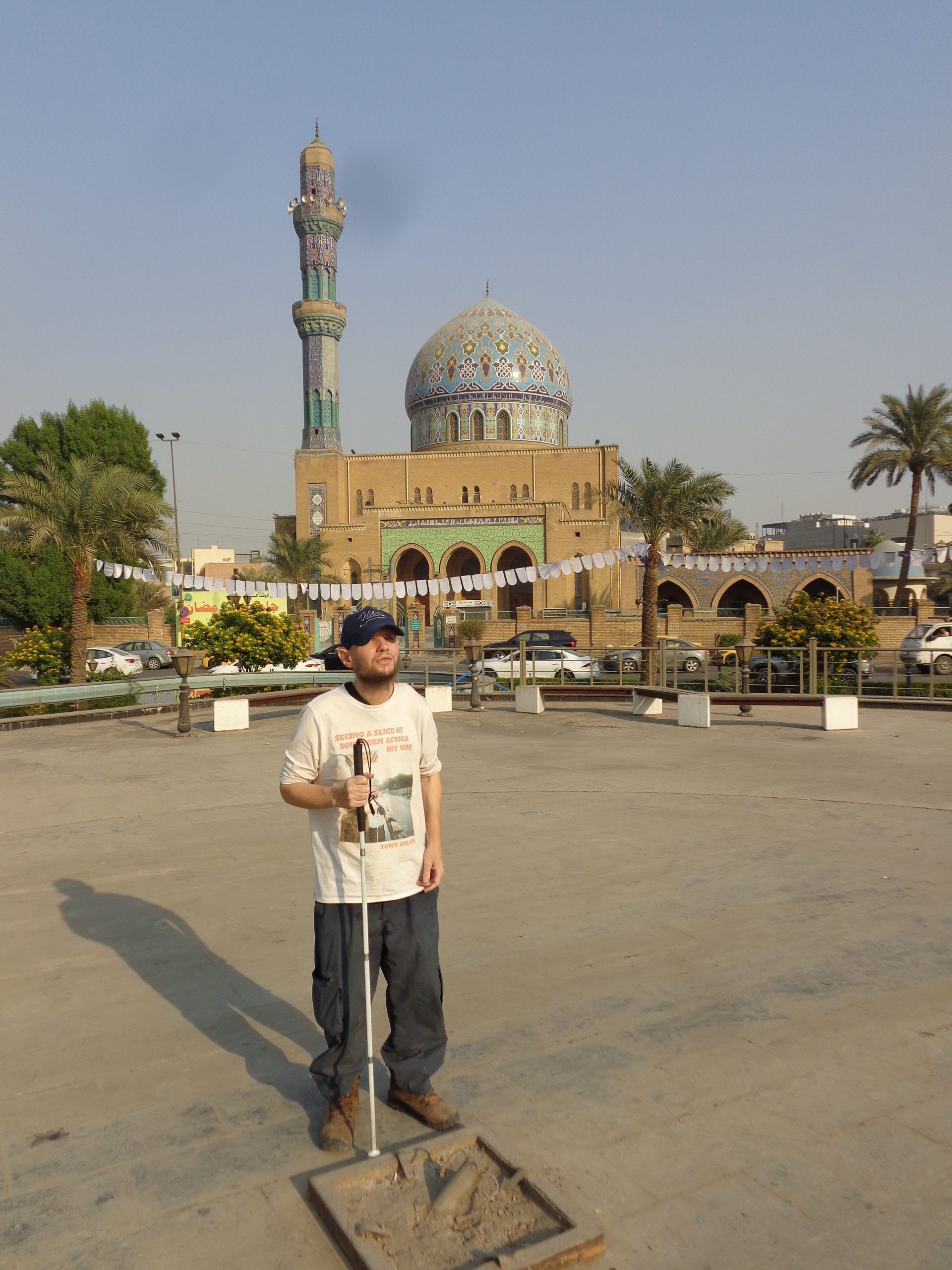
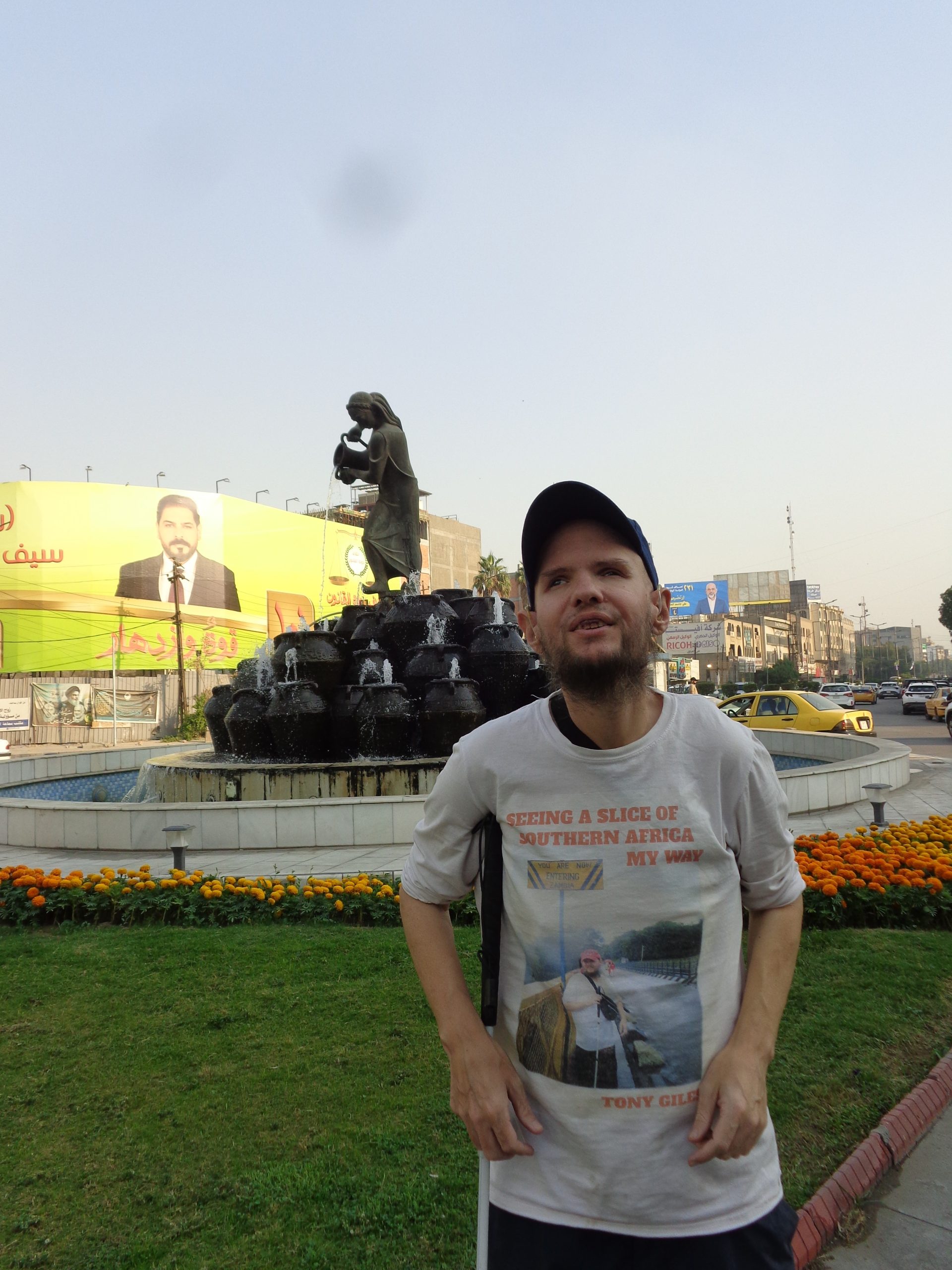
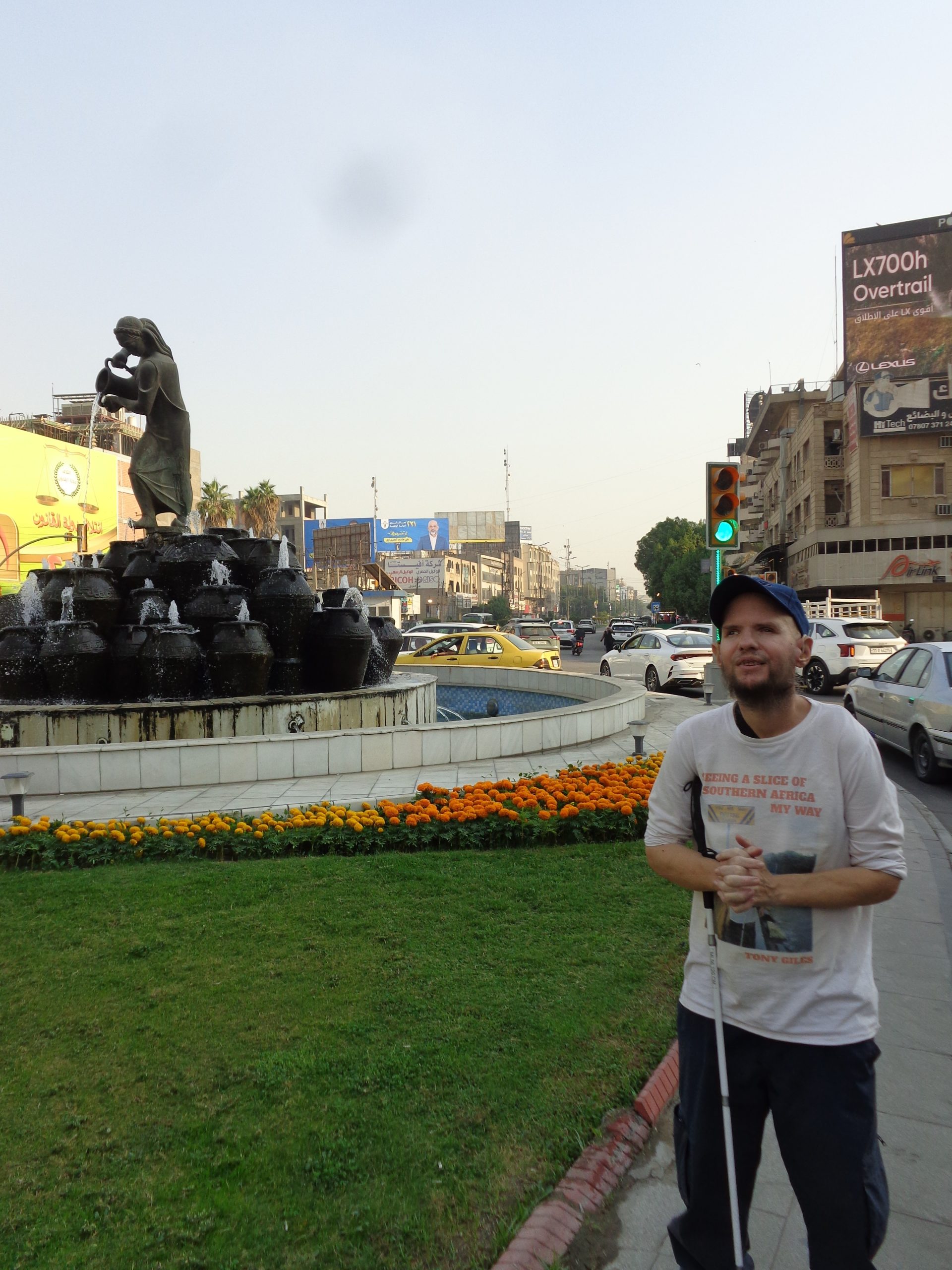
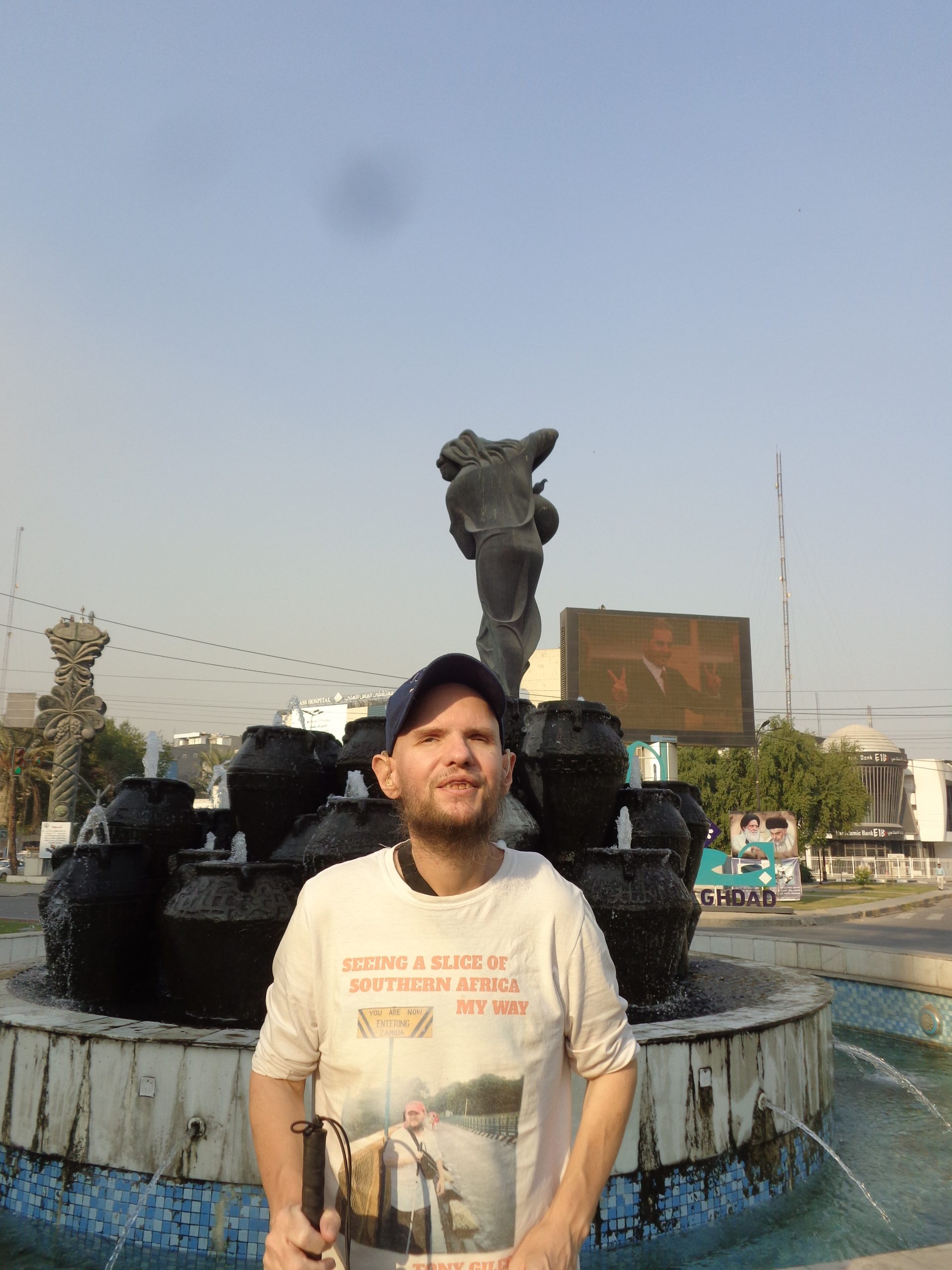
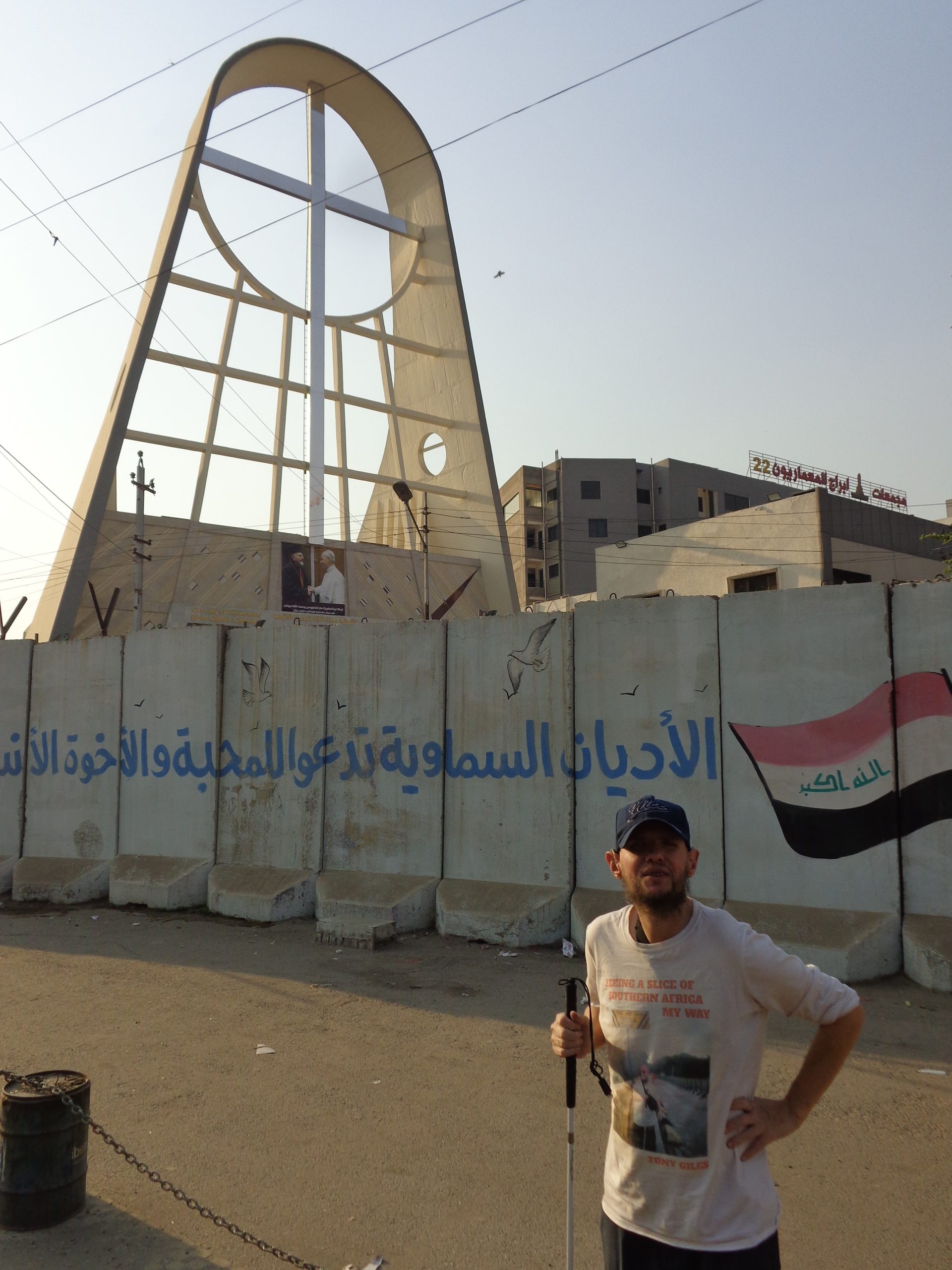
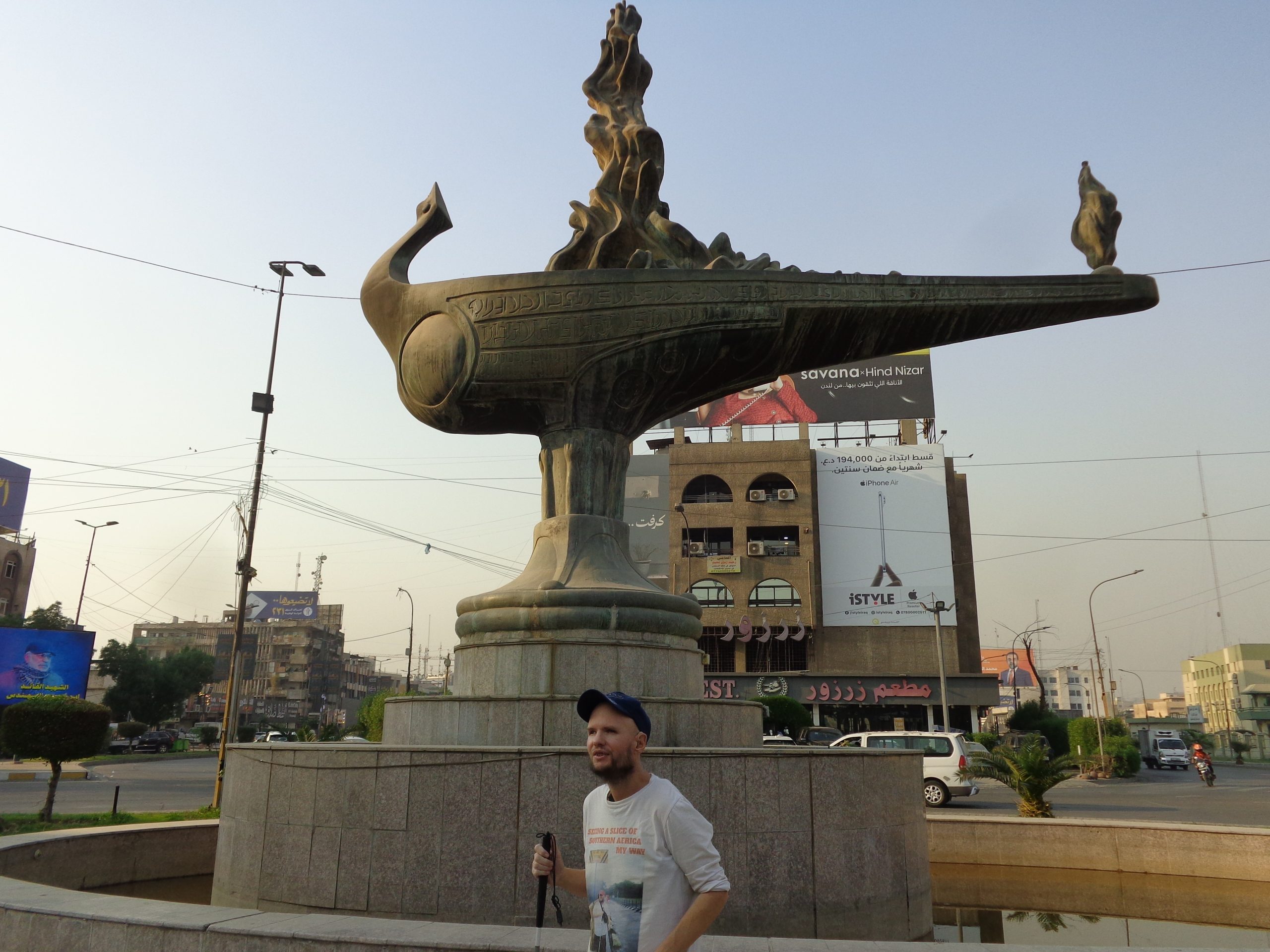
Baghdad is the capital and largest city in Iraq. It is located on the banks of the Tigris river in central Iraq. The city has an estimated population of 8 million. It is one of the largest cities in the Middle East and the Arab world and contains 22% of Iraq’s population.
Wednesday, 12th November 2025
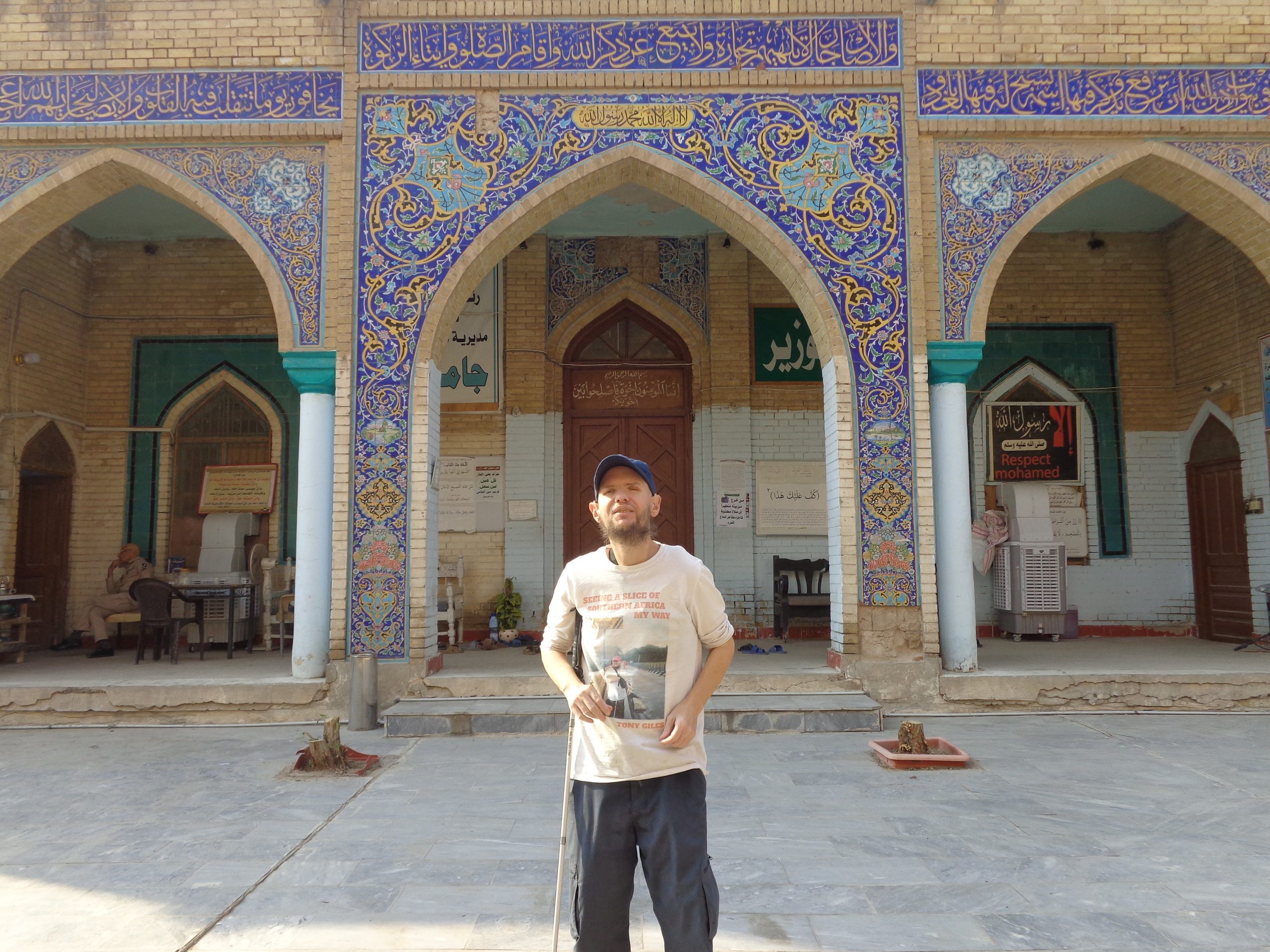
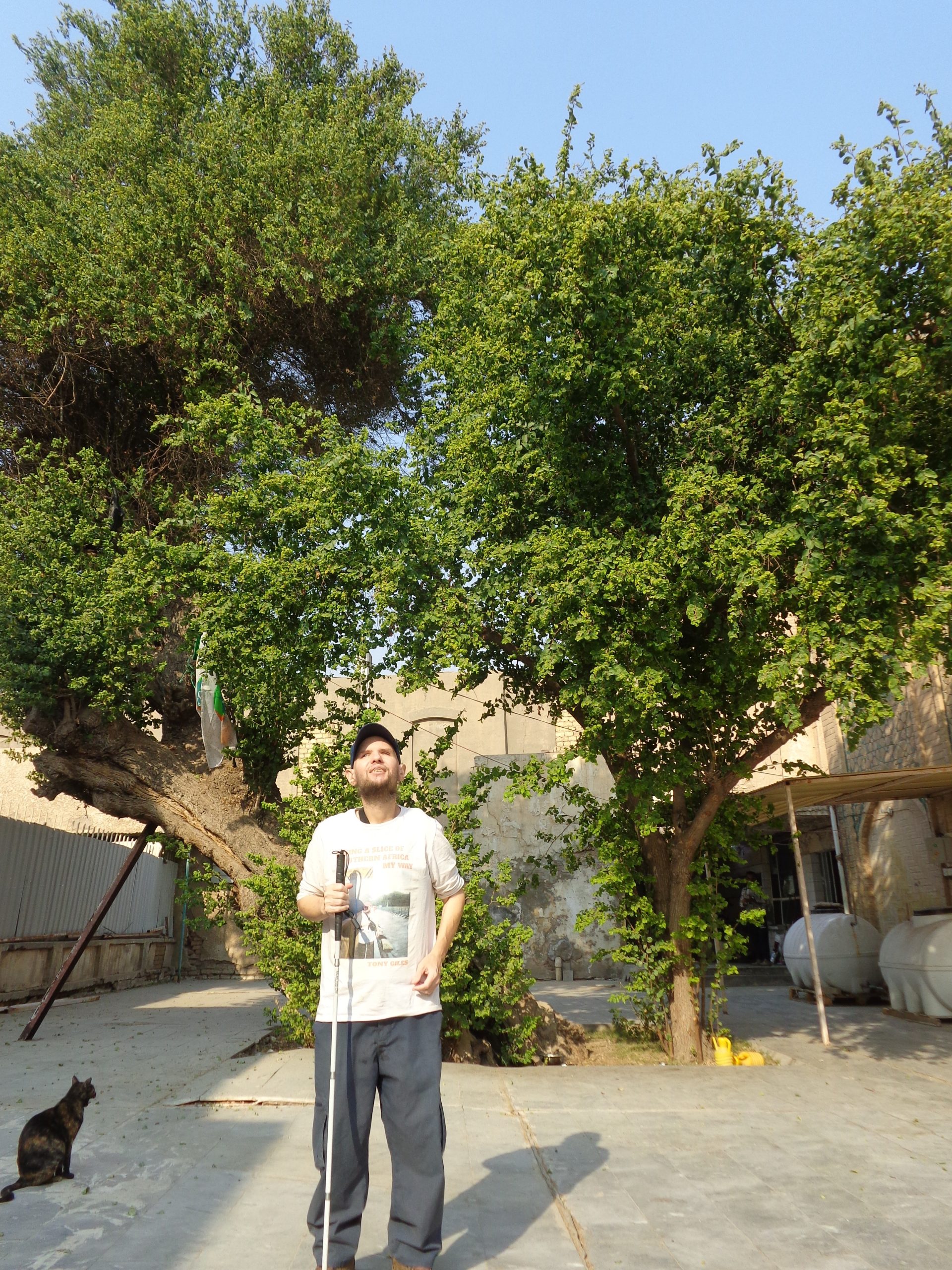
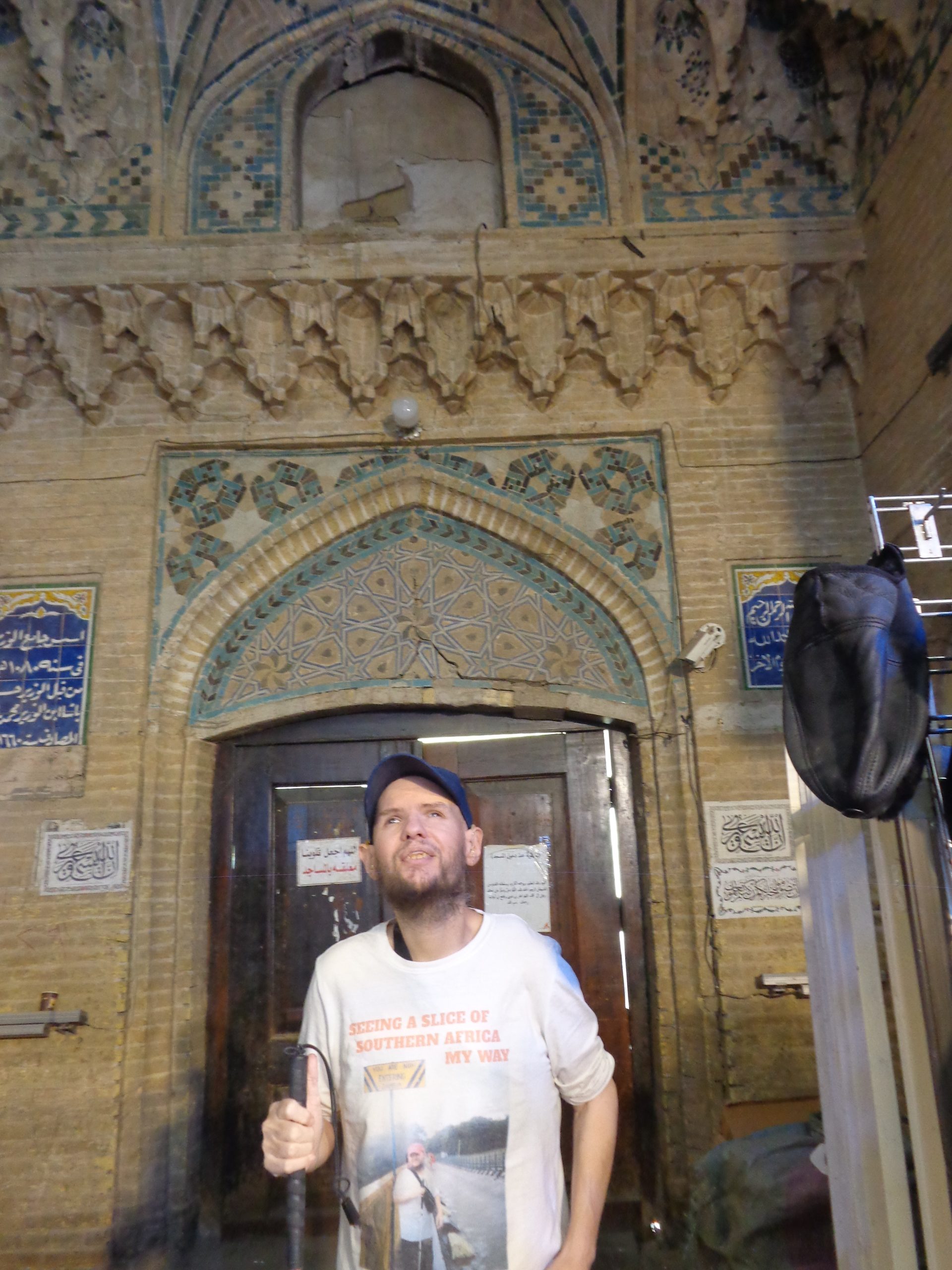
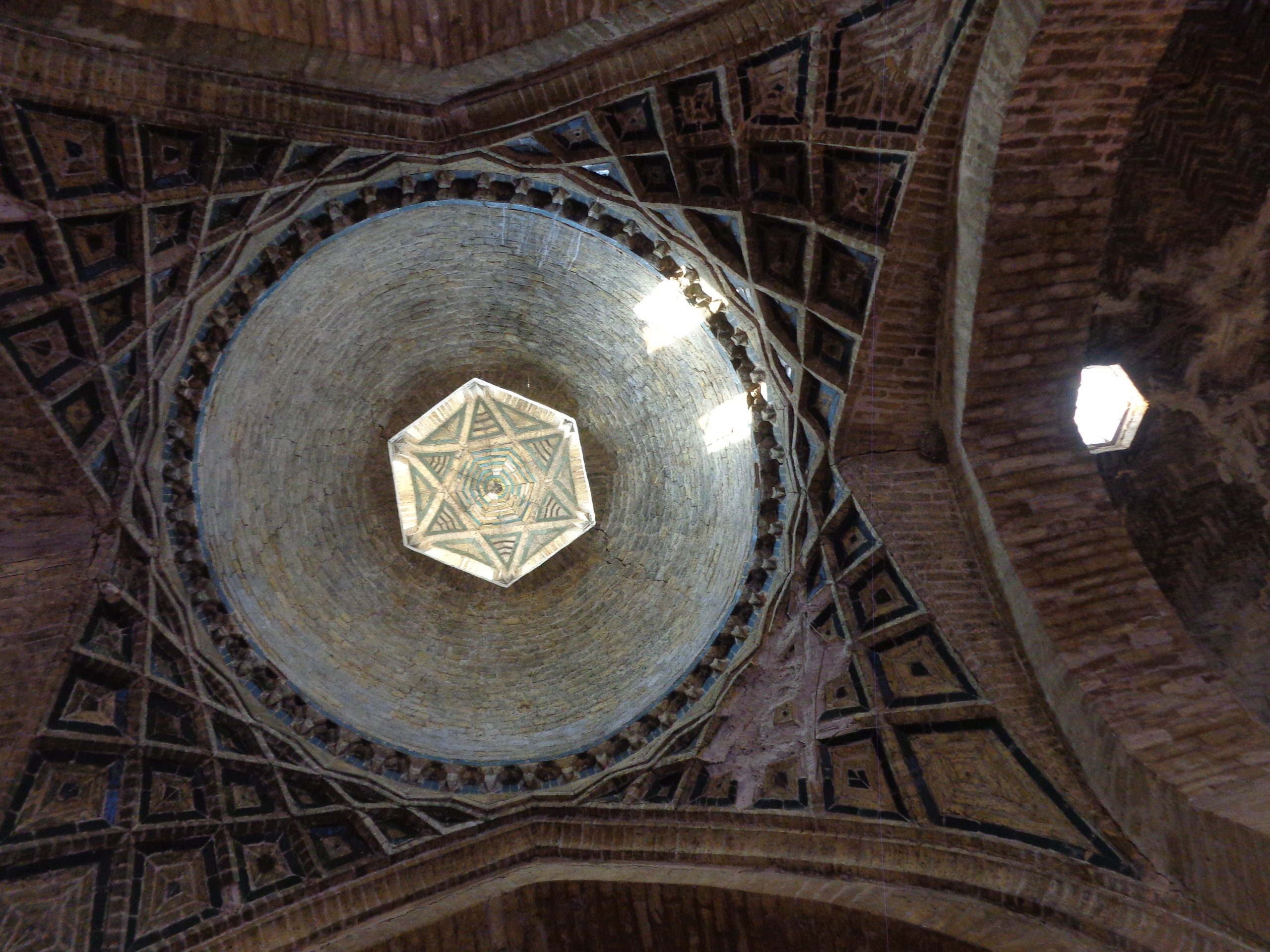
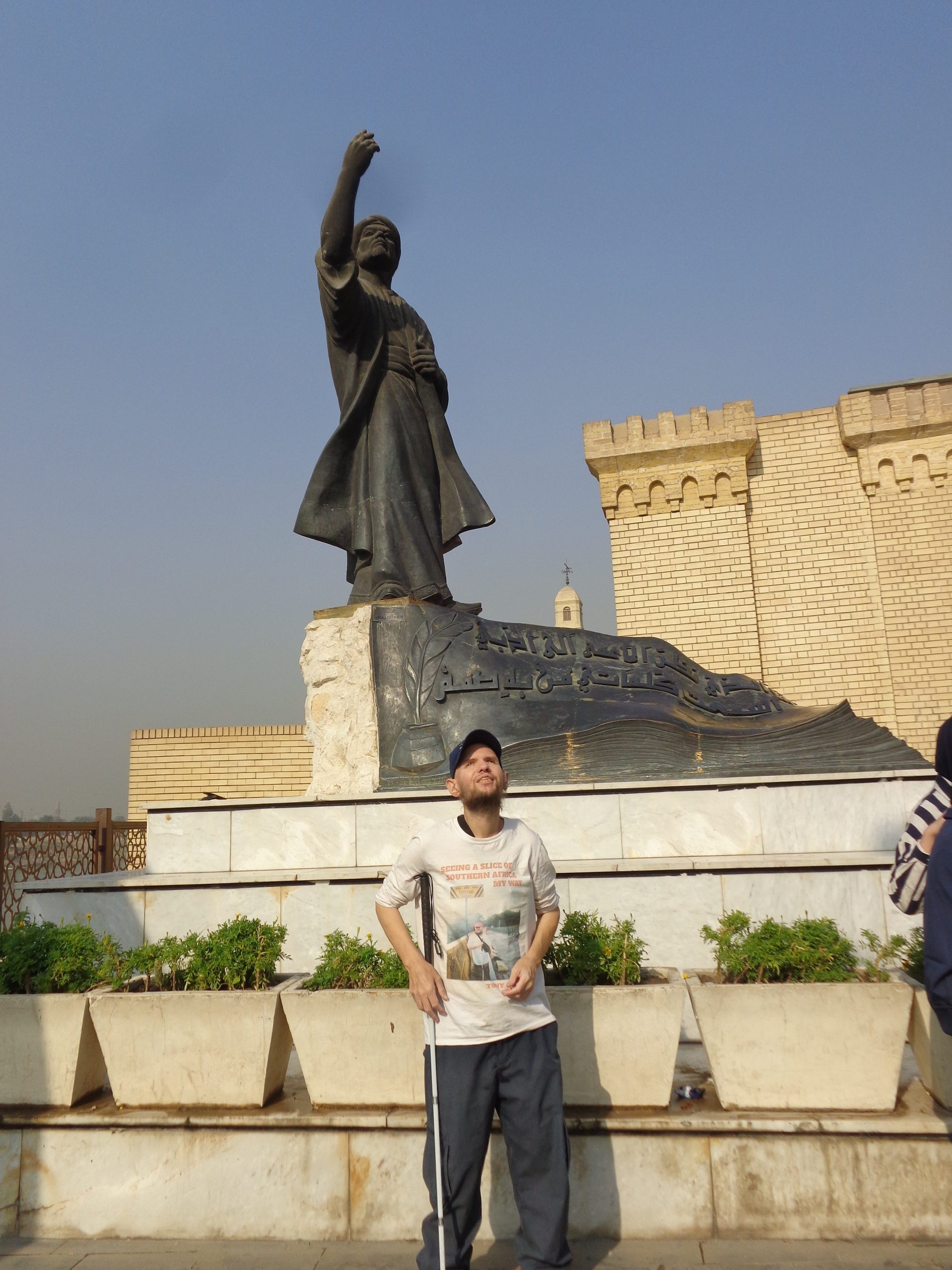
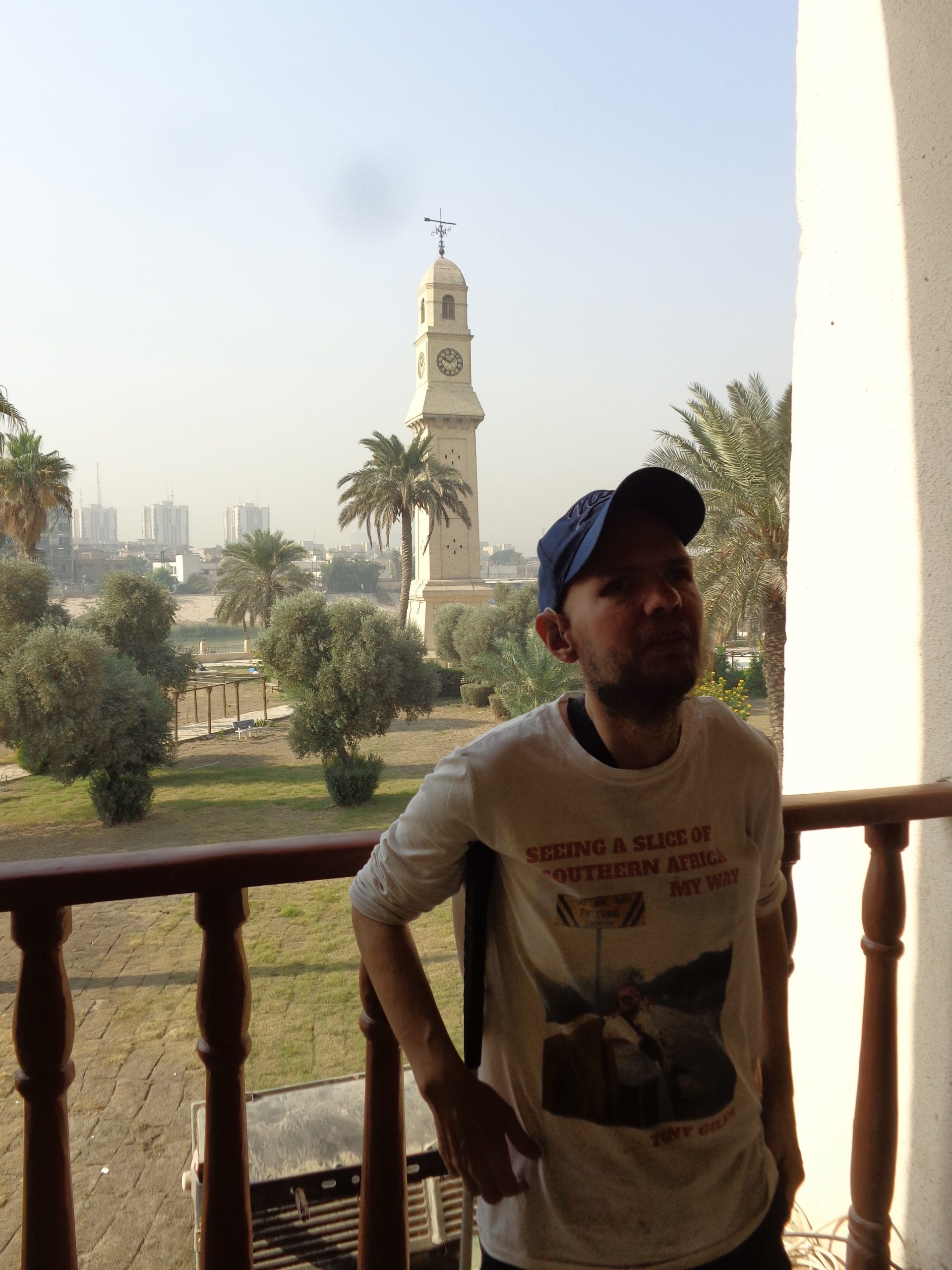
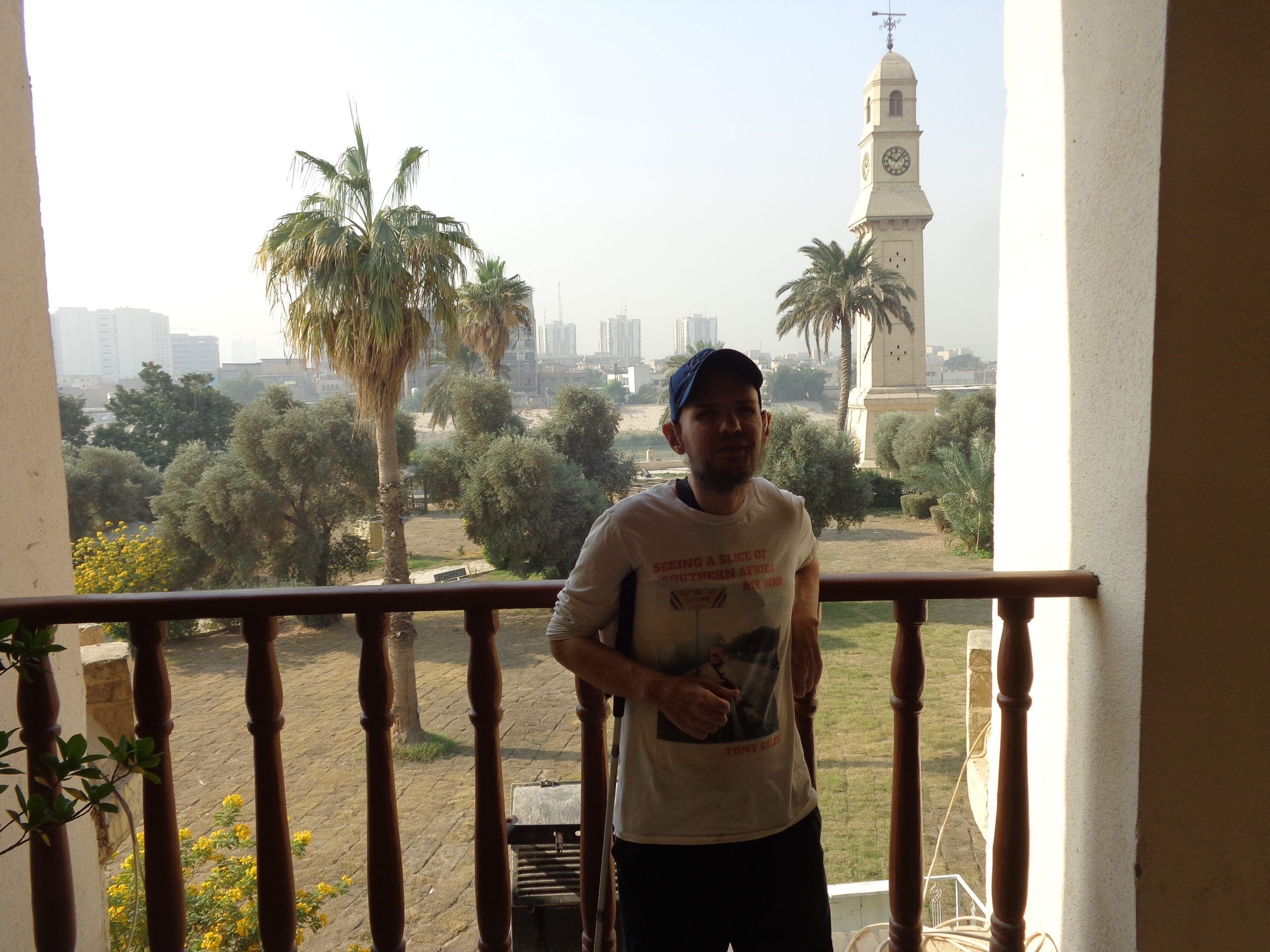
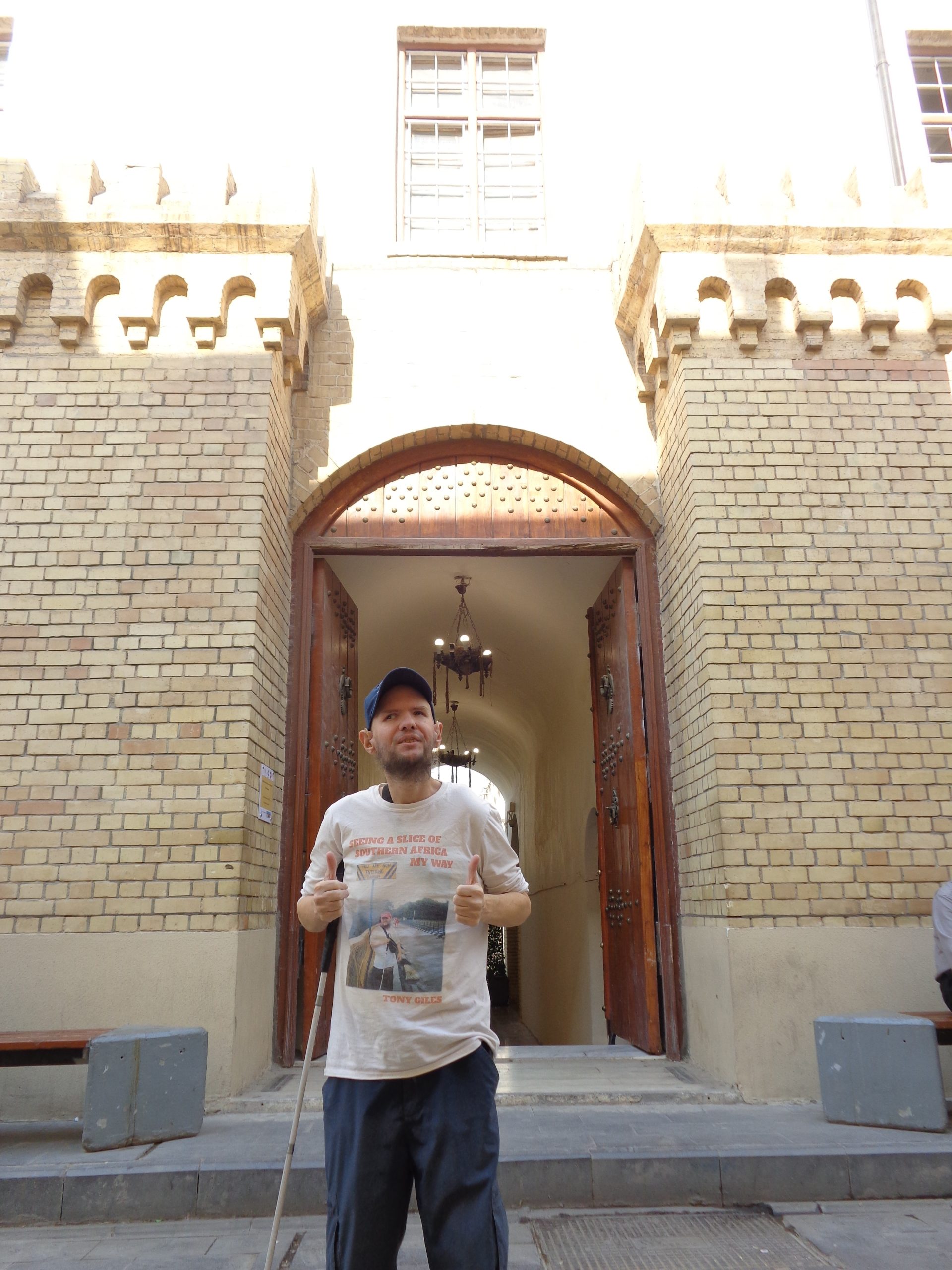
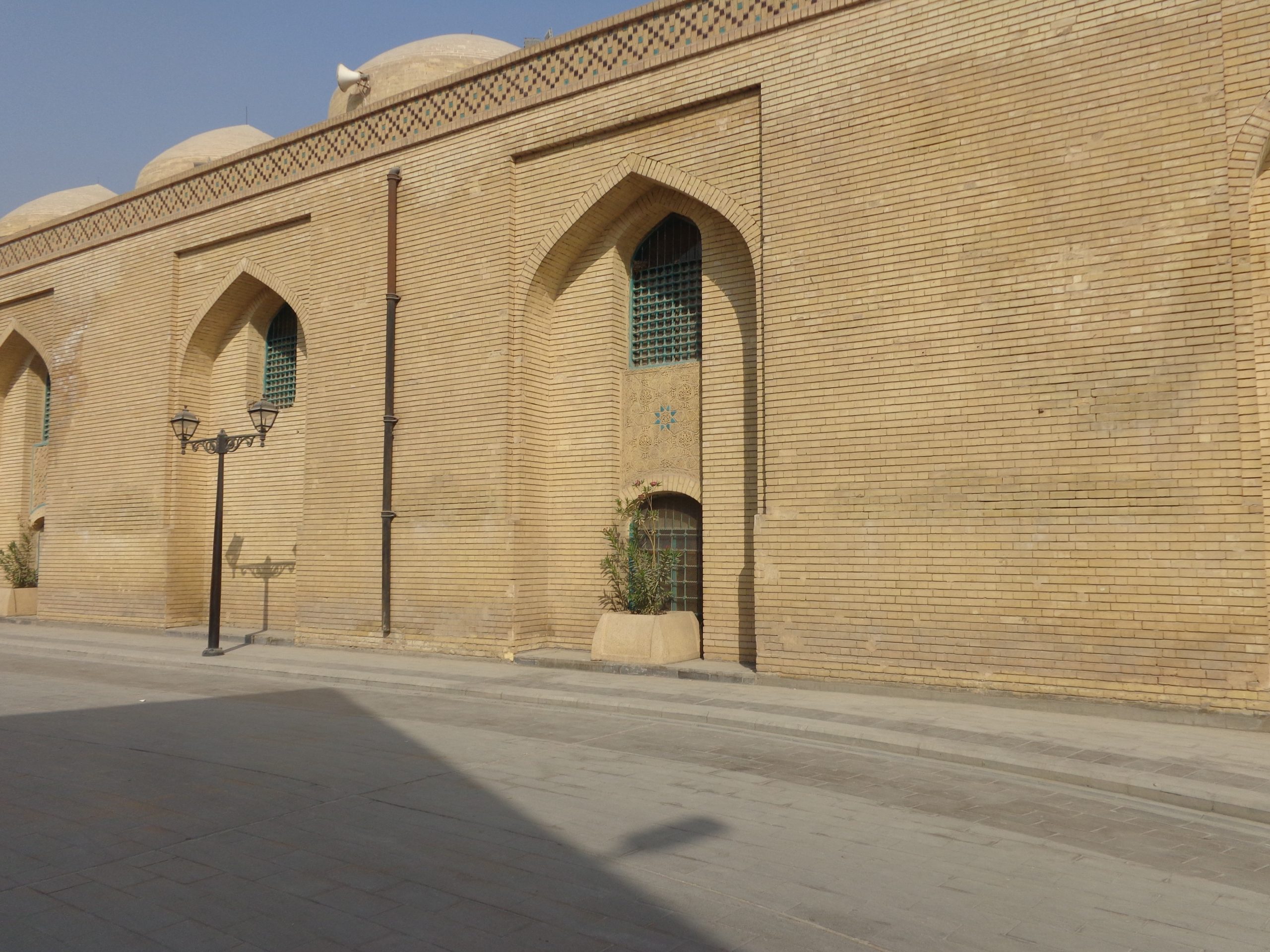
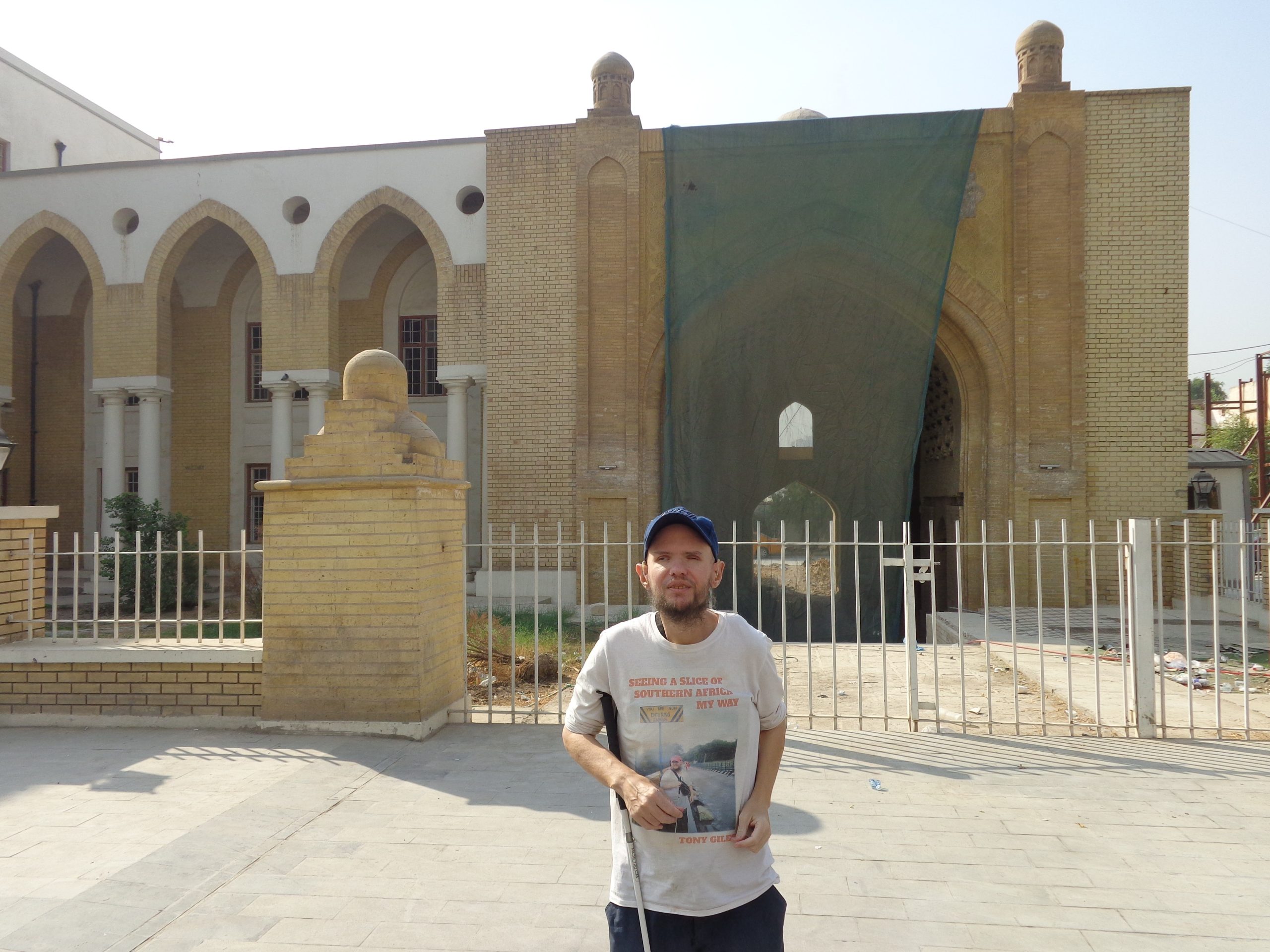
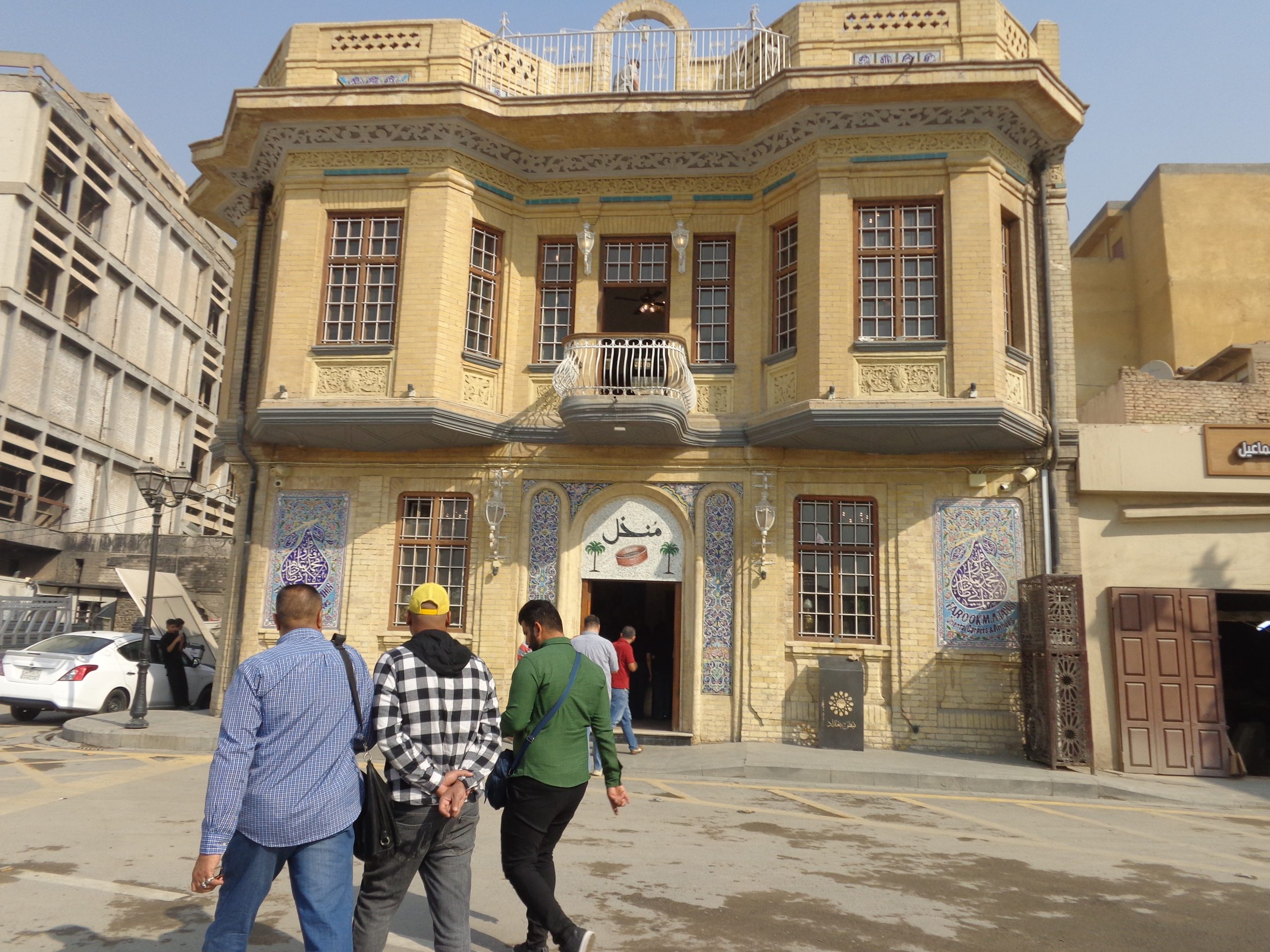
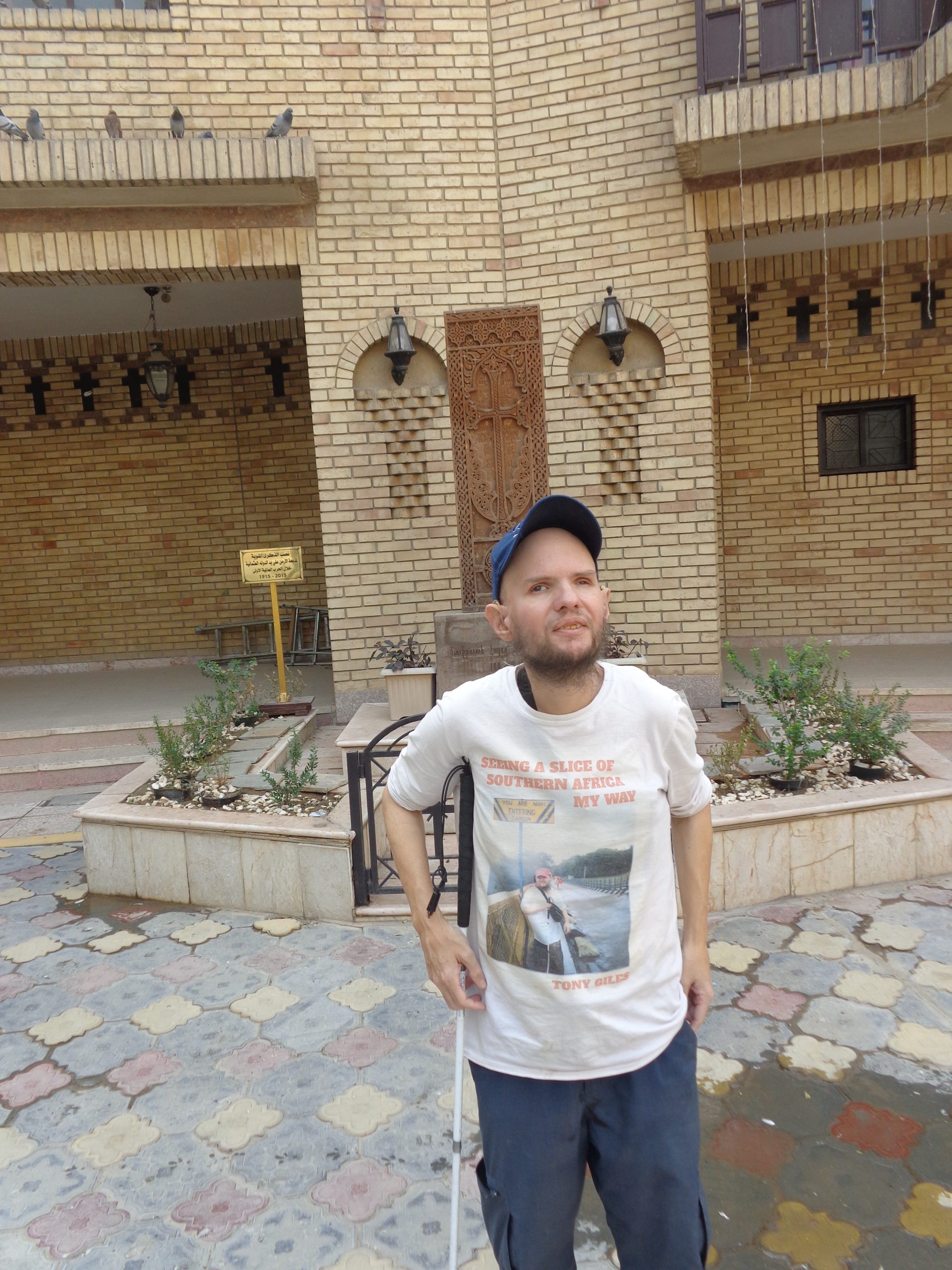
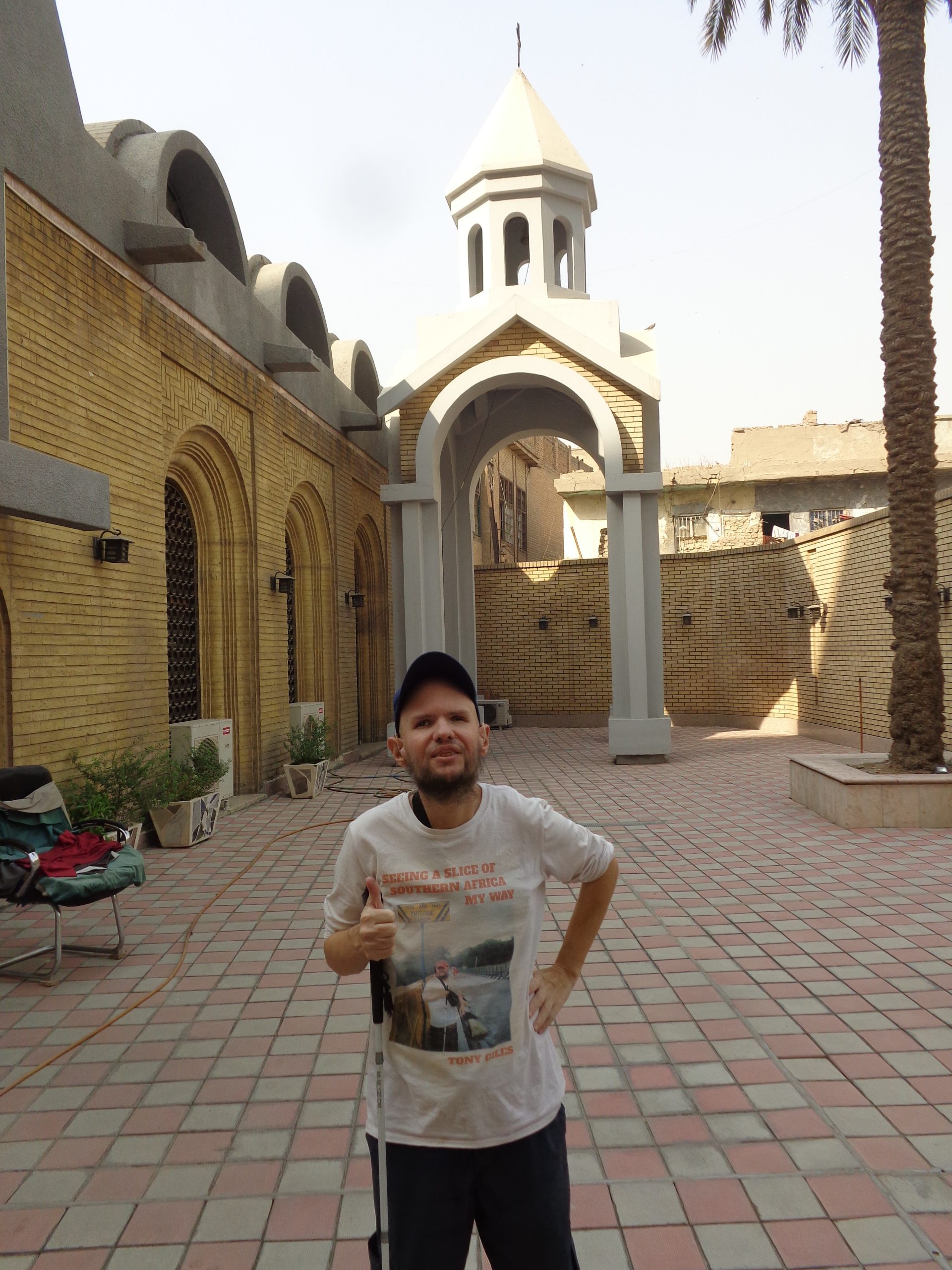
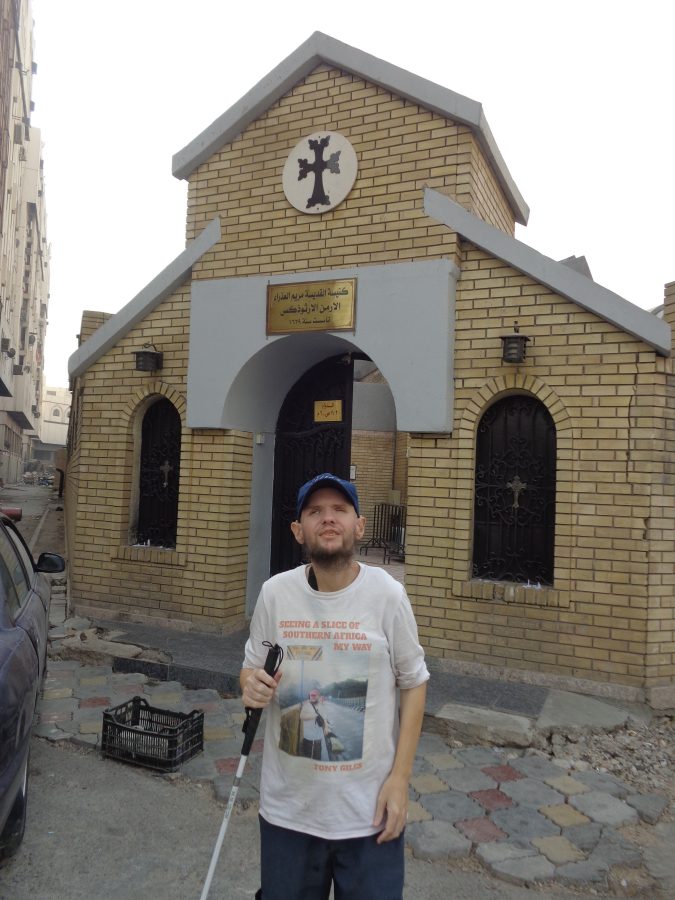
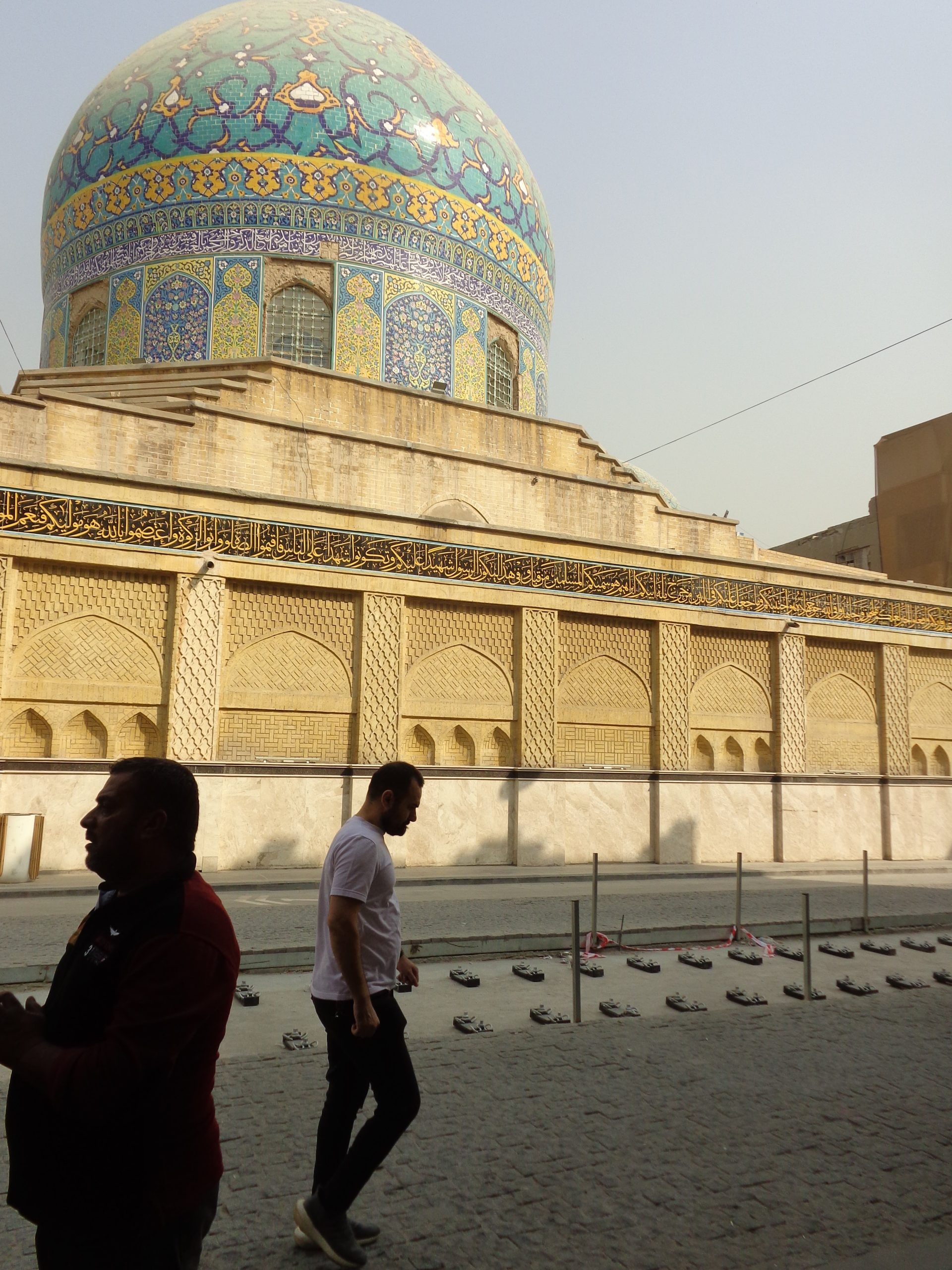
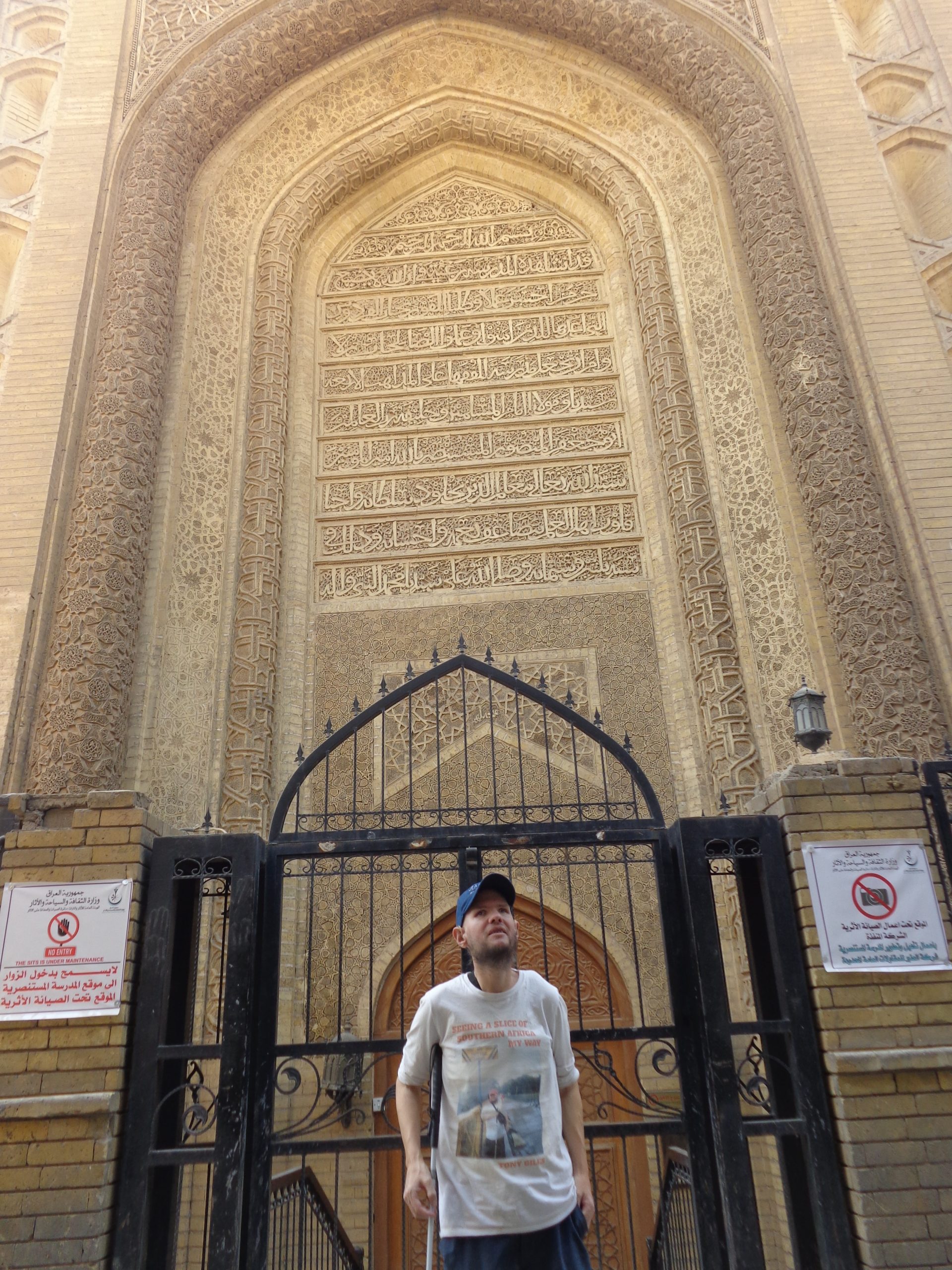
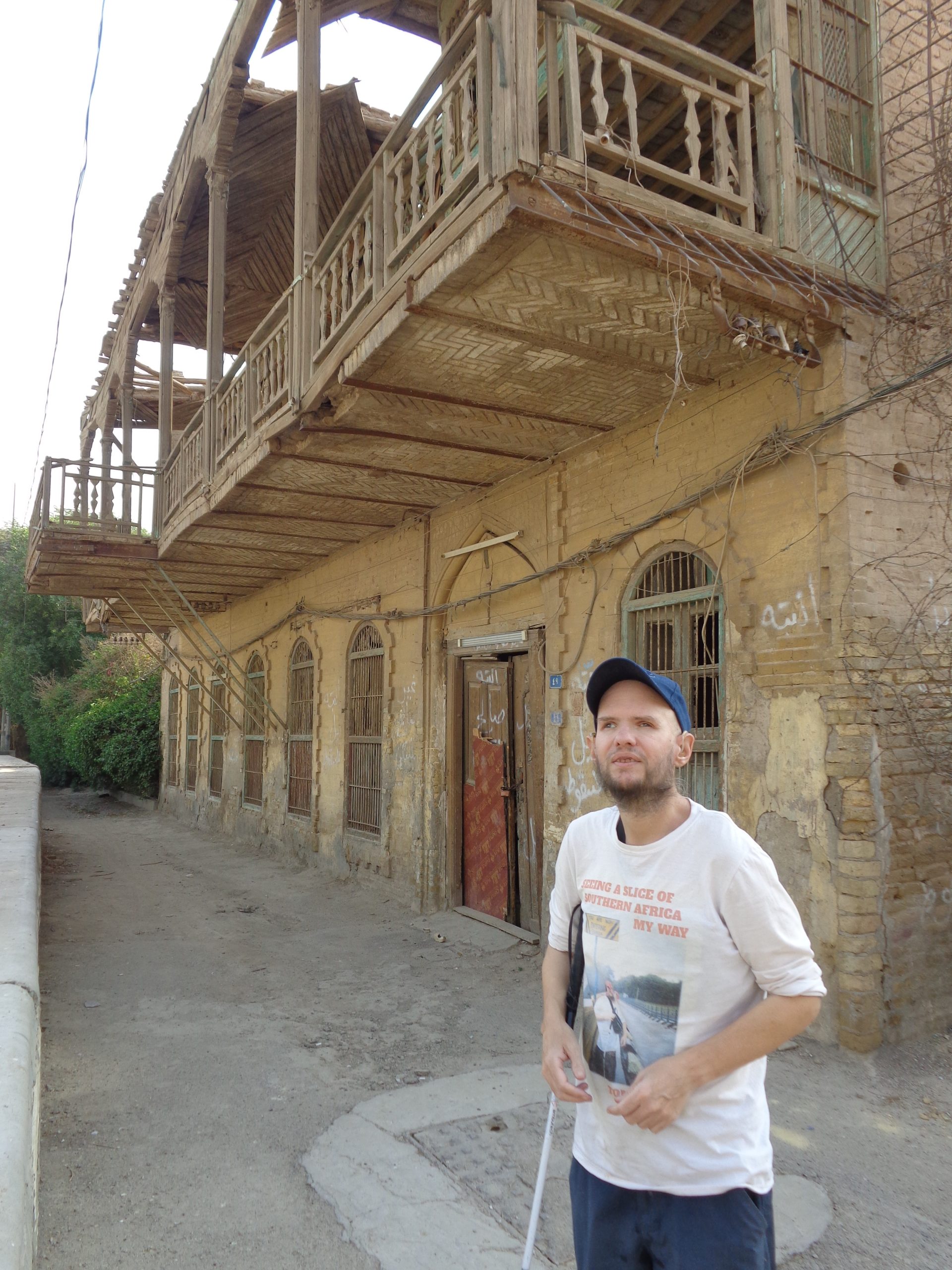
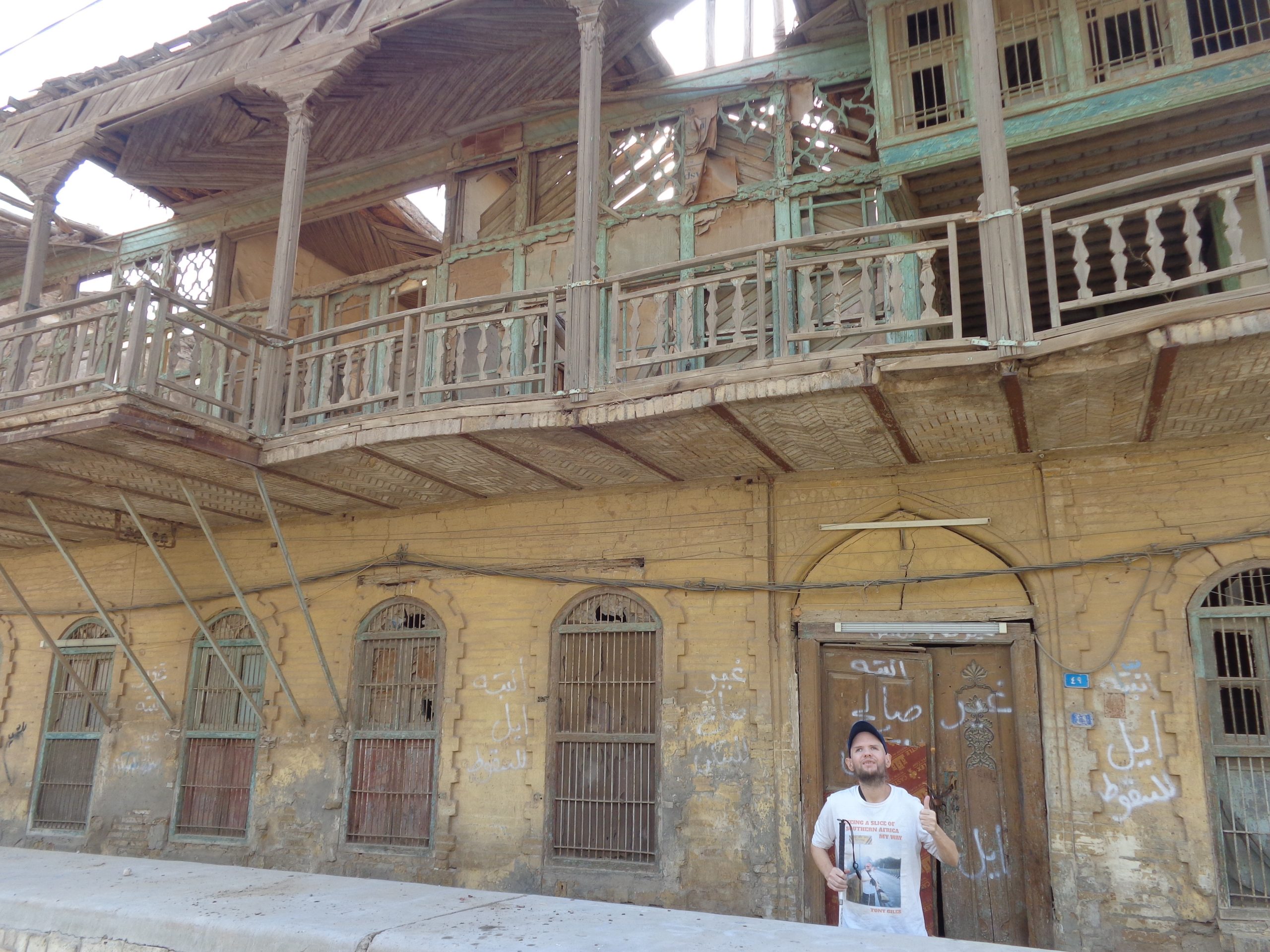
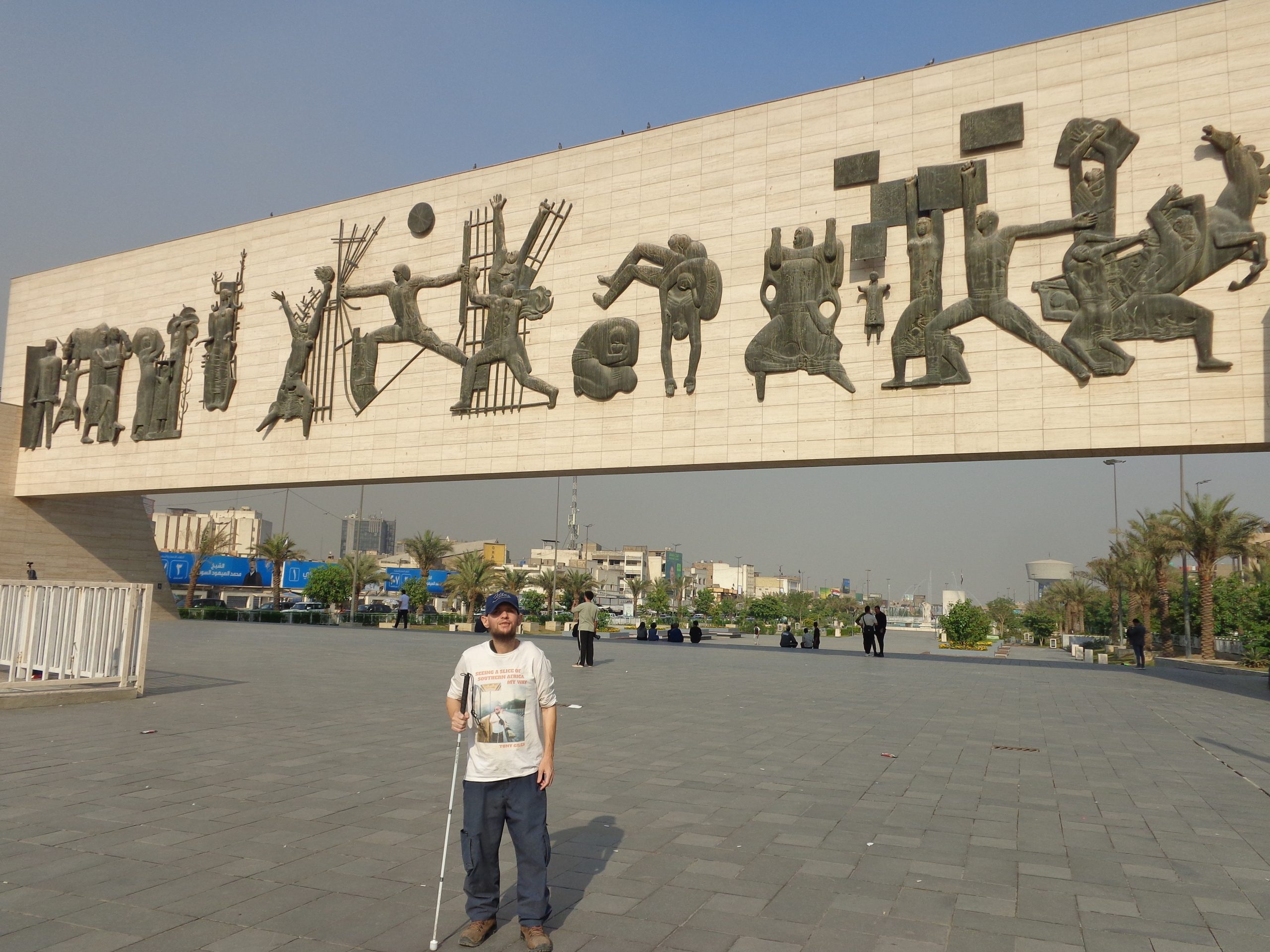
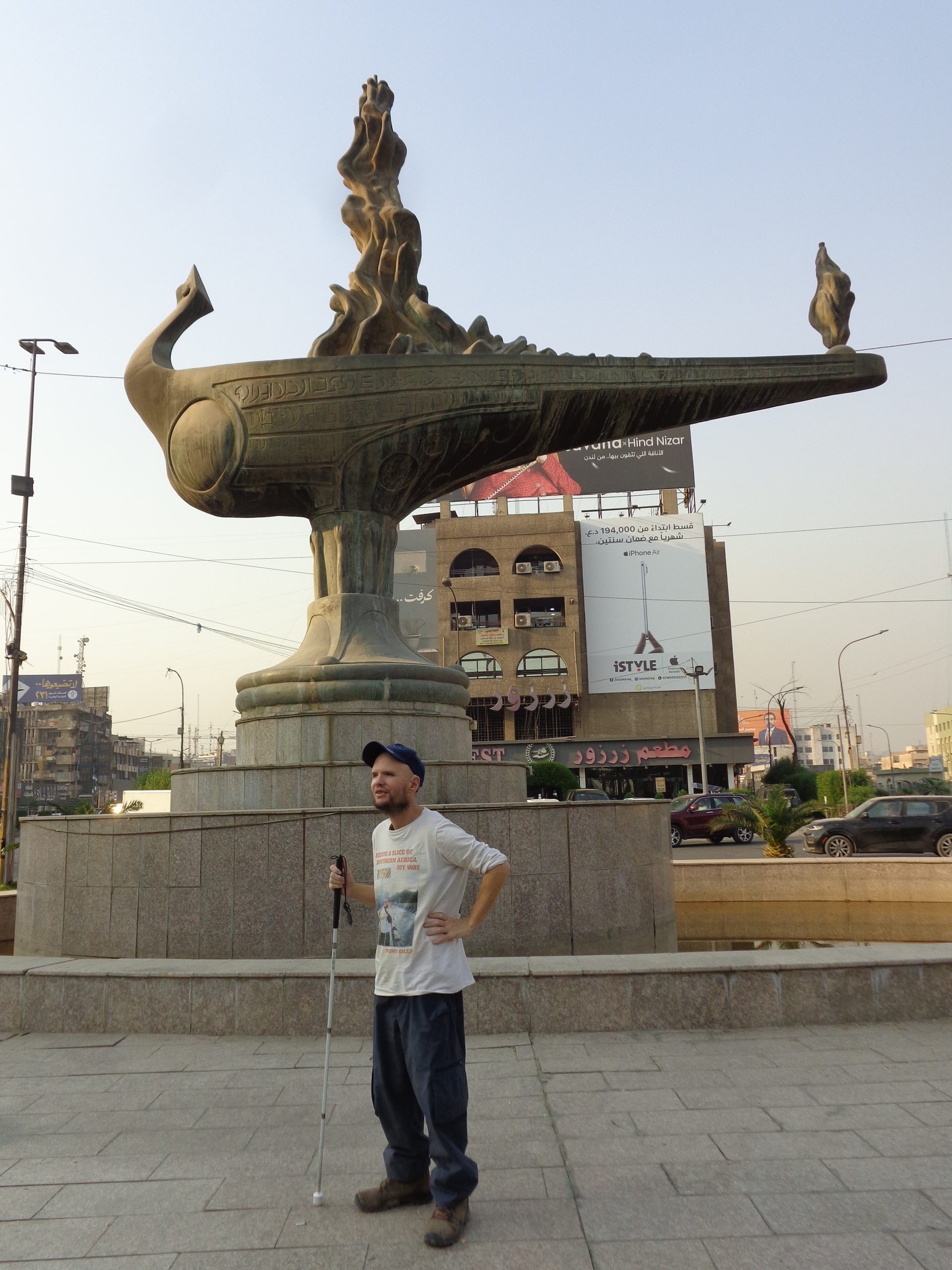
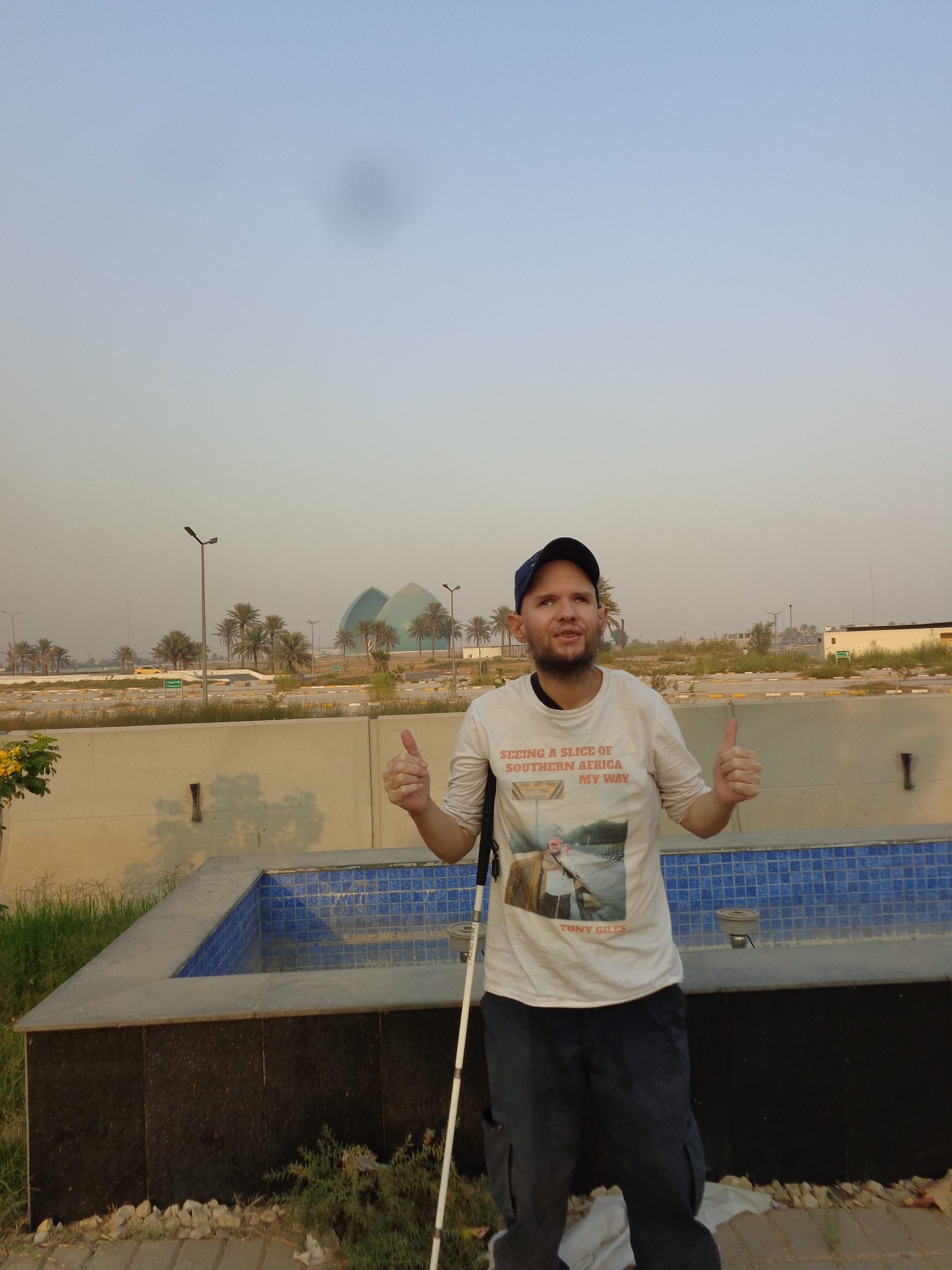
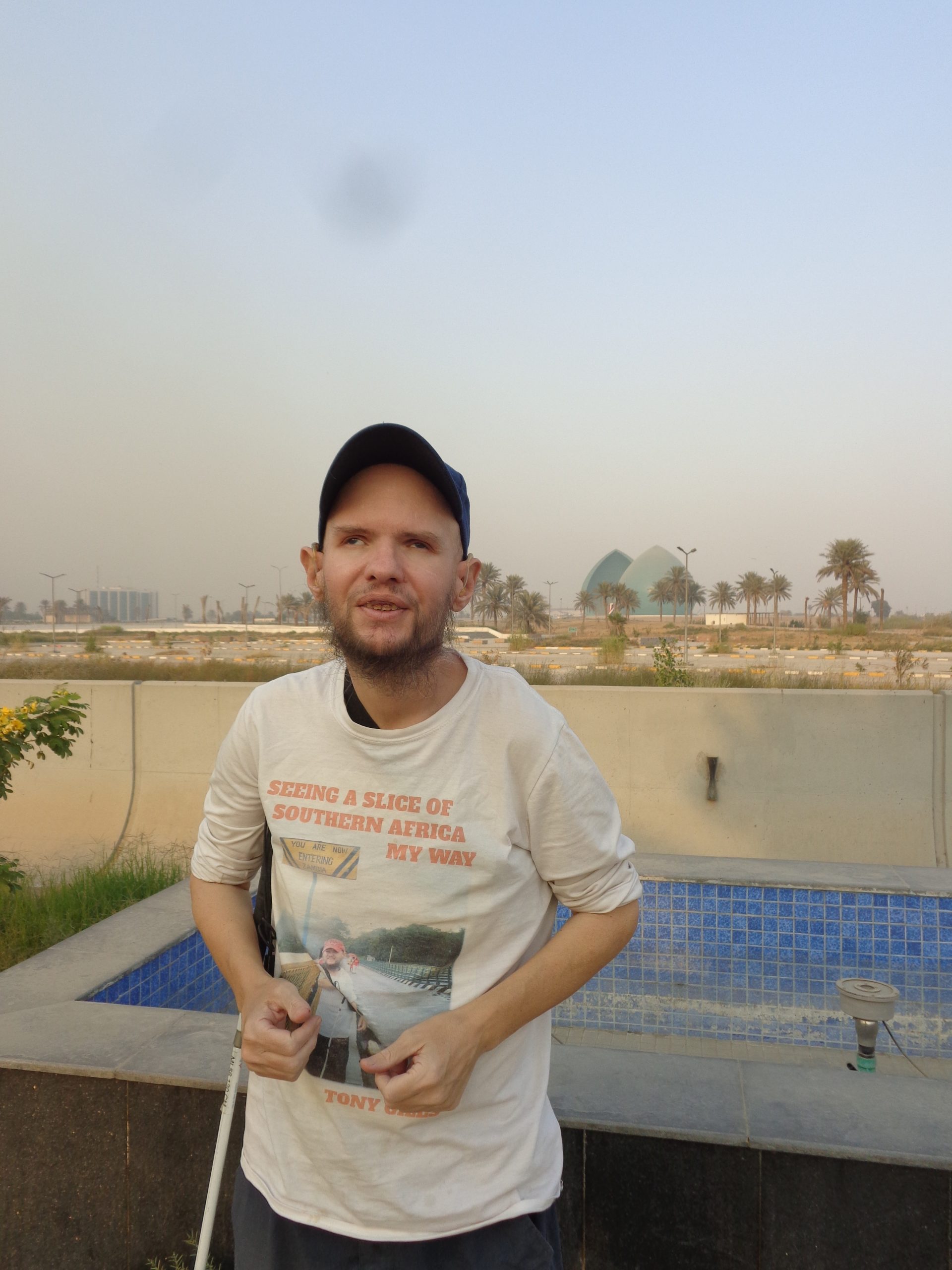
Tony outside the ornate entrance to the Al-Wazeer (Al-Wasir) Mosque which includes Islamic and Ottoman architectural features. Three pointed-arches are in view which lead into a large porch with the wooden main doorway in the centre. The outer facade is decorated with intricate tile work. At the top of the arches is blue and gold writing in Arabic script. Below this the tiles depict stylised plants with stems, leaves and flowers in several colours including blue, gold, green and turquoise. Within the porch there are various signs and posters: the only one in English reads “Respect Mohamed”. A man, perhaps a guard or caretaker, can be seen sitting in a chair. This Sunni Islam mosque was built by the Wazir (governor) of Baghdad, Hassan Pasha, in 1599. It is situated behind the Souk al-Sarai near the riverbank of the Tigris.Tony in the courtyard of the Al-Wazeer (Al-Wasir) Mosque. Tony is standing in the foreground with stone slabs underfoot. In the background are a pair of mature trees covered in green foliage. The courtyard is enclosed by walls. A dark tortoiseshell cat is sitting on the ground close to Tony.Tony inside the Al-Wazeer (Al-Wasir) Mosque with the main wooden doorway behind him. The top of the doorway and wall above are ornately decorated with tiles and brickwork. The door arch incorporates geometric decoration including 5- and 10-pointed stars. Above are mosaic tiles with simple geometric designs. The walls also display Arabic calligraphy written on blue and white tiles.The Al-Wazeer (Al-Wasir) Mosque’s impressive brick domed ceiling with intricate geometric patterns. There is a large central dome that is supported by arches beneath. The top of the dome has a large hexagonal opening with light shining from hidden windows at the sides. Within the hexagonal opening there is a decorative brickwork design forming a large six-pointed star. Below the circular base of the dome the brickwork forms a pattern made-up of four-sided kite shapes: the size and angles of this shape change as the pattern extends down the sides of the arches. In addition, to the right, a hexagonal window can be seen in the vaulted brick ceiling. The architecture showcases classic Islamic or Middle Eastern design elements.Tony stood in front of a large statue of Al-Mutanabbi. This bronze statue depicts a robed Mutanabbi with one arm raised upwards and the other at his chest. Al-Mutanabbi was born in circa 915 and died in An Numaniyah in 965 aged about 50. He was an Abbasid-era Arab poet at the court of the Hamdanid emir Sayf al-Dawla in Aleppo. In front of the statue are stone containers filled with plants with green foliage. In the background are beige brick buildings and the domed top of the Qushla Clock Tower can also be seen.Tony on a balcony in the Qushla building. Behind him are wooden railings and below is a garden covered with grass as well as several palm and olive trees. Just beyond this stands the 19th-century Qushla Clock Tower and then the banks of the Tigris river. Construction of the Qushla (or Qishleh) began in 1881 under Ottoman governor Mehmed Namık Pasha. It was built as headquarters and barracks for the Ottoman army who were responsible for protecting and providing security for Baghdad at that time. The Qushla Clock Tower was completed in 1871 and was built to wake the soldiers housed within the Qushla. It is 30 metres in height. There are clock faces on all four sides of the tower. The current clock faces and clock mechanism were a gift from King George V to King Faisal I when he visited Britain in 1927.Tony again on the balcony of the Qushla with the Qushla Clock Tower behind. The clock tower is topped with a weather vane. Several tall buildings are visible away on the far side of the Tigris river.Tony stood in front of the arched entrance to the Qushla. A set of large double doors are open: they are made of thick wooden with metal studs and knockers. The surrounding walls are made of beige brick.Tony sat on a traditional wooden bench covered with a colourful patterned fabric in the famous Shabandar Café. A yellow brick wall behind is filled with framed photographs, portraits, and documents, arranged in a collage-like manner. Most of the photos are black and white or sepia-toned and many of them show famous Iraqis who have visited this café, which is one of the oldest and most famous coffeehouses in Baghdad. During its history it has been frequented by poets, writers, politicians and intellectuals. It is located at the end of al-Mutanabbi Street near the Qushla. Originally a printing press, the coffee house was established in 1917. In the wake of sectarian violence following the US invasion of Iraq in 2003, the Shabandar Café was the victim of a car bomb attack in 2007, which killed more than a hundred people. The cafe was destroyed and four of owner Muhammad al-Khashali’s sons were killed. The cafe subsequently rebuilt with the aim of preserving its cultural heritage and old identity with funding from the state, merchants, and its customers.Tony outside the entrance of the Shabandar Café, a historic two-story building with a balcony spanning the structure at first-floor level.Tony again in front of the Shabandar Café. The building adjoins two streets with the entrance on the corner.Outside the Old Baghdad Governorate Building. The building is in ruins with only the outer walls still standing. The front facade looks weathered but is mostly intact. There is a large arched doorway in the centre. The windows are now decorated with stained glass in green, yellow, and blue tones. The building was constructed in the first half of the 20th century and in 1934 it was renovated and rebuilt in English Victorian architectural style. Government offices were based here until 1985. It was damaged by fire and partially destroyed during the 2003 invasion of Iraq. The site is opposite the Qushla building off Mutanabbi Street.The outside walls of the Al-Sarai Mosque, also nicknamed the King Ghazi Mosque, because it was where the old Iraqi kings prayed during the Royal Era. It is also known as Hassan Pasha Mosque or Al-Nasr li-Din Allah Mosque. This Sunni mosque is located in the Rusafa district of Baghdad close to the Qushla building. The mosque is said to have first been constructed by the 34th Abbasid Caliph al-Nasir in 1193. Between 1704 and 1723, Hassan Pasha, Governor of Baghdad at that time and founder of the Mamluk state of Iraq, reconstructed the mosque in its current wide form and it was then named the “New Hassan Pasha Mosque” in his honour.Yellow brick walls outside the Al-Sarai Mosque (King Ghazi Mosque). The mosque is historic but these outer walls look relatively modern. There are windows shaded inside large recesses topped with pointed arches. There are three small domes visible along the roof. Variously coloured bricks make a geometric pattern below the roof line. A traditional-style cast iron street lamp stands in the road in front.A large historic building immediately adjoining the Qushla. The building appears to have undergone recent construction or repair work but currently looks disused. It is Islamic in style. On the right side of the building is a very large pointed arch entrance currently partially covered with a green mesh. To the left are three tall but quite narrow arches supported by columns and with windows recessed within. Tony is in the foreground in front of a low wall with white painted metal railings. The building is possibly called the Palace of the Sultan or the Palace of the Ottoman Governor.An old town house that is now a cafe located in the Al-Sarai district of Baghdad close to the river Tigris. This two-story yellow brick building has ornate architectural details including eloborate tile panels with geometric decoration and Arabic calligraphy as well as carved stone panels below the upper windows. The main doorway is in the centre with an elegant balcony with curving white railings emerging directly above.Tony stood in the courtyard of Sourp Asdvadzadzin (Holy Mother of God) Armenian church in Baghdad, which is also known as the Church of the Virgin Mary. It dates from 1639. In 1970 there was a renovation process and they discovered a box hidden in one of the walls that contained remains of 40 Armenian soldiers. The photo shows the brick walls of the church. There are some small raised flowerbeds in front as well as a tall rectangular stone carved with a geometric design around the edge, and in the middle, a cross surrounded by writing in Armenian script.Tony again in the courtyard of Sourp Asdvadzadzin Armenian church. The brick outside walls of the church can be seen as well as a small free standing bell tower. The bell tower has a square profile with arched open sides that support a steeple and dome containing a bell. The bell is rung using a rope from ground level. The trunk of a tall palm tree is also in view. The courtyard is paved with pink and cream square blocks.Tony stood in the street outside Sourp Asdvadzadzin Armenian Church. A doorway behind leads into the church’s courtyard. There is a cross and a metal plaque in Arabic script above the door. There are windows protected with metal bars on both sides. The church appears small from this angle, but it extends a long way back.Outside Haydar-Khana Mosque showing its impressive dome covered with turquoise, blue and yellow tilework. The dome’s decoration includes floral and geometric designs as well as Islamic calligraphy. Lower down there is another long strip of Islamic calligraphy written in gold on a black background. The lower stone or brick walls are carved with simpler geometric decoration with arches, alcoves and pillars. A mosque has stood here since the 12th-century. The original mosque was built by the Abbasid Caliph al-Nasir. The structure was rebuilt in the 19th-century by Mamluk Dawud Pasha and was completed in 1827. Today the mosque is one of Baghdad’s most recognisable historical landmarks.Tony stood in front of a grand doorway perhaps belonging to a palace. Above the wooden door itself is a very high pointed arch. The inside of the arch is covered with Arabic calligraphy and the sides are decorated with elaborate geometric designs. Access is blocked by metal railings and a sign says the site is closed for maintenance.Tony stood in front of an old, weathered Ottoman-style building. Agatha Christie is believed to have lived here for a time with her husband archaeologist Max Mallowan. There is debate over the dates Agatha Christie lived here and indeed some people question whether this is actually the correct house. Agatha Christie first visited Iraq in 1928 and after marrying Max Mallowan in 1930 accompanied him on archaeological expeditions to Iraq for the next 40 years. The two-storey building has a balcony running along its entire length. It is in poor condition with parts of the structure appearing to be close to collapsing.Another view of Tony outside the Agatha Christie house located on the banks of the Tigris river.Tony stood in Liberation Square. This is Baghdad’s largest and most central square located in the al-Rusafa district on the eastern banks of the Tigris river. In the background, spanning across the width of the square, is the huge Freedom Monument. This modernist relief mural was completed in 1961 and was built to commemorate Iraq’s declaration of independence. It consists of 14 bronze castings, representing 25 figures, on a stone slab, raised six metres off the ground. The monument is 10 metres in height and 50 metres in length. The abstract figures, which are in bas-relief, are intended to evoke Babylonian, Assyrian and Arab artworks. The monument is intended to be read as a verse of Arabic poetry from right to left. It depicts events in Iraq’s history up to the 1958 revolution. The monument was the work of husband and wife sculptors Jawad Saleem and Lorna Selim.Tony stood in front of a large bronze statue of a woman with raised arms. This is Queen Scheherazade, the heroine from One Thousand and One Nights, a collection of Middle Eastern folktales compiled in the Arabic language during the Islamic Golden Age. The statue depicts Queen Scheherazade narrating a story to her reclining husband King Shahryar. Scheherazade volunteered to wed the murderous King Shahryar, who would take a different bride to bed each night, and have them executed before the following dawn. Scheherazade devised an ingenious plan to stave off her execution. Each night she would relate a story that enthralled the King, but she failed to reveal the story’s climax until dawn, thus delaying her execution. This goes on for one thousand and one nights, hence the name. The statue was sculpted by Mohammed Ghani Hikmat in 1971 and is located on the Abu Nawas Corniche alongside the river Tigris.Tony touching a bronze statue of King Shahryar wearing traditional Middle Eastern clothing and a turban. He is sculpted reclining on a reddish marble base. This is located alongside the Queen Scheherazade sculpture shown in the previous photo. In the background a palm tree can be seen and there is a modern glass-clad building to the right. The far bank of the river Tigris can be seen away in the distance.Tony with the sculptures of Queen Scheherazade and King Shahryar created by Mohammed Ghani Hikmat in 1971. These are both characters from the One Thousand and One Nights folktales (also known as The Arabian Nights in English). These stories were first published in English in the early 18th century.Tony stood in front of a large, almost empty fountain with a bronze statue in the centre depicting a robed male figure sitting on a magic flying carpet. This is taken from a story in One Thousand and One Nights. Prince Husain, the eldest son of the Sultan of the Indies, travels to Bisnagar in India and buys a magic carpet which will fly and transport the person sitting on it should they will it by thought. This sculpture was created by Mohammed Ghani Hikmat and was completed in 1989.Tony next to the magic carpet fountain and sculpture. The large, multi-storey building in the background is the 16-storey International Palestine Hotel. It was built in 1982 by the Iraqi government. This was one of the hotels used by foreign journalists during the 1991 Gulf War and the 2003 invasion of Iraq. During the 2003 invasion of Baghdad an American tank fired a shell at the hotel killing two journalists: these were Reuters cameraman Taras Protsyuk and José Couso of Telecinco Spanish television. The Americans wrongly believed they were firing on Iraqi troops.Tony again stood next the the magic carpet fountain and sculpture but facing the other way. In the background is another tall hotel. This is the Ishtar Hotel (formerly known as the Ishtar Sheraton Hotel). It is 99 metres in height and was built in 1982: it is the third tallest building in Baghdad. The hotel was regularly used by foreign journalists during the 1991 Gulf War and the 2003 invasion of Iraq. Following the 2003 invasion the hotel became a target for mortar or rocket fire and in 2005 it was seriously damaged by a bomb attack and was closed for more than a year afterwards. It was renovated in 2011.Tony in Al-Firdos Square with the 17th of Ramadan Mosque in the background. The mosque has a large, ornate blue, turquoise and yellow dome with intricate geometric patterns and a tall minaret decorated with similar colourful tilework. The building was completed in 1959. Al-Firdos Square is a public square close to the Ishtar and Palestine Hotels in central Baghdad. It is named after the Persian word Ferdows meaning ‘paradise’. This square is where the large statue of Saddam Hussein, then President of Iraq, was toppled by a US Marine military vehicle on 9th April 2003.Tony stood in front of the Kahramana fountain and sculpture located in Kahramana Square on Al-Sa’adoon Street. The sculpture depicts a scene from the legend of Ali Baba and the Forty Thieves – a story taken from One Thousand and One Nights – in which the slave girl Morgiana outwitted a group of thieves by tricking them into hiding inside jars over which she poured hot oil. The fountain’s base is circular. In the centre Morgiana is depicted standing on top of a stack of large jars. She is depicting holding a jug. Water can be seen pouring from the jug and also bubbling up from the jars. The water then flows down into a large pool around the base of the fountain. The fountain is 3.3 metres in height. It was officially opened in 1971 and is the work of the Iraqi sculptor, Mohammed Ghani Hikmat.Tony again stood next to the Kahramana fountain. There are orange and yellow flowers planted in front. The fountain is in the middle of a junction between busy roads. Cars can be seen queuing around the side. There are several large billboards in view attached to surrounding buildings.Tony now stood at the other side of the Kahramana sculpture. The jars with water bubbling out can be seen behind with Morgiana standing on top of them. In the background to the left another artwork can be seen. This is a bronze depiction of a date palm. A large video screen mounted on a pedestal is also in view.Tony stood on a street with a line of concrete security barriers behind him forming a wall. The barriers have blue Arabic writing, white doves, and an Iraqi flag painted on them. Beyond the wall, a tall arched concrete structure, with a white cross in its centre, can be seen. This is part of Our Lady of Deliverance Syriac Catholic Cathedral. A poster can be seen attached to it showing Pope Francis during his 2021 visit to Iraq. This church was attacked by Islamic State of Iraq (ISI) militants in October 2010 resulting in 58 deaths of worshippers, priests, policemen and bystanders.Tony stood in front of the Magic Lantern (Al Fanous El Sehri) sculpture. This large bronze monument is shaped like a traditional oil lamp, with sculpted flames emerging from the top, and a bird-like figure at the front. The lantern is set upon a high circular stone pedestal with a pool of water around the base. It is located in the middle of a roundabout on al-Karaada street. The sculptor was Mohammed Ghani Hikmat and it was inaugurated in 2011. It is part of a set of four monuments commissioned by the Mayor of Baghdad.Another view of Tony in front of the Magic Lantern (Al Fanous El Sehri) sculpture by Iraqi sculptor Mohammed Ghani Hikmat.Tony with thumbs up standing in front of a low blue-tiled fountain or pool which does not contain any water. Away in the middle distance a massive turquoise dome can be seen. This is the Al-Shaheed Monument: it was originally dedicated to the Iraqi soldiers killed in the Iran–Iraq War (1980-1988) and has since grown to become generally considered to be a commemoration of all Iraqi martyrs. It was designed by Iraqi sculptor Ismail Fatah al-Turk and was opened in 1983.Another view of the Al-Shaheed Monument with Tony in the foreground. The monument includes a 40-metre tall turquoise dome with a pointed top. The dome is split down the middle into two off-set parts with an eternal flame in the middle. The monument is on a circular platform 190 metres in diameter in the centre of an artificial lake: the lake is not visible in the photo. A museum, library, cafeteria, lecture hall, and exhibition gallery are on two levels underneath the domes. The dome is in the middle distance with scattered palm trees towards the foreground.